
100% S2 Review: Coverage, Fit, Fog, and Lens Choice
A large semi-rimless shield whose value depends on cheek clearance, helmet fit, and the exact lens bundle.
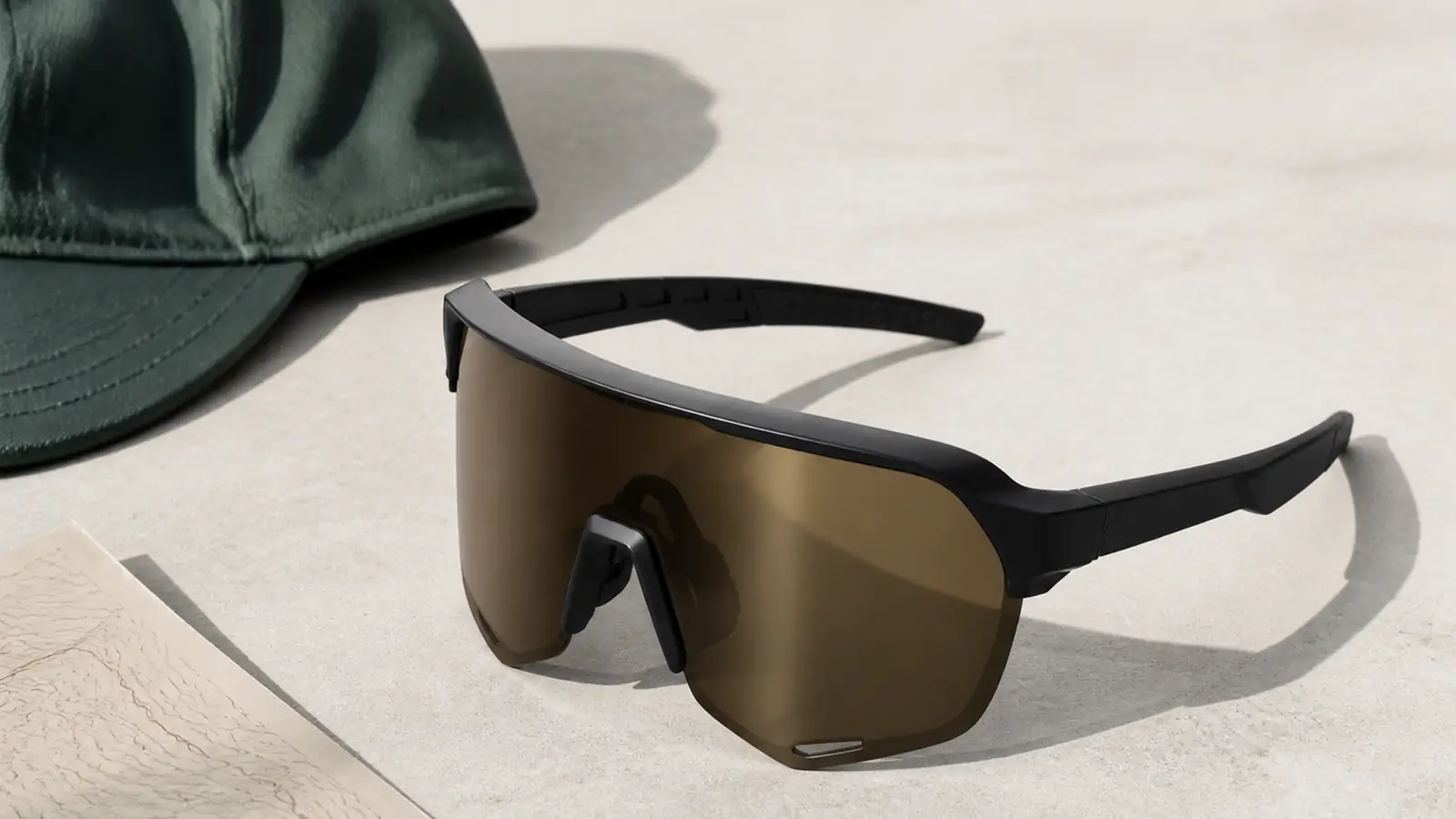
The 100% S2 works best when its broad shield clears your face and its lens transmission matches the route.
The 100% S2 is a coverage-first performance sunglass with a semi-rimless shield, secure rubber contact points, and an interchangeable lens system. It is most convincing for people who want a large protected view and can get the lens to sit clear of their cheeks, eyelashes, and helmet.
This review is based on current manufacturer documentation and several independent evaluations. KnowOutdoor has not conducted a hands-on test, so no claim below is presented as our field measurement or personal experience.
- The 56-millimeter-deep shield clears your cheeks when you smile
- The brow does not touch the lens or block its ventilation
- The fixed frame sits level without needing an adjustable temple
- The supplied nosepiece places the optical area correctly in front of your eyes
- Your helmet does not push the stiff arms inward or the shield downward
- The selected SKU has the tint and spare lens you need
The S2 is not simply a heavier Hypercraft. Its lower lens structure, shape, and fit create a different balance between support, airflow, and presence on the face.
Who is the 100% S2 best for?
The S2 best fits riders and runners who want a large uninterrupted view but prefer some structure under the lens. Independent reviewers generally agree that coverage and clarity are strengths, while the large shape makes face compatibility the main purchase risk.
BikeRadar measured the tested pair at 30 grams with a 56-millimeter lens depth. Those numbers help explain why the S2 feels more substantial than a 23-gram frameless Hypercraft even though both use a large cylindrical shield.
OutdoorGearLab found the frame broadly comfortable and secure, but its testers also identified possible brow contact. The glasses sit away from the face enough to encourage airflow, which improves fog resistance while leaving more room for dust to enter around the edges.
It is a sensible road-cycling option when wind coverage and a stable position matter through long descents. Trail runners can also benefit from the broad view, though bounce and cheek contact deserve more attention because running moves the head differently from riding.
The model is less convincing for someone who already knows that tall shield lenses touch their cheeks. It is also a poor blind purchase if a low helmet shell routinely clashes with sunglass temples.
This is why the S2 should be judged as a structured coverage model rather than a universal performance sunglass. Its advantages depend on fixed geometry landing correctly, and the frame offers fewer adjustment routes than a design with bendable temples or an adjustable nose bridge.
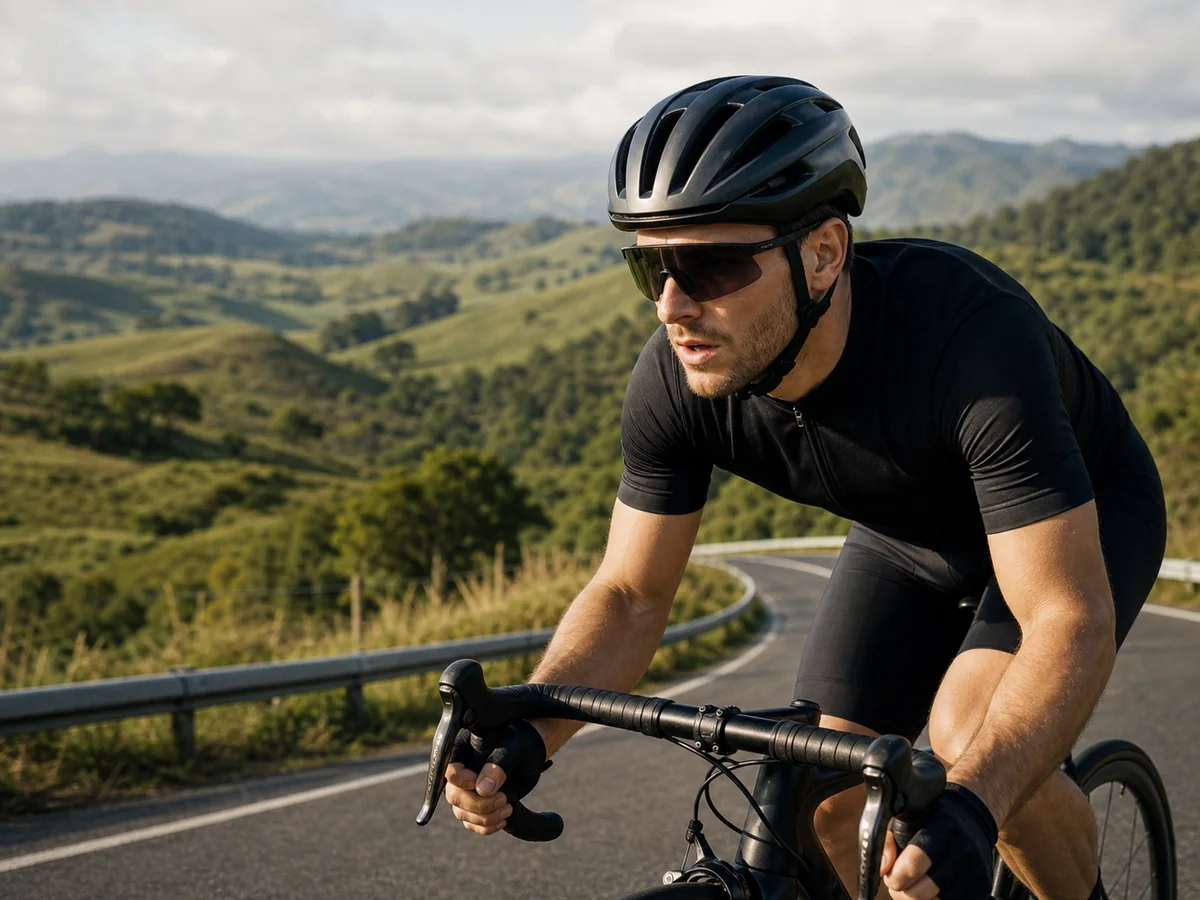
How does the S2 fit on different faces?
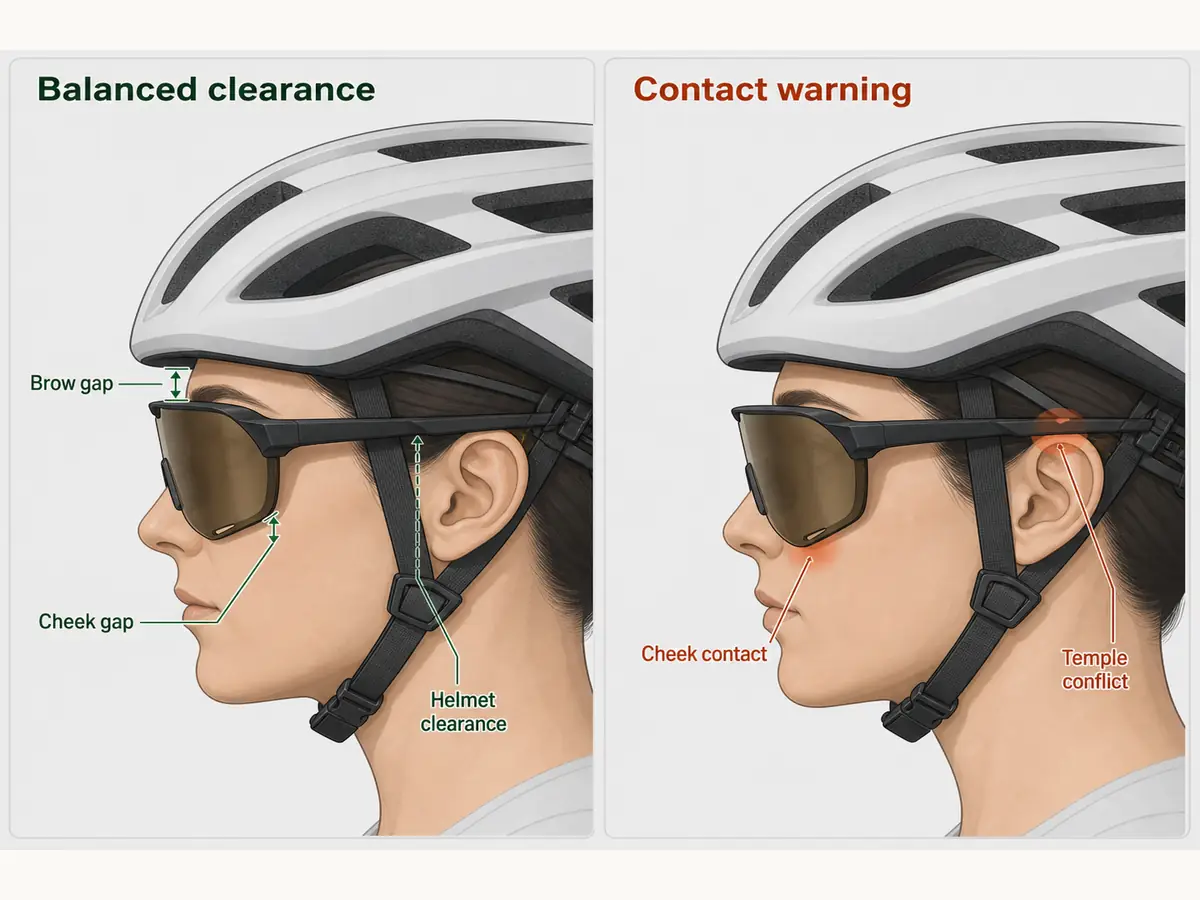
Good S2 fit means the optical area stays centered in front of your eyes without the lower lens resting on skin.
The nosepiece should carry the glasses, while the temple tips stabilize them without squeezing.
A wide face may benefit from the shield's coverage but still feel pressure at the temples. A narrow face may avoid pressure yet allow the frame to move, so face width alone does not predict success.
OutdoorGearLab describes the frame and nose position as fixed rather than continuously adjustable. The detachable nosepiece can change contact and is replaceable, but it also becomes a small part that can be misplaced during cleaning or a lens change.
Cheek contact matters beyond comfort. Each smile or hard breath can lift the shield, disturb the optical center, and transfer sweat to the lower lens, while brow contact can irritate skin during long sessions.
- Blink fully without eyelashes touching the lens
- Smile without the lower edge lifting from cheek contact
- Look down without the nosepiece sliding
- Wear the helmet and check for pressure at both temple tips
- Turn your head quickly and watch for lateral movement
- Confirm the upper vents remain clear below the helmet brow
Current S2 packages commonly include an alternative-fit nosepad. That part can change lens height and contact at the bridge, but it cannot correct every width or cheek-clearance problem.
Try both nose pieces before deciding that the shield itself is too tall. If neither creates eyelash, cheek, and brow clearance at the same time, the frame geometry is wrong for your face and a different model is the cleaner fix.
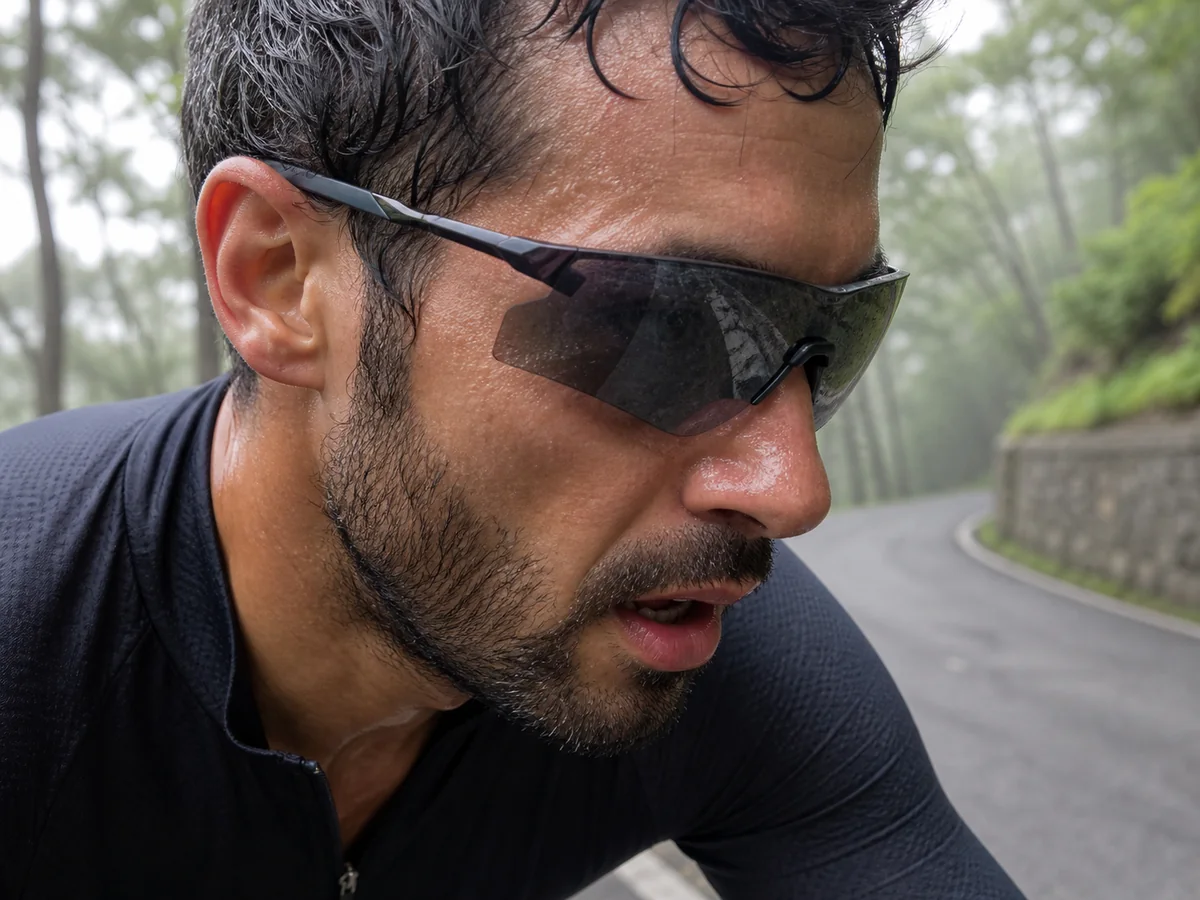
Does the S2 stay put when you sweat?
100% uses its Ultra Grip rubber at the nose and temple contact points. That material is intended to maintain contact as moisture increases, which supports stability without requiring excessive clamping pressure.
OutdoorGearLab reported secure retention in its testing, while BikeRadar characterized the frame and hinges as relatively stiff. Together, those findings describe a frame that resists wandering but may feel less forgiving when the temples do not match the head.
Security begins with geometry. Rubber cannot compensate for a nosepiece that sits above the bridge or temples that are being pushed inward by a helmet retention system.
Test movement after ten minutes of real warmth rather than immediately in an air-conditioned shop. Skin oils, sweat, and softened helmet pads can reveal movement that a dry first fitting hides.
Rough-surface stability also depends on vertical clearance. A shield that remains attached can still be a poor fit if every bump makes the lower edge tap the cheeks or the brow touch the lens.
Can the S2 manage fog on slow climbs?
The S2 has small vents intended to let warm moist air escape. Moving speed helps those openings, while a slow humid climb removes airflow as sweat production rises.
Fog management was a standout strength in OutdoorGearLab's comparative testing. The same off-face spacing that helped clear moisture also reduced the seal against trail dust, so airflow and particle protection pull the fit in opposite directions.
Fog performance therefore changes across a ride. A lens that stays clear during a descent can cloud when you stop at a junction in cold air.
| Situation | Airflow state | Fog pressure | Best response |
|---|---|---|---|
| Fast movement | Continuous air crosses the lens | Usually lower unless the brow is sealed | Keep the upper gap open below the helmet |
| Slow humid climb | Moisture rises with little forward air | Higher near the upper inside surface | Ease the shield away briefly in a safe low-speed moment |
| Cold roadside stop | Warm face meets a colder lens | Rapid condensation can form | Avoid trapping the top vents under a cap or helmet pad |
| Rain | Water and humid air reach both lens surfaces | Drops and internal haze can combine | Use a clean lens treatment and avoid wiping grit across the surface |
No vent layout guarantees a clear lens. Helmet position, brow shape, clothing around the forehead, and the pace of the activity can each change the air path.
For gravel or dry trail use, that dust caveat may matter more than fog. A lens can remain optically clear yet leave the eyes irritated if the lower and side gaps funnel fine material behind the shield.
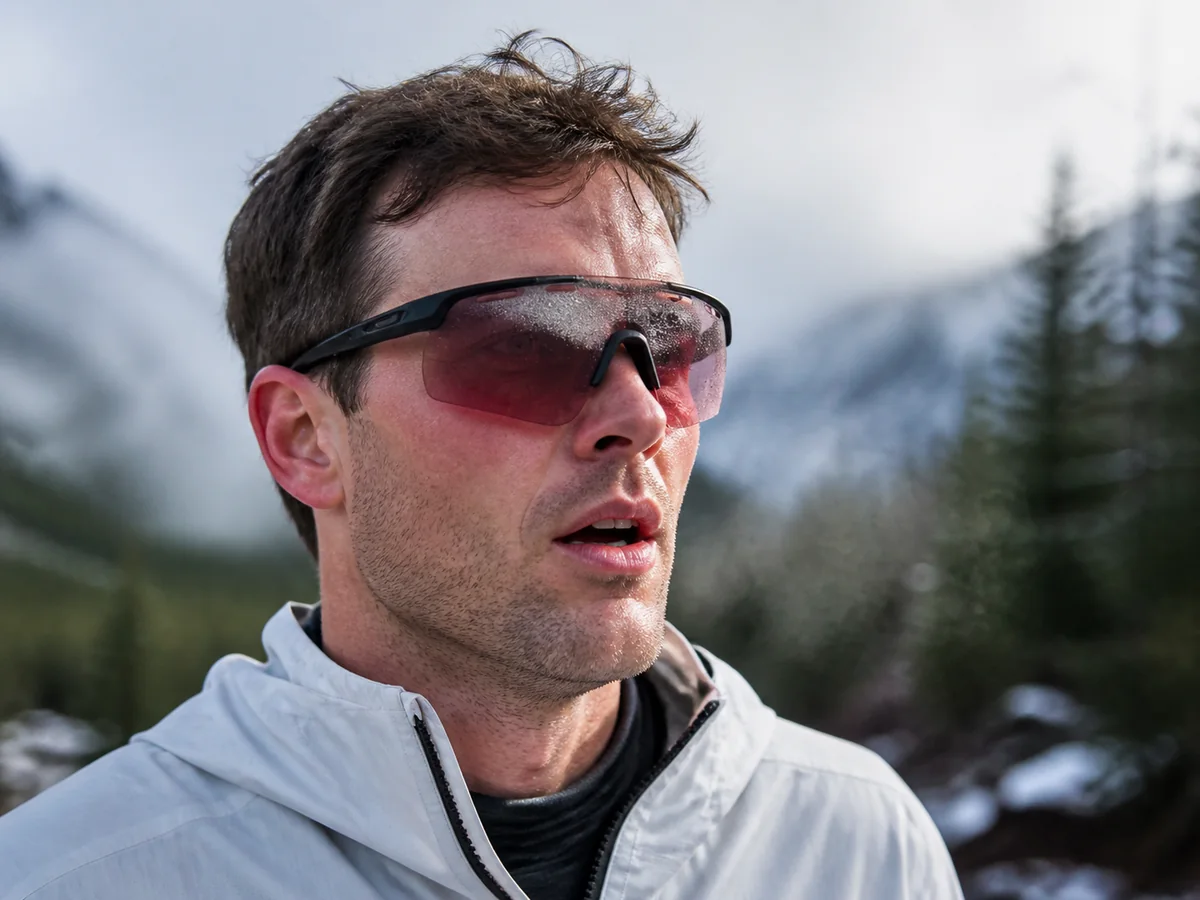
Which S2 lens works for your light conditions?
Start with visible light transmission.
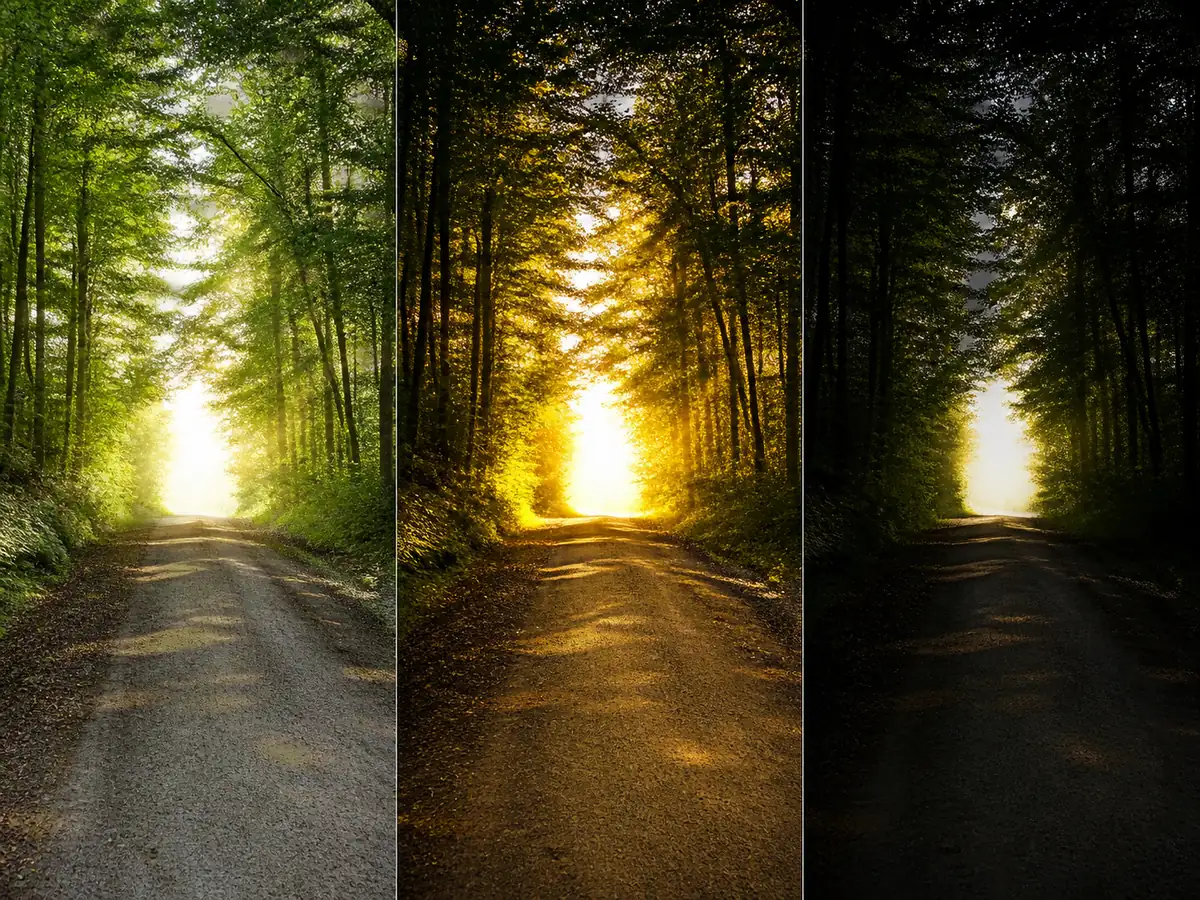
A low VLT lens is darker for sustained bright exposure, while a higher VLT lens admits more light for woodland, cloud, dawn, or dusk.
Mirror color does not tell the complete story. The base tint and transmission determine what reaches the eye, so two visually similar mirrored lenses can suit different conditions.
- Fixed tint
- Holds one transmission level and suits predictable light
- HiPER
- 100%'s branded contrast-enhancing lens option
- Photochromic
- Changes tint within a stated transmission range as ultraviolet exposure changes
- Clear spare
- Useful for darkness or very low light when included with the selected package
- Filter category
- Summarizes lens darkness and must be checked for the exact colorway
The official S2 catalog includes fixed, HiPER, and photochromic versions. Some packages include a spare lens and some do not, so the model name is not enough to establish what comes in the case.
The official eyewear workbook describes the S2 as using an Ultra HD high-impact polycarbonate shield with UV400 protection, scratch resistance, and hydrophobic and oleophobic treatments. Those stable construction details do not identify the transmission or base tint of the SKU in your cart.
For a route that repeatedly moves between forest and open ground, a broad photochromic range can reduce stops. A fixed dark lens is a cleaner choice for continuous bright roads, while a clear spare is more useful for night riding than any dark contrast lens.
Choose for the darkest part of the route where vision still matters, then check whether the bright end remains comfortable. Buying for the brightest noon segment alone can leave you removing the glasses in woods, which also removes their wind and debris coverage.
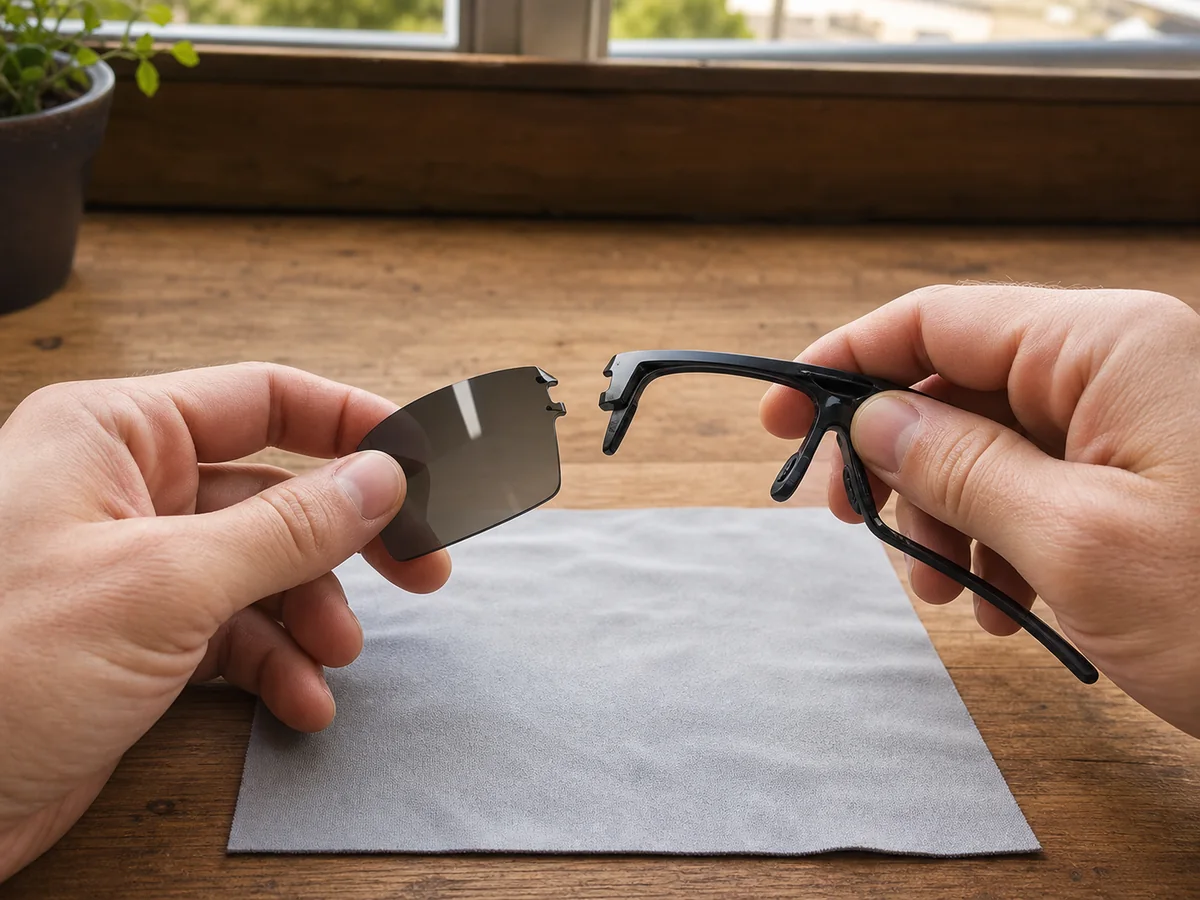
How difficult is it to change and care for the lens?
An interchangeable lens only adds value when you are willing to handle it. Work over a clean soft surface, keep fingerprints away from the optical center, and stop if a tab does not align without force.
BikeRadar found the attachment secure but described a learning curve before changes became easy. The stiff structure can feel reassuring once seated, yet forcing an unfamiliar tab is a poor way to discover the correct release sequence.
- Clean your handsOil and grit can transfer to the coating during the change.
- Release the installed lensFollow the current 100% instructions for the S2 rather than bending the shield at random.
- Align the replacementSeat the connection points in the specified order with no twisting.
- Inspect every edgeA partially seated lens can move or stress a tab.
- Store the unused lensUse a clean sleeve or rigid case so it cannot rub against keys or tools.
Rinse loose dust before wiping. A hard coating improves resistance to ordinary handling, but repeated dry wiping can still pull grit across the surface.
The tested packages in both major independent reviews included a rigid case and a clear spare lens. Treat that as evidence for those review units rather than a guarantee for every market, model year, or photochromic bundle.
How does the S2 compare with lighter rimless sunglasses?
The S2 keeps more structure around the lower part of the lens than the original Hypercraft. That structure can make the shield feel more protected and visually anchored, though it adds material and can interact differently with cheeks.
The more useful contrast is not simply 30 grams versus 23 grams. S2 buyers accept a fixed, stiffer frame for support and secure retention, while Hypercraft buyers prioritize minimal material and a more exposed lens edge.
| Decision | S2-style semi-rimless shield | Fully rimless shield |
|---|---|---|
| Lens-edge structure | More support around the lower area | More exposed edge |
| Face presence | Larger and more defined | Lighter and more open |
| Cheek interaction | Lower structure can make contact more noticeable | Lens edge can still touch but has less frame material |
| Handling | More frame to hold during changes | Greater need to avoid pressure on exposed lens edges |
| Best reason to choose | Coverage with added structure | Minimum mass and unobstructed view |
Neither design is automatically more comfortable. The S2 wins when its shape matches your face and you value coverage with structure, while a fully rimless option wins when the lowest face weight matters most.
Is the 100% S2 worth buying?
The S2 is worth considering when a large shield fits cleanly and the exact lens package matches your light conditions.
It becomes poor value when you pay for interchangeable optics but never use the spare, or when cheek contact keeps shifting the lens.
Pros
- Broad coverage and open field of view
- Rubber nose and temple contact designed for movement and sweat
- Fixed, contrast, and photochromic lens choices
- Semi-rimless structure gives the shield more physical definition
Cons
- Large shape will not clear every cheek or eyelash line
- Fog behavior remains dependent on speed, humidity, helmet, and brow gap
- Lens bundles differ by colorway and market
- Interchangeability adds handling and cleaning work
Fit is the first specification. Once the S2 clears your face and works with the helmet, VLT and lens type decide whether it belongs on your actual routes.
Sources
The current 100% S2 collection and an official S2 product listing were used to verify the model family, available lens types, contact materials, and package-dependent features on August 31, 2026.
Independent observations were compared across reviews from OutdoorGearLab, BikeRadar, NZ Mountain Biker, and Cycling Weekly.