
How Long After a Trip Can Giardia Symptoms Start?
Which is why it gets blamed for illness it did not cause, and missed when it did.
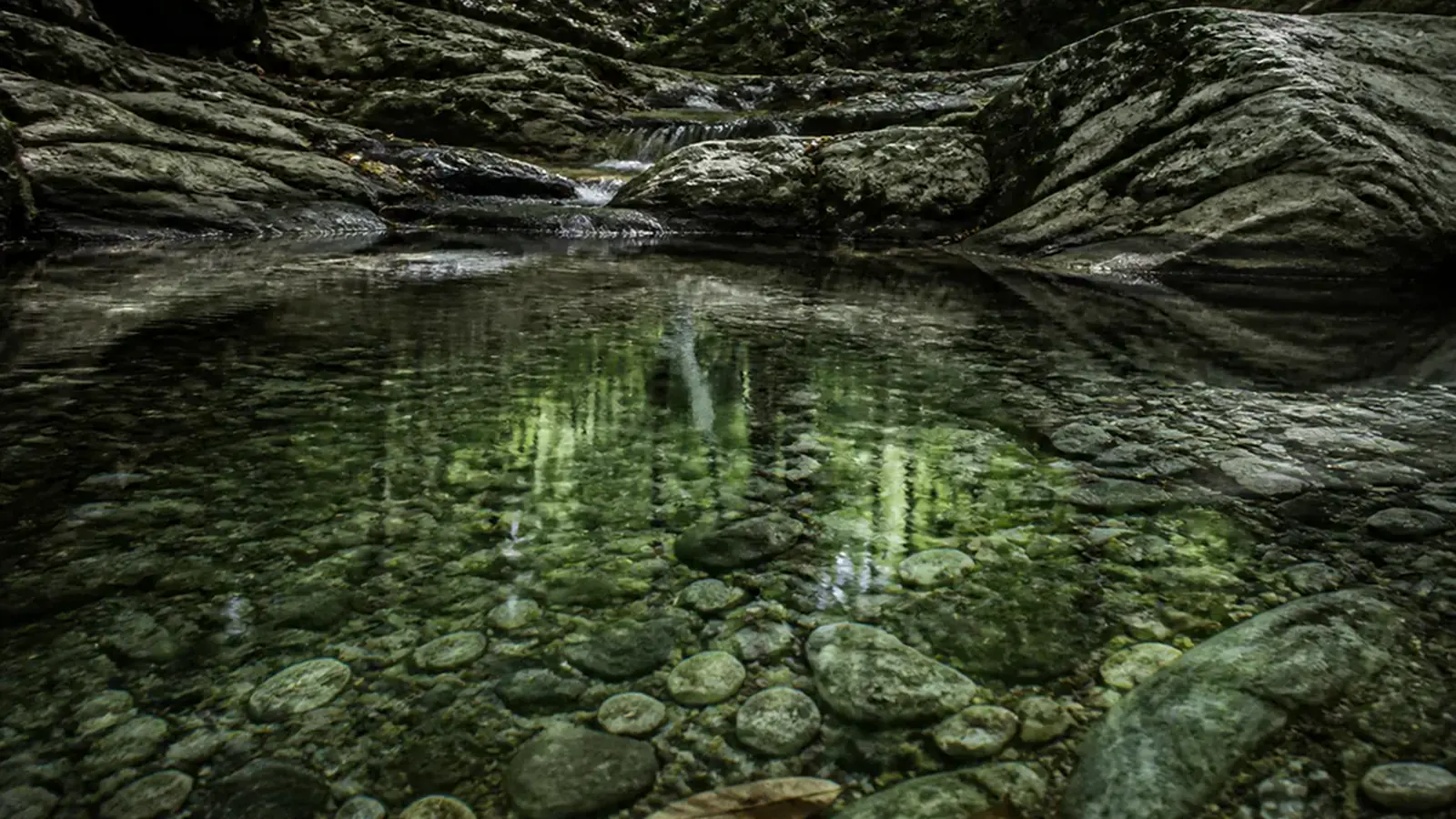
Giardia is identified by its clock far more reliably than by its symptoms. The one to three week delay between swallowing a cyst and feeling anything means mid-trip stomach trouble is rarely this, and real cases arrive long after anyone is still thinking about a stream.
The stomach trouble that hit on day three was almost certainly not giardia.
Something that starts a fortnight after you have unpacked, showered and gone back to work might well be. This organism is identified by its clock far more reliably than by its symptoms.
Here is how long the common backcountry gut infections take to appear.
That gap is why giardia gets blamed for illness it did not cause and missed in the cases where it did.
Why does giardia show up so long after the trip?
The usual window is one to three weeks, and most often one to two. A few cases run considerably longer.
The delay is not the parasite waiting. Swallowed cysts have to open in the small intestine, and the organisms released have to multiply enough to interfere with how the gut absorbs food before anything is noticeable.
That build-up takes days at minimum, and normally the better part of a fortnight.
Two consequences follow, and they pull in opposite directions. Illness during a trip is rarely giardia, because the timing does not fit anything you drank on that trip.
Day-three diarrhea points at something faster. Norovirus moves in under two days and the common bacterial causes in under five.
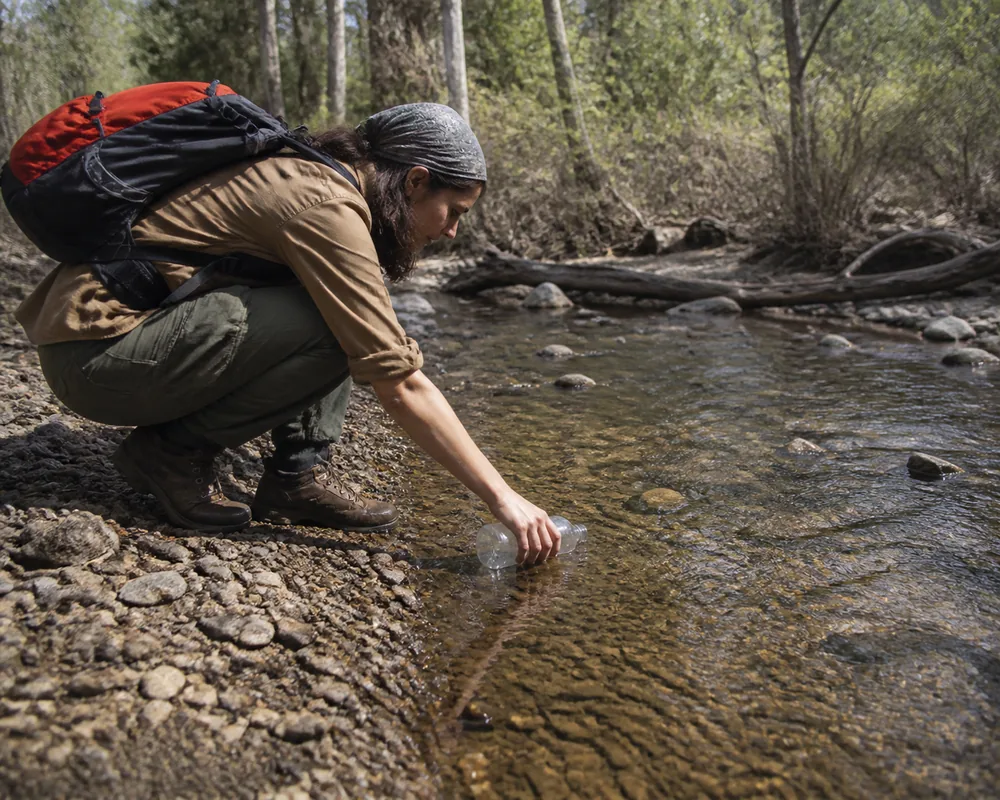
The second consequence is the one that costs people more. By the time symptoms arrive, the trip is over, the pack is put away, and nobody involved is still thinking about a stream.
So the illness gets attributed to something eaten locally, and it goes untested for weeks. A doctor who has not been told about backcountry travel has little reason to look for a parasite.
What does giardiasis actually feel like?
Persistent diarrhea with a particular character. Stools tend to be pale, greasy and inclined to float, with heavy bloating, cramping and belching that tastes strongly of sulphur.
Fatigue and unintended weight loss are common once it has run a week or two.
- Onset
- One to three weeks after exposure, most often one to two
- Hallmark signs
- Greasy stools that float, heavy bloating, sulphurous belching
- Usually absent
- High fever and blood in the stool, which point toward a bacterial cause
- Duration
- Two to six weeks without treatment
- Afterwards
- Temporary lactose intolerance that can outlast the infection
- Confirmed by
- A stool test rather than a symptom pattern
The absences carry as much information as the symptoms. High fever and blood in the stool are not typical here, and either one shifts suspicion toward a bacterial infection that needs its own assessment.
Watery diarrhea with a fever that came on overnight is a different problem. Speed and fever arriving together is the bacterial and viral pattern rather than this one.
Untreated, the acute phase usually runs two to six weeks, which is long enough that a great many people conclude they must have developed something chronic. Some people carry it and never feel anything at all, which is part of how it moves quietly through a group.
There is also a tail worth knowing about.
Temporary lactose intolerance frequently outlasts the parasite, so symptoms that continue after a completed course of treatment are often dairy rather than a treatment that failed.
None of this settles the question on its own. A stool test is what confirms it, and the pattern above is only the reason to ask for one.
Which really infects people, the water or their hands?
Three routes get collapsed into one whenever this subject comes up, and they are not equally important.
Untreated surface water
The route everyone assumes. Drinking untreated stream or pond water is associated with more diarrhea, though it accounts for less of the total than its reputation suggests.
Hand to mouth
The strongest single control point in the evidence, and the one almost nobody packs for.
Shared food and gear
Once one person in a party is carrying something, the group snack bag and the passed water bottle do the rest without any stream involved.
Cysts reach water through faeces, and the sources are mostly not human. Beavers, cattle and sheep all shed it, which is why a drainage below a beaver pond or a grazing allotment is a poorer bet than the map alone suggests.
The evidence points fairly consistently at hygiene. Careful handwashing, or alcohol-based hand cleaner where water is short, is the measure most strongly associated with staying well, and stopping hand-to-mouth transfer matters more than any single thing you do to your drinking water.
Bacteria and viruses also turn up more often than giardia does in backcountry diarrhea.
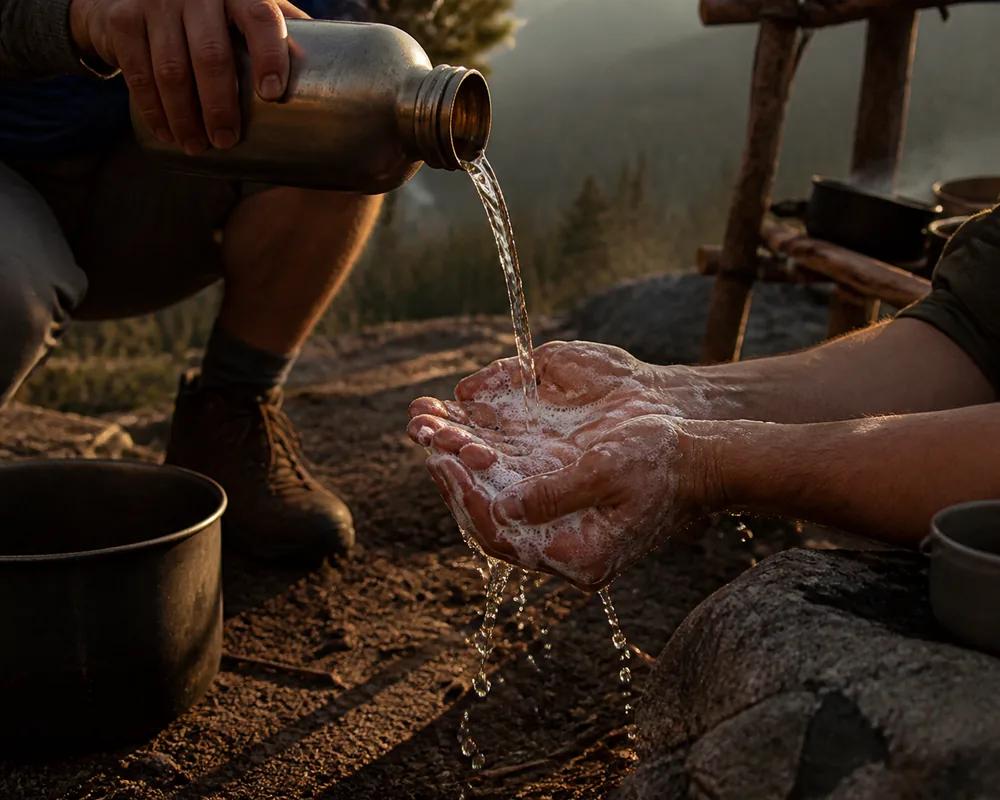
It is easy to over-correct from there. A confident line has circulated for years that backcountry giardia is essentially a myth, and that overstates the case in the other direction.
Field sampling has found meaningful acquisition rates, with one study putting 5 to 8 percent of tested hikers picking it up on a single trip. Verified waterborne outbreaks among campers exist in the record.
Both confident positions are wrong. The water is not the main route and it is not a non-issue, which is a duller conclusion than either camp offers.
Where that leaves you is straightforward. Put the effort into hands, and keep treating water because doing so costs very little.
Not every water treatment kills the cyst
The failure here is usually in what people are already carrying rather than in what they neglected to bring. Treating water is not one decision, and methods that are near-equivalent against bacteria diverge sharply on this organism.
Giardia cysts are large as waterborne threats go, roughly 7 to 10 microns across and up to 20 long. Being large makes them easy to filter and comparatively hard to poison.
That second half is where the trouble sits.
| Method | Against giardia cysts | Time needed |
|---|---|---|
| Rolling boil | Complete | One minute at a rolling boil |
| Filter, absolute 1 micron or finer | Complete, mechanical removal | Immediate |
| Filter, nominal 1 micron | Passes 20 to 30 percent of particles that size | Immediate but incomplete |
| Chlorine dioxide | Effective | About 30 minutes, or four hours in cold water |
| Iodine or plain chlorine | Low effectiveness against cysts | No contact time fixes this |
Iodine and plain chlorine handle bacteria and viruses well and are weak against protozoan cysts. Anyone carrying iodine tablets specifically because of giardia has the wrong tool.
Chlorine dioxide is the chemical that does work on them.
It works on a clock, though, and the clock is where it fails in practice. Thirty minutes is the figure for giardia, and water below about 40F pushes that out to four hours, as does cryptosporidium at any temperature.
A fifteen-minute wait because the group is ready to move is not a shortened treatment. It is an untreated bottle.
The filter distinction is the other thing worth checking on your own gear. An absolute pore rating of 1 micron or smaller physically blocks these cysts, while a nominal rating of the same number describes an average and can let 20 to 30 percent of particles that size through.
Two filters can read 1 micron on the label and perform very differently.
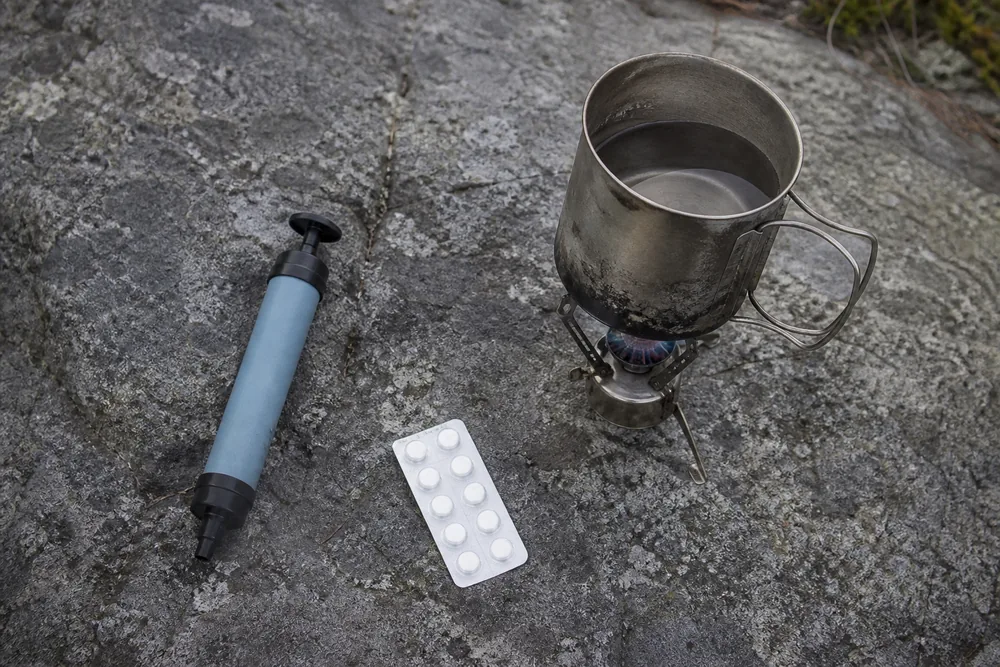
Clarity tells you nothing. Cysts are invisible in clean-looking water, and a pool that runs clear over gravel carries no guarantee about what is upstream of it.
How do you actually lower the risk?
Most of the available benefit sits in the ten seconds before you eat.
- Wash or sanitise hands before every meal, not only after a cathole
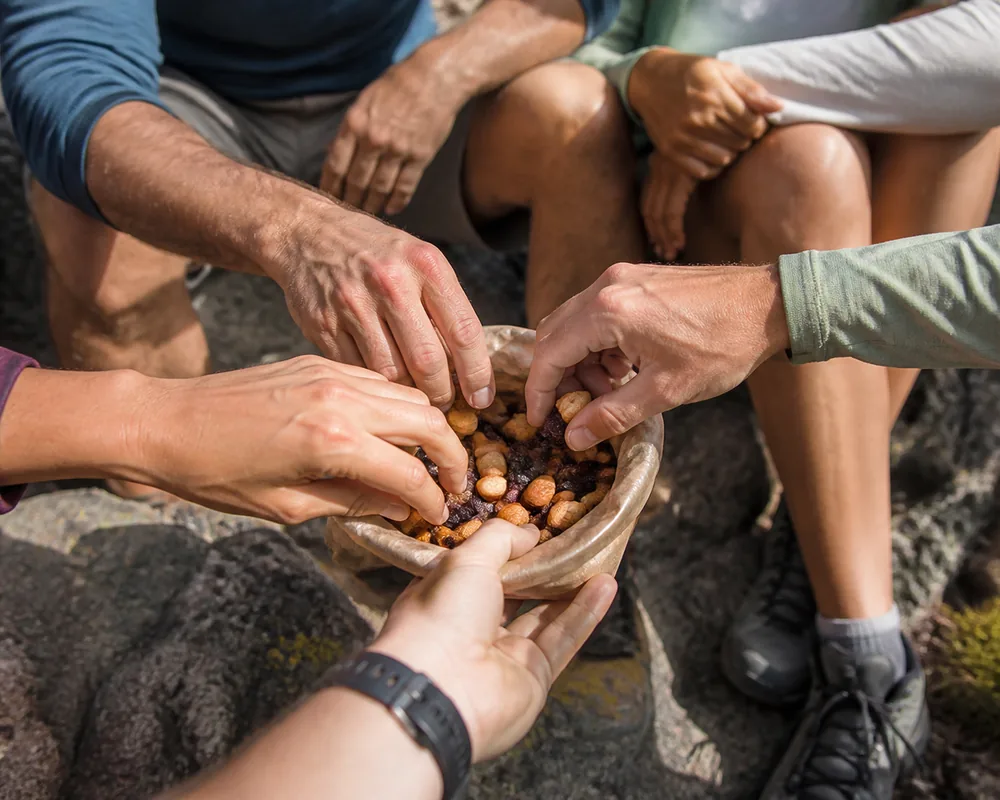
- Serve from the bag into hands rather than letting everyone reach in
- Keep bottles, cups and spoons personal for the whole trip
- Treat water even where it looks clean
- Site catholes at least 200 feet from water, camp and the paths between them
- Wait out the full contact time if you are using chemicals
The first two items carry more weight than the rest combined. Almost everyone thinks about hands after using a cathole and almost nobody thinks about them before dinner, which is the moment that matters.
Group habits are the part that gets overlooked. One person carrying something without symptoms can pass it to a whole party through a shared bag of trail mix, and no water source is involved anywhere in that chain.
Hand cleaner is a reasonable substitute when water is short, though it is not equivalent. It performs less well against some organisms than washing properly does, so treat it as the fallback rather than the plan.
None of this makes water treatment optional. It stays on the list because the cost of doing it is a few minutes and the cost of being wrong is a fortnight of your life.
The treatment is prescription-only
Nothing in your first aid kit touches this. There is no field treatment for giardiasis and there is no over-the-counter one either.
The drugs used are metronidazole, tinidazole and nitazoxanide, all prescribed after a doctor has confirmed what they are treating. That is why the timeline runs through an appointment rather than a pharmacy counter.
The courses differ in a way worth knowing before the appointment. Tinidazole is usually a single dose while metronidazole runs five to seven days, and they are not equally well tolerated.
Dosing is a prescriber's decision and depends on things this page cannot know about you.
What you can control is what the doctor is working with. Tell them you were in the backcountry and roughly when, because giardia is not near the top of the list for a patient who presents with three weeks of diarrhea and no travel history.
Without that detail, a stool test for parasites may simply never get ordered. The routine workup for adult diarrhea does not automatically include one.
Be prepared for the test itself to need repeating. Shedding of cysts is intermittent rather than constant, so a single negative sample does not rule the infection out and clinicians often ask for more than one collected on different days.
A negative result from one sample, in someone whose timing and symptoms fit, is worth questioning rather than accepting.
For the ordinary case, the reasonable course is to stop waiting it out. Two to six weeks is a long time to lose to something that a test and a short course of treatment resolve.
Sources
The incubation window of one to three weeks, the two to six week duration of the acute phase, and metronidazole, tinidazole and nitazoxanide as the drugs of choice are set out in the Merck Manual professional entry on giardiasis and the Mayo Clinic diagnosis and treatment guidance.
Comparative incubation periods for norovirus and campylobacter come from CDC material on norovirus outbreak management and the foodborne outbreak investigation timeline.
Cyst dimensions, the absolute versus nominal pore-rating distinction, and the 20 to 30 percent pass-through figure come from the CDC guide to water filters and Minnesota Department of Health guidance on water treatment in the backcountry.
Boiling, chlorine dioxide contact times, the cold-water extension, and the weakness of iodine and chlorine against protozoan cysts are covered in the Colorado State Extension guide to treating water in the backcountry.
The evidence on hand-to-mouth transmission as the dominant control point, and the argument over how much backcountry diarrhea is actually giardia, is set out in Evidence-Based Medicine in the Wilderness: The Safety of Backcountry Water015[0235:EMITWT]2.0.CO;2) and reviewed against the field sampling data in this summary of the research.
AnswersQuestions readers ask
How long after drinking bad water does giardia start?
One to three weeks, most often one to two. That delay is the single most useful piece of evidence you have, because it means illness that began during a trip is rarely giardia.
Is diarrhea on day three of a trip giardia?
Almost certainly not. Norovirus appears in 12 to 48 hours and common bacterial causes in two to five days, so anything that starts that quickly points at a faster organism.
What does giardia feel like compared to ordinary food poisoning?
Pale greasy stools that float, heavy bloating and sulphurous belching, usually without high fever or blood in the stool. Fever and blood point toward a bacterial infection instead.
Does iodine or chlorine kill giardia?
Not reliably. Both handle bacteria and viruses well but are weak against protozoan cysts, so anyone carrying iodine tablets specifically for giardia has the wrong tool. Chlorine dioxide works given about 30 minutes.
Is it the water or my hands that gives me giardia?
Hand-to-mouth transfer is the stronger control point in the evidence, and bacteria and viruses cause more backcountry diarrhea than giardia does. Untreated surface water still raises risk, so treat water and wash hands before eating.
Can you treat giardia in the field?
No. Metronidazole, tinidazole and nitazoxanide are all prescription drugs, and nothing carried in a first aid kit resolves the infection. It needs a stool test and a doctor after the trip.