
What Causes Blisters, and Should You Drain One?
Which is why the products aimed at friction keep disappointing you.
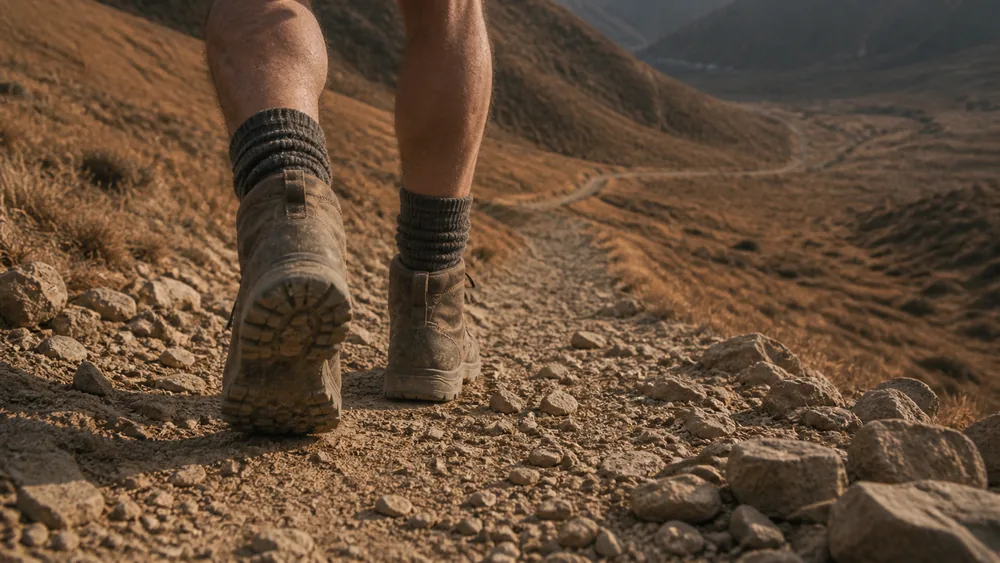
A blister is an intraepidermal tear produced by repetitive shear, and it is well underway before anything shows on the surface. Once you know that, the hot spot stops being a warning and starts being the injury, and the measures that work make sense.
Almost everything written about blisters starts from the wrong idea. It says your sock rubbed your skin raw, which is not what happened and is why the products aimed at rubbing keep disappointing you.
The damage is deeper than the surface, and it starts before you can see anything.
That instruction only sounds proportionate once you know what is happening under the skin.
A blister is a tear, not a rub
A blister is an intraepidermal tear. The layers of your skin are being dragged in opposite directions until they separate, and the gap fills with fluid afterwards.
Experimental work in 1955 produced blisters deliberately and biopsied them.
The tear appeared in the prickle layer of the epidermis every single time, well below the surface that a sock ever touches. The same work found blisters formed somewhere between 27 and 138 repetitions, which is a smaller number of steps than most people expect.
The cause is repetitive shear rather than friction at the surface, and shear needs three things to happen at once.
Motion of bone
Your heel bone moves inside the soft tissue while the skin is held still by the sock. This is the element nobody thinks about, and it is why fit beats every surface treatment.
High friction force
The skin is gripped rather than sliding. Popular advice targets only this element, which is why it helps a little and not enough.
Repetition
One shear event does nothing. A few dozen at the same spot produces a tear, which is why descents and long days blister feet that short walks never touch.
Look at that list and the pattern in your own feet makes sense. You blister in the same place every time because the bone underneath moves the same way every time, and no amount of powder changes that.
It also explains why a blister appears on skin that looked fine at lunch.
The tear was accumulating for an hour before the fluid arrived. The blister is the receipt, not the event.
Why is damp skin worse than soaking wet skin?
Moisture does not work the way people assume. It is not a straight line where drier is always better, and the shape of the curve is genuinely useful.
The 1955 work measured this too.
Friction was lower on skin that was dry, and lower again on skin that was greasy or very wet. It was highest on skin that was merely moist, which is exactly the state a sweating foot inside a warm boot occupies for an entire day.
- Dry skin
- Low friction, and the state worth actively maintaining
- Moist skin
- The peak of the curve, and where a sweating foot lives all day
- Very wet skin
- Friction drops again, so a soaked foot is not the worst case
- Greasy skin
- Also low friction, which is the honest case for lubricants
This is why a hot dry day in heavy boots can wreck feet that came through a wet day untouched. The wet day soaked them past the peak, and the dry day held them at it.
The practical version is a sock change rather than a philosophy.
Swapping to dry socks at a lunch stop moves your feet off the worst part of the curve for a few hours, and it does more than anything you can spread on them. Lubricants do work by the same mechanism, and they wear off, which limits how long they hold.
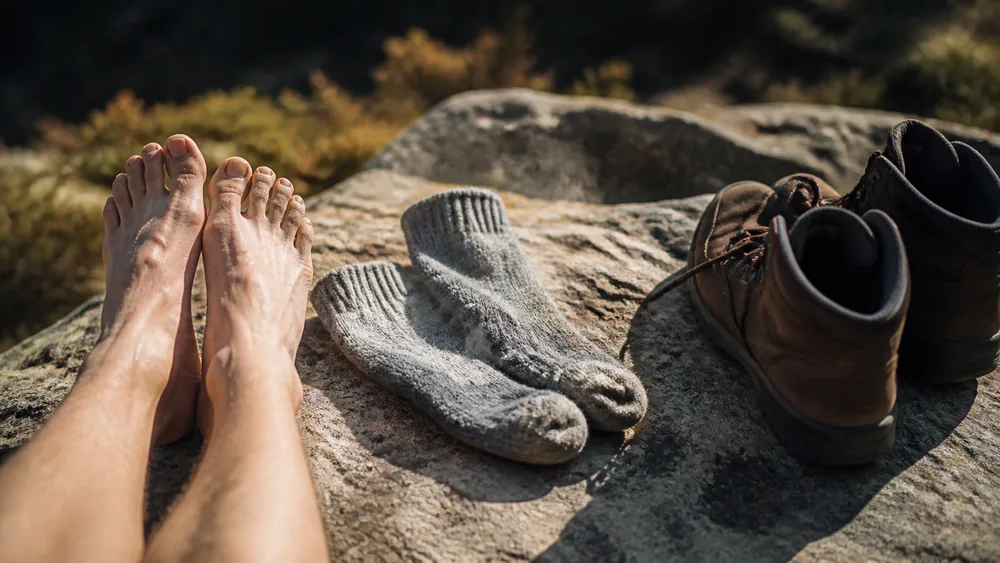
The tape trials disagreed, and the reason is useful
Paper tape is the most tested blister intervention available, and it has been trialled twice on ultramarathon runners with opposite results. The disagreement turns out to be the most useful part.
The first trial taped one entire foot and left the other as a control.
It found nothing. Blisters occurred on 52 percent of taped feet against 39 percent of untaped ones, with a p value of 0.22, and every single participant developed blisters somewhere.
The second trial changed one thing. Instead of taping a whole foot, it taped the specific areas each runner knew blistered, and compared those against untaped skin on the same foot.
That version worked clearly.
Blisters fell by 40 percent, with a number needed to treat of 1.31, which is an unusually strong result for anything in this field. The distribution also told its own story, with toes accounting for half the blisters and heels for just under a quarter.
| What differed | First trial | Second trial |
|---|---|---|
| How the tape was applied | One whole foot taped | Only the areas that historically blister |
| Compared against | The other, untaped foot | Untaped skin on the same foot |
| Result | No protective effect, 52 percent against 39 | Blisters reduced by 40 percent |
| What it means for you | Wrapping a foot is not the intervention | Tape the two or three spots that actually go |
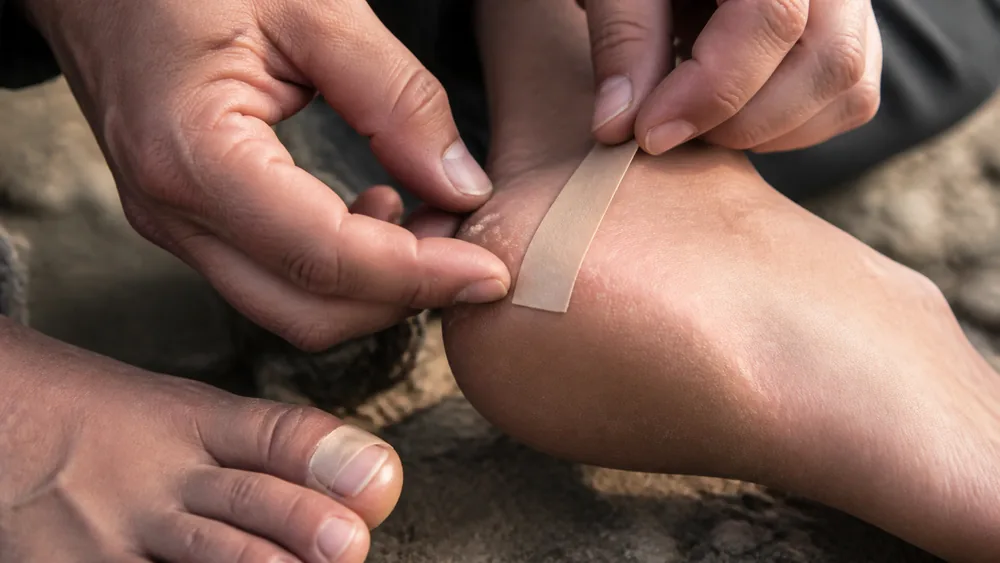
So the instruction is narrower than tape everything. Tape the places your feet have blistered before, on clean dry skin, before you start walking.
One more figure from that data is worth carrying. Eighty percent of the blisters had appeared by the end of the second stage, so this is a first-two-days problem far more than a last-two-days one.
What do you do at the first hot spot?
The sensation people describe as warmth or a hot patch is the tear in progress. Treating it as an early warning of a future problem gets the timing wrong, because the problem has started.
The cost of stopping is five minutes and some social awkwardness in a group.
The cost of not stopping is usually the rest of the trip. That trade is lopsided enough that it should not require deliberation, and yet people walk on because the group is moving.
- Stop when you noticeNot at the next junction, not at lunch. The count that produces a tear is low.
- Boot and sock offYou cannot locate the spot or find its cause through fabric.
- Dry the footTape does not stick to a moist foot, and moist is the high-friction state anyway.
- Cover the exact spotA small patch on the place that hurts, not a wrap around the whole heel.
- Find the causeA seam, a rucked sock, grit, or a heel lifting will reproduce the same spot within the hour.
- Retie before you moveHeel lift is the bone-motion element, and lacing is the only field tool you have against it.
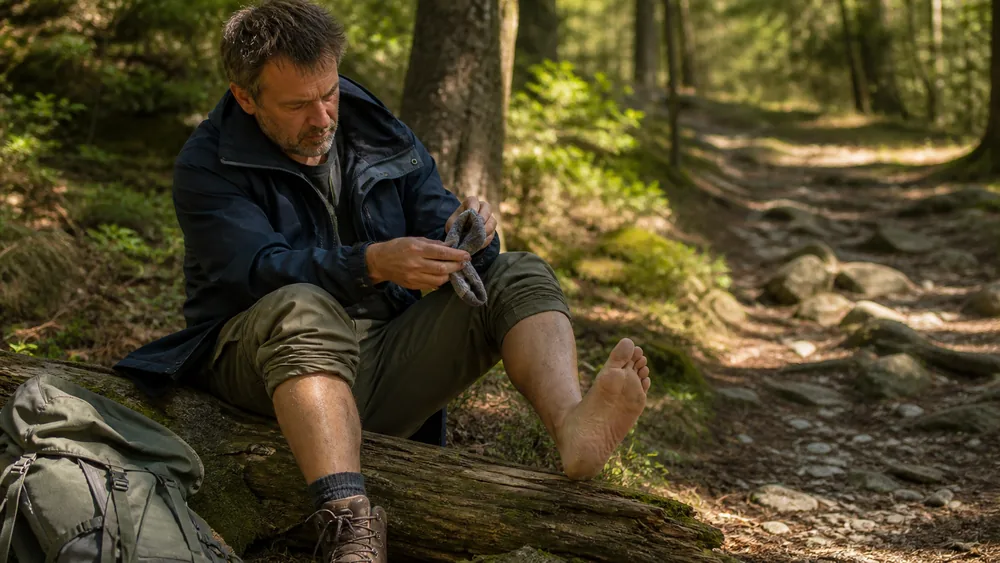
The cause hunt matters more than the dressing. A patch over a spot that is still being created by a fold of sock buys you twenty minutes.
Grit is the one people miss most often.
A single piece of trail grit inside a sock will reproduce the same hot spot repeatedly, and it survives being shaken out unless you actually turn the sock inside out and look.
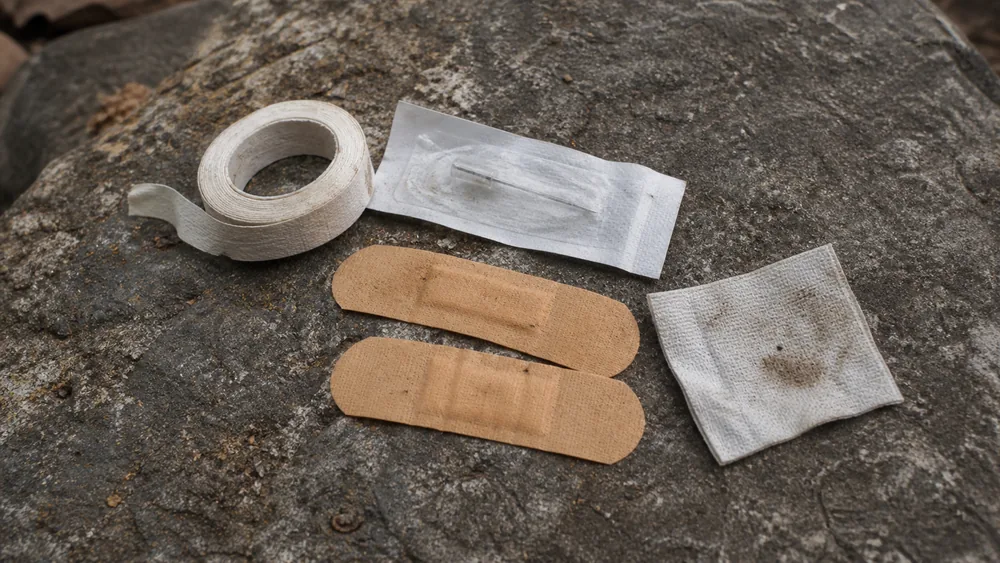
Should you drain it?
Start from the principle, because it settles most cases. An intact blister roof is the most sterile dressing you will ever have access to, and it is already perfectly fitted.
The default is therefore to leave it alone.
That default flips when the pressure itself is doing damage, which happens when there is real distance still to walk and the blister sits somewhere every step loads. A tense blister under a loaded heel keeps tearing at its edges, and relieving it is the better trade.
- The roof is still intact, so you are choosing to give up sterile cover.
- You have significant distance left rather than an hour to the car.
- It sits where every step presses on it, such as a heel or the ball of the foot.
- You can do it cleanly, with washed hands, a sterile needle, and a clean dressing.
- It is not a blood blister, which carries more infection risk and is left alone.
If you do drain it, leave the roof in place. It is still protecting the raw base underneath, and trimming it away converts a manageable blister into an open wound.
Draining also does nothing about the cause.
The shear that produced it will keep working unless you change the fit, the sock, or the lacing at the same time. People drain a blister, feel the relief, walk on unchanged, and refill it within the hour.
A blister that has already torn is a different problem.
Treat it as an open wound, clean it, dress it with something that will not stick to the base, and accept that infection risk is now the thing you are managing. Blood blisters and blisters under a toenail are generally left alone in the field, because both carry more risk than a clear one and neither responds well to improvised drainage.
The line between a blister and an infection
Normal recovery is quiet and boring. The pain fades over a day or two, the fluid is reabsorbed or drains, and the skin underneath toughens up.
Anything that gets more painful after the second day is running against that course.
The signals worth acting on are spreading redness beyond the blister, warmth in the surrounding skin, pus rather than clear fluid, red streaks running away from the site, or a fever alongside a foot wound. Any of those turns a nuisance into something that needs proper attention rather than another dressing.
Two situations change the threshold entirely.
Anyone with diabetes or reduced circulation in the feet is managing a different level of risk, and a foot wound in that context is significant from the first day rather than the third. Increasing pain is the tell, and it is worth more than how the blister looks.
Sources
The mechanism used throughout, including that blisters are an intraepidermal tear caused by repetitive shear deformation rather than surface rubbing, and the three elements of bone motion, friction force, and repetition, is set out in: Friction Blisters of the Feet: A New Paradigm to Explain Causation.
The trial that taped specific blister-prone areas and found a 40 percent reduction with a number needed to treat of 1.31, along with the distribution across toes and heels and the finding that most blisters appeared by the end of stage two, is: Paper Tape Prevents Foot Blisters, Clinical Journal of Sport Medicine.
The earlier trial that taped one whole foot against the other and found no protective effect is: A Prospective Randomized Blister Prevention Trial Assessing Paper Tape in Endurance Distances00197-5/fulltext).
The 1955 experimental work establishing where in the epidermis the tear occurs, the repetition counts involved, and the moisture curve showing friction highest on moist skin, is summarised in: Blister Research Timeline: Shear Deformation.
AnswersQuestions readers ask
What actually causes blisters?
Repetitive shear inside the skin rather than rubbing on the surface. The tear happens in a deep layer of the epidermis, which is why it forms while the skin still looks normal.
Does taping prevent blisters?
It does when applied to the specific spots that blister. A trial that taped blister-prone areas cut blisters by 40 percent, while an earlier trial that taped one whole foot found no effect at all.
Are wet feet or damp feet worse for blisters?
Damp is worse. Friction is lower on dry skin and lower again on very wet skin, and it peaks on moist skin, which is the state a sweating foot in a warm boot stays in all day.
Should you pop a blister?
Usually not, because an intact roof is the best sterile dressing you have. Draining makes sense when there is real distance left and the blister sits where every step loads it, and only if you can do it cleanly.
Do you cut the skin off a drained blister?
No. The roof still protects the raw base underneath, so it stays in place. Removing it turns a manageable blister into an open wound.
How do you know a blister is infected?
Pain that increases after the first day or two runs against normal healing. Spreading redness, warmth beyond the blister, pus, red streaks, or a fever are the signals worth acting on.