
What to Wear Hiking, From Base Layer to Boots
Dress for hiking by layer function rather than by garment count, so you can shed heat on the climb, hold it at the top, and stay dry enough to keep going.
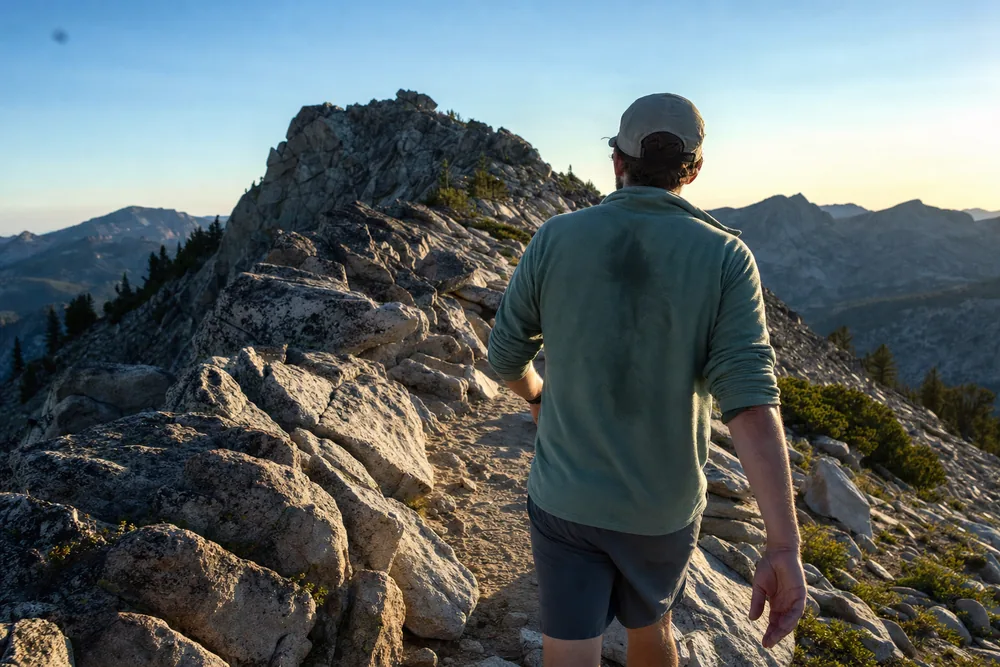
Choose hiking clothing by what each layer does, how the fabric behaves when wet, and how the fit holds up over miles.
Hiking clothing gets judged by the wrong question. People ask how many layers to wear, when the useful question is what each layer has to do, because a hot climb and a windy summit thirty minutes apart ask for opposite things.
Think in three jobs instead of three garments. Something moves sweat off your skin, something traps warmth, and something blocks wind and water.
On a July afternoon two of those live in your pack, but all three should be with you.
Those ratings describe one thing only, which is how much warmth the fabric still gives you after it gets soaked. It is the property that decides how a bad afternoon ends.
Which layers actually do the work?
Work out from the skin. Each layer solves a problem the one beneath it created, which is why adding a warm jacket over a soaked cotton shirt fixes almost nothing.
The base layer is the one hikers underestimate. Its job is not warmth, it is moving sweat away from your skin so the air trapped in your other layers stays useful.
A base layer that fails at this makes every layer above it worse, because trapped sweat turns your insulation into a cold wet sponge the moment you stop walking.
Merino wool and synthetics both do this well. Wool resists odour better over multiple days and synthetics dry faster and cost less, and either beats cotton by a margin that matters.
The middle layer traps air. Fleece, a light synthetic puffy, or a grid-knit pullover all work, and the right thickness depends on whether you run hot and how long you plan to stand still.
- A base layer that moves sweat and is not cotton
- A mid layer you can add at a summit or a long break
- A wind and rain shell that actually closes at the neck and wrists
- Trousers or shorts that dry faster than denim
- Socks matched to your footwear, not to whatever was clean
- Sun cover for your head, neck, and eyes
Base layer weight matters more than most people are told. A lightweight knit moves sweat fast and suits hard walking, while a midweight adds real warmth and holds moisture longer once you push the pace.
Pick the weight around your effort rather than the forecast. A hiker climbing hard in cold air often needs a thinner base layer than someone strolling the same trail, because the sweat load is what decides comfort.
The shell is your weather insurance. A light windproof layer changes a summit from unpleasant to fine, and it weighs almost nothing in the pack.
Three habits do most of the work on a normal day out:
- Leave the trailhead one layer cooler than feels comfortable - Keep the shell where you can reach it without unpacking - Treat the mid layer as stop-moving equipment rather than walking equipment
Children run through this cycle faster than adults and say so later than they should, so a family hiking plan needs more frequent changes and a spare dry set.
What you leave off matters as much as what you bring. Start the climb slightly cool, because the layer you sweat through on the way up is the layer that cannot warm you at the top.
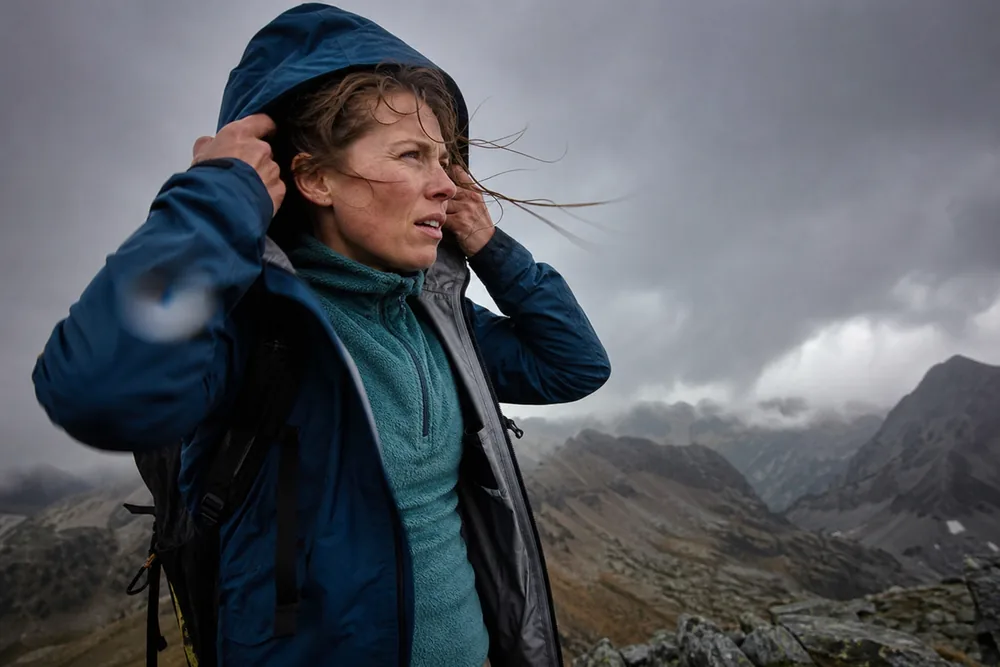
Shell details separate a useful one from a bag with a zip. A hood that adjusts and turns with your head, cuffs that close over gloves, and underarm vents all decide whether you keep the shell on or take it off and get wet anyway.
Waterproof and breathable is a compromise rather than a promise. Every membrane moves less moisture than a hard climb produces, so ventilation you can open matters more than the number on the label.
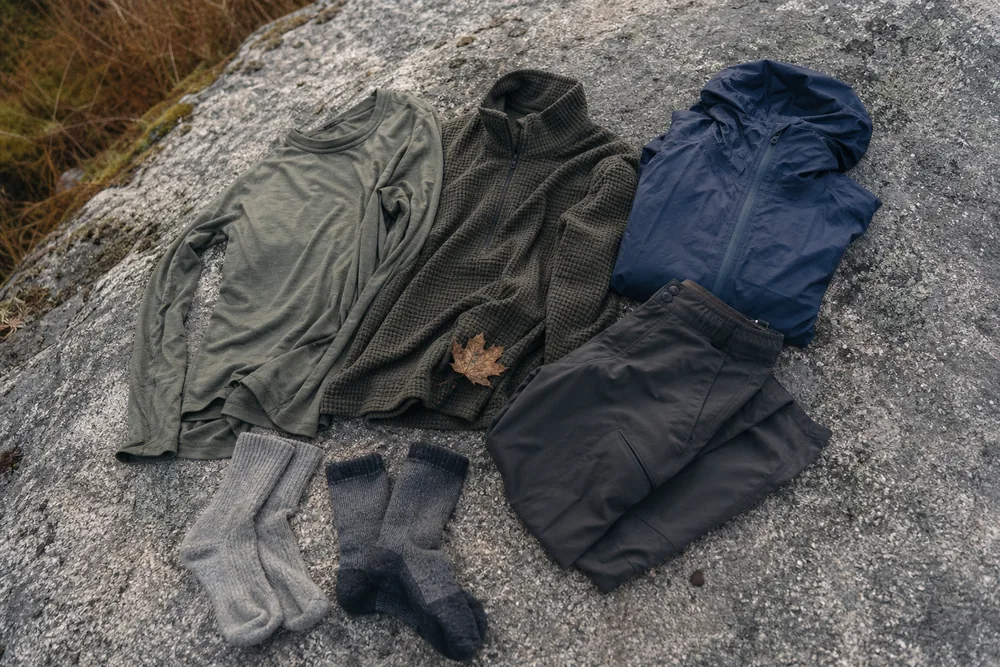
A full hiking kit list covers what goes in the pack alongside these, and the two decisions are easier made together.
What makes cotton fail when other fabrics hold?
Cotton absorbs water into the fibre itself rather than holding it between fibres. A soaked cotton shirt can carry well over its own weight in water, and that water sits against your skin.
Wet fabric pulls heat away from your body far faster than dry fabric does. That is fine on a hot afternoon and genuinely dangerous once wind and elevation arrive.
Drying time is the other half. Wool and synthetics push moisture to the surface where it evaporates, and cotton holds it until the sun or a fire takes it out.
| Fabric | Warm when wet | Dry speed | Best use |
|---|---|---|---|
| Merino wool | Yes | Moderate | Base layers, socks, multi-day trips |
| Synthetic (polyester, nylon) | Yes | Fast | Base layers, trousers, hot weather |
| Fleece | Partly | Moderate | Mid layer in cool and damp conditions |
| Down | No | Very slow | Dry cold only, or under a reliable shell |
| Cotton | No | Very slow | Short warm walks with no weather risk |
Wool against synthetic is a real choice rather than a ranking. Wool keeps smelling acceptable after several days, handles a wide temperature range, and costs more while wearing out faster at friction points.
Synthetics dry faster, survive rough use better, and cost less, and they hold odour after a hard day in a way wool does not. For a single day out the difference is small enough that price and fit should decide it.
Down deserves a note of its own. It is the warmest insulation per gram by a wide margin and it collapses into uselessness when soaked, so it belongs on dry cold days or under a shell you trust.
Drying speed shows up in ordinary situations, not just emergencies. A synthetic shirt soaked in a rain shower is usually wearable again within an hour of walking, and the cotton equivalent stays cold and heavy until you get back to the car.
This is the same physics behind most cold-weather trouble on ordinary trails. Damp clothing, moving air, and a slowing pace are the early conditions for hypothermia risk, and none of them require dramatic weather.
Fit decides whether clothing helps or rubs
A garment that performs perfectly in a shop can still ruin a day at mile eight. Seams that sit under a pack strap, a waistband that folds over a hipbelt, and a collar that traps sweat all cause problems distance makes worse.
Movement is the test that matters. Reach overhead, take a long step up, and crouch, because a shirt that rides up or a trouser that binds at the knee will do the same thing a thousand times on a real climb.
Check fit against the pack, not against a mirror. Where the hipbelt load transfer sits is exactly where a thick seam or a bunched shirt will start working on your skin.
Specific details cause most of the trouble:
- Shoulder seams that land directly under a pack strap - Waistbands that fold over once a hipbelt is tightened - Sleeves too short to stay under a shell cuff when you reach - Trouser cuffs wide enough to catch on rock and brush
Build quality shows up in exactly these details, which is the same logic behind a sensible gear buying order for everything else you carry.
Flat seams, a slightly longer cut at the back, and fabric with a little stretch are the details that separate clothing that disappears from clothing you keep adjusting. Persistent rubbing is worth solving properly, and the fixes in a long-mileage skin plan start with the garment rather than the ointment.
How should socks and footwear work together?
Socks are the layer people spend least on and notice most. A sock's job is cushioning, moisture movement, and keeping friction between fabric and fabric rather than fabric and skin.
Wool and synthetic blends both work and cotton socks are the reliable route to blisters. Thickness should match the boot it was fitted with, because adding a thicker sock to a snug boot changes pressure everywhere.
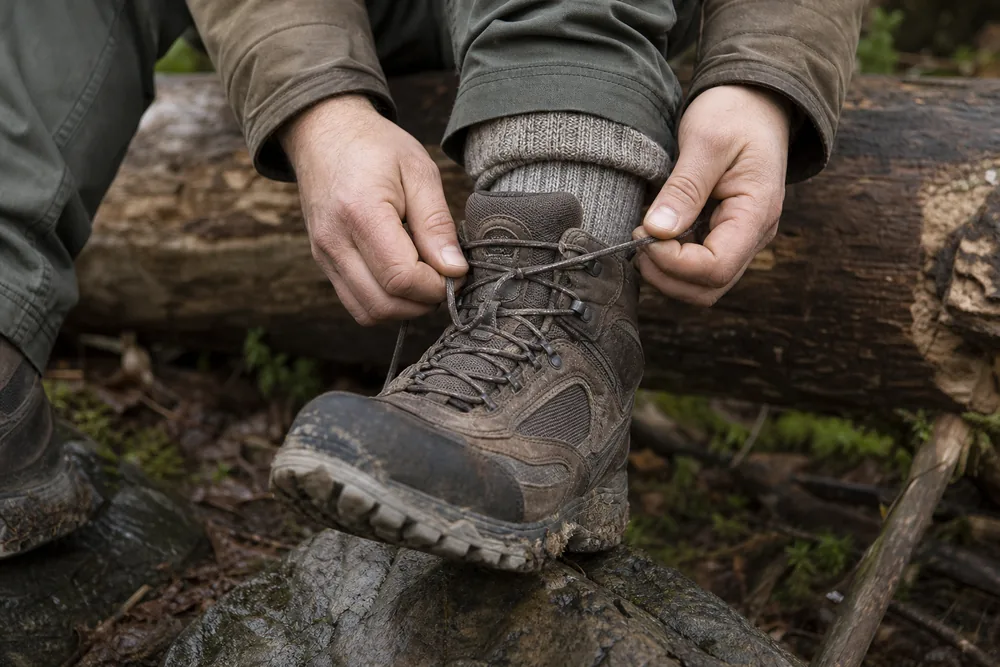
Sock height is the detail people skip. The cuff has to clear the top of the boot, because any gap puts a stiff collar directly against bare skin on every step.
Carrying one spare pair changes a wet day completely. Dry socks at a lunch stop reset your feet for the descent, and they weigh almost nothing.
Boots against trail runners is a genuine choice rather than a hierarchy. Boots give ankle support and protection when the ground is rough or the pack is loaded, and trail runners are lighter, cooler, and dry far faster after a stream crossing.
Weight on your back shifts that decision. Once you are carrying a loaded daypack setup, the extra support and stiffer sole start earning their weight on descents.
Fit rules are simpler than the marketing suggests. You want a thumb's width in front of your longest toe, a heel that lifts barely at all, and no pressure across the widest part of your foot when standing.
Try footwear late in the day with the socks you intend to hike in. Feet swell over hours of walking, and a boot fitted to a fresh morning foot often becomes too tight by mile six.
Watch for these when testing:
- Heel slipping upward as you roll onto your toes - Any pinch across the widest part of the foot while standing - Toes touching the front on a downhill ramp - Pressure over the instep once the laces are properly tensioned
Lace them differently going down. A heel-lock finish stops your foot sliding forward, which is what bruises toenails and costs you grip on a long descent.
Sun and head cover are not a summer-only problem
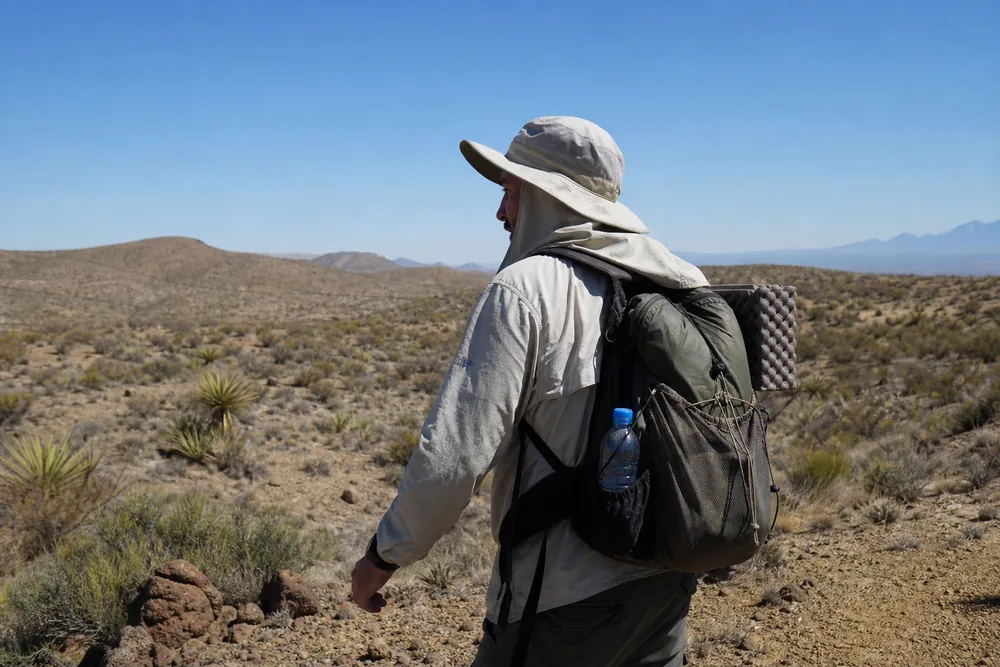
UV exposure rises with elevation and reflects off snow, water, and pale rock. A bright winter ridge can burn you faster than a hazy valley in August.
Snow and pale rock make it worse by reflecting light upward. That is why hikers burn under the chin and nose in spring conditions, where sunscreen is usually applied as if the sun only comes from above.
A brimmed hat, sunglasses, and cover for the back of your neck handle most of it. Sun-rated light fabric is more comfortable than repeated sunscreen on the arms and does not wash off with sweat.
Brimmed hat
Shades your face and the back of your neck, which is where hikers burn most and notice least.
Sunglasses
Reduce squinting fatigue and matter more on snow, water, and open rock than in forest.
Light long sleeves
Cooler than they sound in dry heat, and they remove the need to re-apply sunscreen on your arms.
Buff or neck cover
Doubles as sun cover, dust filter, and a warm layer at a windy summit.
Elevation is the multiplier people forget. UV intensity climbs roughly ten percent for every thousand metres you gain, so a ridge walk exposes you to noticeably more than the car park did.
Starting or finishing in the dark changes the calculation again, because temperatures fall fastest around dawn and dusk. Clothing choices for a dawn or dusk outing need to cover a wider range than the middle of the same day would.
What changes between seasons
The three jobs stay the same and the weight of each one shifts. Summer moves the emphasis to sun cover and fast drying, and winter moves it to insulation and wind blocking.
Summer clothing failures are usually about sun and salt rather than cold. Long dry days leave crusted sweat in seams, and that stiffened fabric is what starts rubbing on the following outing unless it gets washed properly.
Rain is its own case rather than a temperature case. A shell that breathes badly leaves you as wet from the inside as the weather would have made you, and the tradeoffs in a wet-weather hiking plan are mostly about ventilation rather than waterproofing.
Cold changes the margin for error more than it changes the clothing list. Once snow and short daylight arrive, spare insulation stops being optional, and the decisions in a cold-season hiking plan assume you are carrying more than you expect to wear.
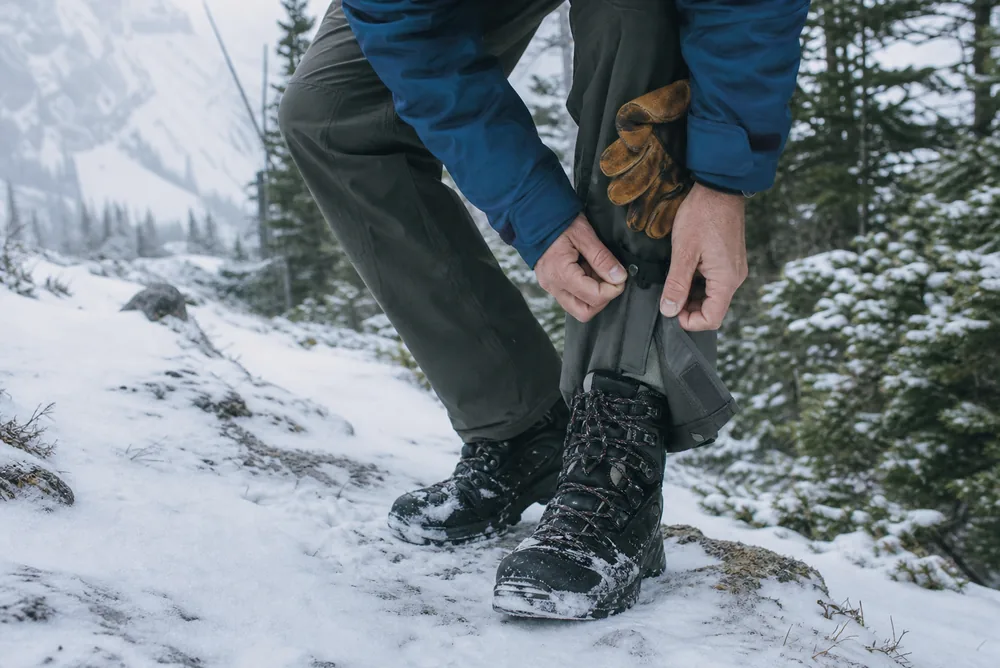
Shoulder seasons cause more trouble than deep winter does. Spring and autumn hikers dress for the valley and meet genuine cold higher up, where the air is several degrees colder and moving faster.
A rough figure helps here. Temperature drops around six degrees Celsius for every thousand metres of elevation gain, and wind on an exposed ridge removes more warmth on top of that.
Heat deserves the opposite instinct. Loose, light, pale, and covered usually beats less fabric, which is why hot-weather hiking clothing leans toward long sleeves rather than away from them.
Buying order matters when the budget is finite. Footwear and socks change every step of every hike, a shell decides whether bad weather ends the day, and the insulating layer can stay cheap for a long time without much cost to you.
When to change layers on the trail
Most people change layers too late in both directions. The pattern is easy to spot once you know it.
They climb in a jacket until they are sweating, then stand at the top getting cold while they dig for the layer they should already be wearing.
- Start slightly coolLeave the trailhead wearing one layer less than feels right, because you will warm up within minutes.
- Strip early on the climbShed insulation before you sweat into it, not after.
- Shell up when the wind startsWind removes heat far faster than air temperature alone suggests, so put it on at the first exposed corner.
- Insulate the moment you stopWarmth is easier to keep than to rebuild, so add a layer as you sit down rather than once you feel cold.
- Swap a soaked base before descendingA dry base layer under the same outer layers changes a cold descent completely.
The cost of stopping is smaller than it feels. A layer change takes under a minute and prevents an hour of being wrong, and hikers who refuse to stop usually arrive at the summit both sweaty and cold.
Build the habit of changing at natural breaks. Junctions, treeline, and the last shelter before an exposed section are all obvious triggers, and using them removes the decision from a moment when you are tired.
How far and how hard you are going shapes all of this. A route matched to your current fitness leaves enough margin to stop and adjust, and the broader habits of a well-planned day treat clothing as part of the plan rather than an afterthought.
Sources
- National Park Service, hiking safety guidance on clothing, layering, and weather preparation - Centers for Disease Control and Prevention, guidance on cold stress, wet clothing, and hypothermia risk factors
Step by stepPractical steps
- Start the climb slightly cool, wearing one layer less than feels comfortable at the trailhead.
- Shed the insulating layer within the first fifteen minutes, before you sweat into it.
- Put the shell on when the wind starts, not after you are already cold.
- Add insulation the moment you stop moving at a summit or long break.
- Change into a dry base layer before a cold descent if the one you are wearing is soaked.
AnswersQuestions readers ask
Can I hike in jeans?
You can on a short, warm, dry walk, but denim is a poor choice once weather is involved.
It holds water, takes a long time to dry, chafes badly when wet, and pulls heat out of your legs. Any light synthetic or wool trouser outperforms it for less money than most people expect.
Are hiking boots necessary, or will trail runners do?
Both work.
Boots give more ankle support and protection on rough or loaded days, and trail runners are lighter, cooler, and dry faster. Choose by terrain and pack weight rather than by what looks more serious.
A well-fitted trail runner beats a poorly fitted boot every time.
How many layers should I actually bring?
Three functions, not three fixed garments.
You need something that moves sweat off your skin, something that traps warmth, and something that blocks wind and rain. On a hot day the insulating layer lives in your pack rather than on your body, but it should still be with you.
Should I wear two pairs of socks?
Only if that is what your boots were fitted around. A thin liner under a thicker sock can reduce friction for some hikers, but it also changes the volume inside the boot.
Test the combination on a short walk before committing to it for a long day.
What should I wear if the forecast is warm but the summit is exposed?
Dress for the summit, carry for the climb.
Temperature drops with elevation and wind strips warmth faster than still air of the same temperature. Walk up in as little as you are comfortable in, and keep a warm layer and a shell accessible near the top of your pack.