
When Does Heat Exhaustion Turn Into Heatstroke?
The answer is in what they say back to you, not in how their skin feels.
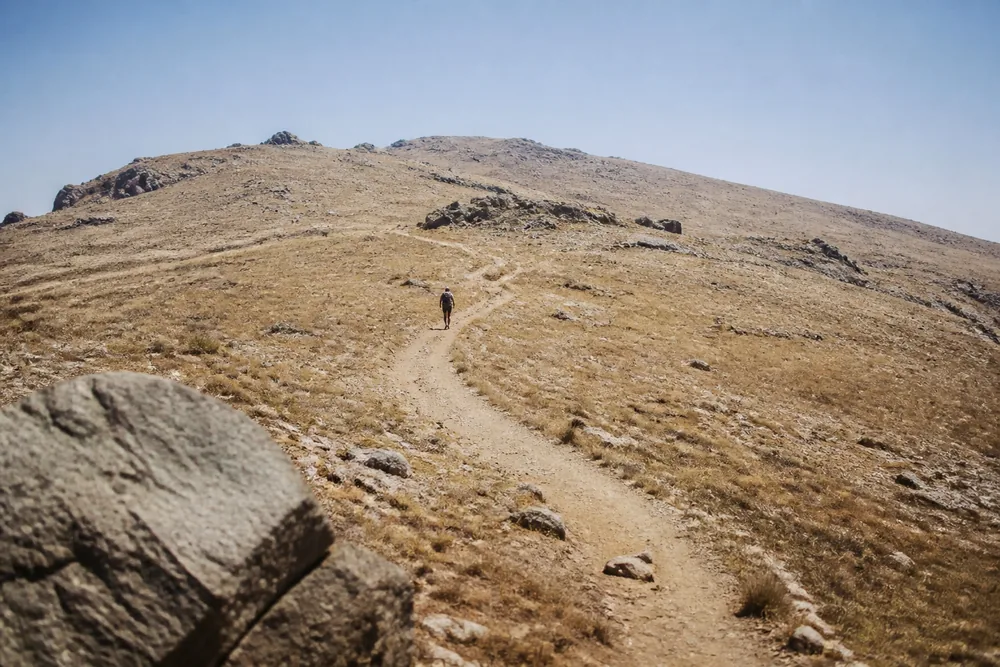
Heat exhaustion and heatstroke look almost identical from the outside, and the sign most people were taught to look for does not appear in hikers at all. What separates them is whether the brain is still working, which is the one test you can run without equipment.
Someone drops to the back of the group, sits down heavily in the first shade they reach and stops joining in.
Act before you diagnose. The opening moves are the same whether this turns out to be heat exhaustion or the emergency it can become.
- Get them out of the sunNatural shade if there is any, the shadow of a tarp or a held-up jacket if there is not
- Lie them down and raise the legsThis addresses the faintness directly and costs you nothing
- Strip back the clothingEverything not needed, so skin is exposed to air and water
- Wet them and move air across themWater on head, neck and torso, then fan with a map, a lid, anything flat
- Give small sips rather than gulpsAn electrolyte drink if the party carries one, plain water if not
- Keep talking to themWhat they say back is the test that decides everything else
That last step matters more than it looks. Their answers, not their skin, are what separate a ruined afternoon from a genuine emergency.
Which sign actually separates heat exhaustion from heatstroke?
The brain. Heat exhaustion leaves someone wretched but oriented, and heatstroke does not.
Altered mental status is the hallmark, and it covers far more than collapse. Confusion, slurred or thick speech, unusual aggression from someone placid, an inability to follow a simple instruction, or an answer to a question nobody asked.
Someone who cannot tell you where they are, or who has to be asked three times, has crossed the line.
Ask things with checkable answers rather than questions they can nod at.
Where are we, what did we walk past twenty minutes ago, and what is the plan from here. People hold on to their own name long after they have lost the thread of the day.
The clinical threshold that goes with this is a core temperature above roughly 104F, or 40C.
That number is real and you cannot use it. Nobody carries a rectal thermometer on a day walk, and every other way of taking a temperature reads unreliably in a hot, sweating person.
Which leaves behaviour as the only test actually available to you in the field.
Now the part that costs lives. Almost everyone has been taught that heatstroke means hot dry skin, and that heavy sweating rules it out.
Dry skin belongs to classic heatstroke, which happens to people who are static and overheating rather than moving. An elderly person in an unventilated flat through a heatwave presents that way.
A hiker who has been climbing for three hours does not.
Check the brain, not the skin. If you wait for the skin to go dry before you treat this as an emergency, you will wait through the entire emergency.
Heat exhaustion has a look, and it is not subtle
The skin is the part that misleads people. Someone overheating badly often turns pale, cool and clammy rather than red and hot, which reads to a bystander as the opposite of a heat problem.
They are still sweating heavily while this happens.
- Skin
- Pale, cool and clammy despite the conditions
- Pulse
- Fast and weak rather than strong and settled
- Head
- Dizziness, headache, and faintness on standing up
- Stomach
- Nausea and muscle cramping, often before they admit anything is wrong
- Behaviour
- Dropping to the back, going quiet, stopping more often
- Still oriented
- Answers questions properly, which is what keeps this on the manageable side
The behaviour line is the one that saves people, because it arrives first. Somebody who has been chatting all morning and has now walked half an hour in silence is giving you information.
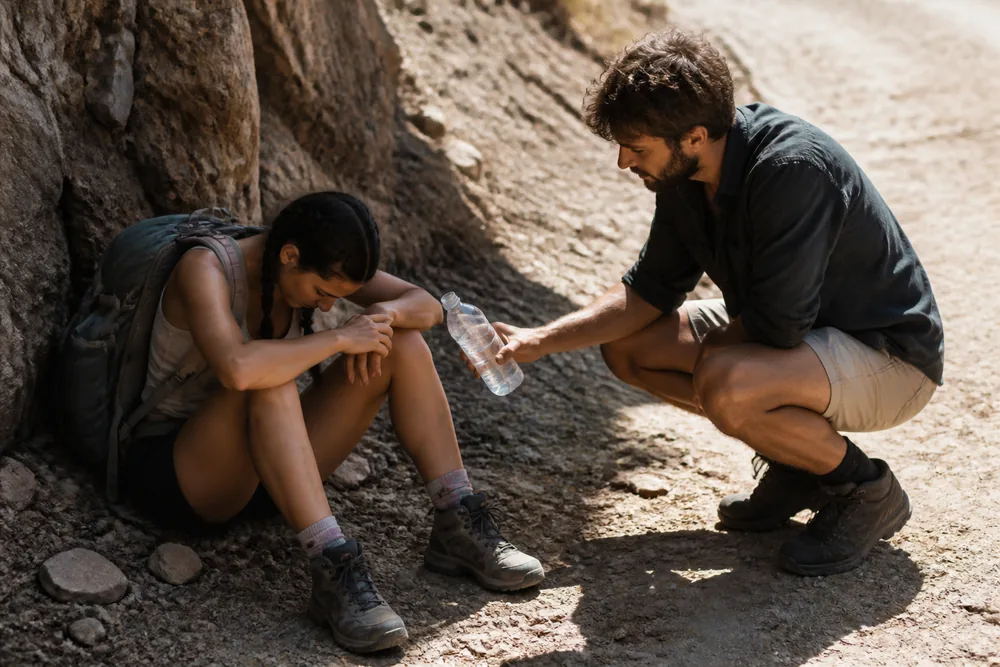
Affected people are consistently the last to raise it. Heat degrades judgement early, and the person who most needs to stop is the one least equipped to make that call.
So the practical rule is that anyone can stop the group, and nobody has to justify it afterwards.
Groups make this worse than solo walkers do. Nobody wants to be the one who ends the day, so everybody waits for somebody else to say it, and the person being deferred to is the one least able to judge.
How do you cool someone down without ice?
Cooling rate is the whole game, and the available methods are not remotely equivalent.
Cold water immersion lowers core temperature at roughly 0.15 to 0.35C per minute. Nothing else you can improvise comes close, and a stream or a lake deep enough to sit in is a genuine piece of medical equipment.
| Method | Roughly what it achieves | When to reach for it |
|---|---|---|
| Immersion in a stream or lake | By far the fastest cooling available | Whenever there is water deep enough to sit in |
| Water poured over head, neck and torso | Good, and repeatable while water lasts | The default when there is water but nowhere to sit |
| Wet clothing plus hard fanning | Strong in dry air, weak in humid | Sustainable if the group takes turns |
| Cold packs at neck, armpits and groin | Slower than almost anyone expects | A supplement, never the main effort |
| Shade and rest alone | The slow baseline everything else beats | Only when there is no water at all |
One caution comes with the top row. Anyone whose mental state is already off should not be put in water without two people holding them, because the confusion that makes this an emergency also makes drowning a real possibility.
The middle row is where most parties actually live. You have a couple of litres, no pool, and a decision about how to spend it.
Spend it on skin rather than on drinking. A person in this state needs external cooling more than they need another mouthful, and small sips alongside the cooling covers the fluid side well enough.
Fanning is not decoration either. Moving air is what makes wet skin cool, and a companion working steadily with a map does measurable work.
That effect collapses when the air is already saturated, which is the reason humid days are so much worse than they look.
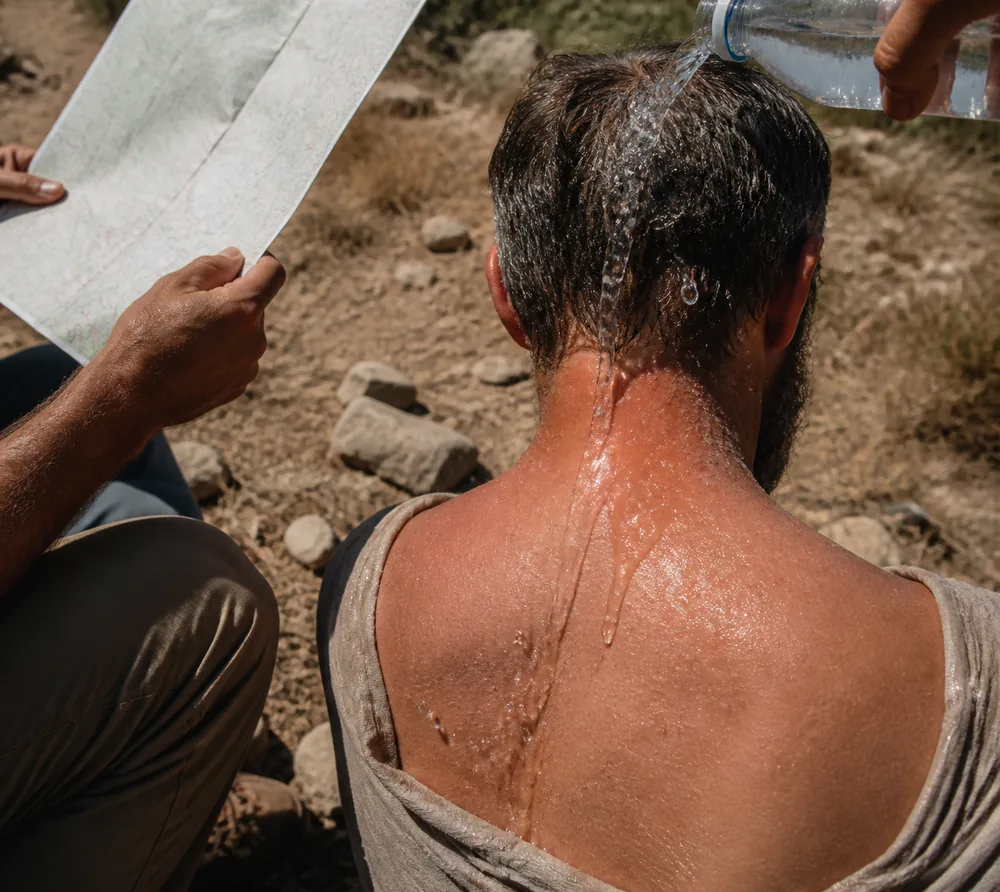
Skip the things that feel productive and are not. Rubbing alcohol, salt tablets on their own, and pushing large volumes of plain water all belong to older advice that has not survived.
When does treating stop and evacuating start?
Give it thirty minutes and expect visible improvement. Someone with straightforward heat exhaustion who is properly cooled and rested should be clearly better inside that window.
Colour returns, the nausea settles, and they start taking part in the conversation again. The improvement should be obvious to everyone standing there rather than something you have to argue for.
If that does not happen, the situation has changed even if nothing looks dramatic. Failure to improve with good cooling is treated as heatstroke, and so is any wobble in mental state at any point, no matter how the episode started.
At that moment the priority order inverts from what most people assume.
Consensus guidance for exertional heatstroke is to cool first and transport second, aiming to bring core temperature under about 104.5F within thirty minutes of collapse. Time spent cooling on the spot is worth more than time spent moving toward help.
So call for help and keep cooling while you wait, rather than stopping the cooling in order to travel. Handing over a cooler patient is worth more than handing over a faster one.
Even a clean recovery ends the day's walking. The standard is several hours of rest after symptoms have fully resolved, and somebody who overheated this morning has no margin left for this afternoon.
Getting them out slowly, in the cool of the evening, is a better plan than proving they are fine.
There is a tail to this as well. Somebody who has had a real heat illness stays more susceptible for several days afterwards, so the next morning is not a clean slate either.
Why a humid 85 degree day beats a dry 95
Sweat only cools you when it evaporates, and evaporation needs somewhere for the moisture to go.
Above roughly 50 percent humidity, that process is badly impaired. Sweat runs off instead of lifting heat away, so the body keeps paying the fluid cost without collecting the benefit.
This is why forecast temperature is a poor risk signal on its own.
Wet bulb globe temperature exists precisely because it combines air temperature, humidity and radiant heat from the sun into one figure. A muggy 85F afternoon can carry more heat stress than a dry 95F one, which is not what the numbers on a phone suggest.
The other half of the risk is the person rather than the day.
Acclimatisation takes 10 to 14 days of progressive exposure, and it decays within about two weeks once that exposure stops. Fitness does not substitute for it, and last summer does not count.
That timing explains a pattern worth knowing. Heat illness clusters in the first days of exposure, which is exactly when people fly into a hot place and start walking.
- Humidity above about 50 percent, where sweating stops doing its job
- The first few days of a hot trip, before any adaptation has happened
- Arriving from a cooler climate with no recent heat exposure
- Two weeks or more away from heat, which undoes previous adaptation
- Starting the day already short of fluid
- A route with full sun and no shade to stop in
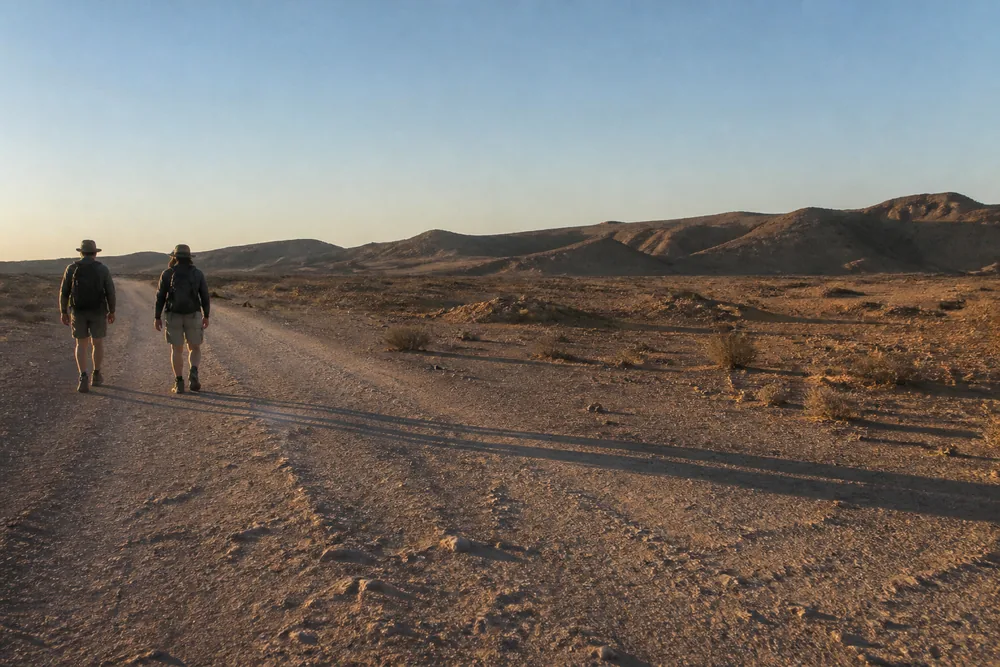
The last item is a planning decision rather than a forecast one. A route with reliable shade every hour is a different proposition from an exposed ridge, on identical weather.
Dehydration compounds all of it. Being short of fluid reduces both sweat production and blood flow to the skin, which degrades the two mechanisms the body has for shedding heat.
Start earlier than feels necessary. Most heat incidents happen in the afternoon on ground that was perfectly comfortable at eight in the morning.
Sources
The role of central nervous system disturbance as the hallmark of exertional heat stroke, and the core temperature threshold above roughly 104F, are set out in StatPearls on heat stroke and the NAEMSP discussion of managing exertional heat stroke.
The finding that there are no published cases of exertional heat stroke without sweating, and that dry skin belongs to classic rather than exertional presentations, comes from a review of common heat illness misconceptions.
Field management of heat exhaustion, including shade, clothing removal, leg elevation, active cooling, sipping fluids and the several-hour rest before resuming activity, follows Mayo Clinic first aid guidance and the American Red Cross heat exhaustion guidance.
Cold water immersion as the gold standard, the cool-first-transport-second principle, the sub-30-minute target, and the 0.15 to 0.35C per minute cooling rate come from the NAEMSP consensus statement on prehospital care of exertional heat stroke.
The effect of humidity on evaporative cooling, and wet bulb globe temperature as a combined measure, are explained by the National Weather Service WBGT guidance. Acclimatisation timelines and the clustering of heat illness in early exposure come from Korey Stringer Institute heat and hydration material.
AnswersQuestions readers ask
How do you tell heat exhaustion from heatstroke?
By mental state. Heat exhaustion leaves someone miserable but oriented, while heatstroke brings confusion, slurred speech or an inability to follow a simple instruction. That is the only test you can actually run in the field.
Does dry skin mean heatstroke?
Not in hikers. There are no published cases of exertional heat stroke in which the person had stopped sweating, and most are found sweating heavily. Dry skin belongs to classic heatstroke in someone static and overheating, not someone who has been moving.
What should you do first for heat exhaustion?
Get them out of the sun, lie them down with the legs raised, strip back clothing, wet the head, neck and torso, and fan them. Give small sips rather than gulps, and keep talking to them so you notice any change in mental state.
What is the fastest way to cool someone in the backcountry?
Immersion in a stream or lake, which lowers core temperature at roughly 0.15 to 0.35C per minute and beats anything else you can improvise. Where that is not available, pour water on head, neck and torso and fan hard to drive evaporation.
How long before you call heat exhaustion an emergency?
About thirty minutes. Someone properly cooled and rested should be clearly better within that window, and failure to improve, or any change in mental state at any point, is treated as heatstroke.
Can you carry on walking after heat exhaustion?
Not that day. The standard is several hours of rest after symptoms fully resolve, and susceptibility stays raised for several days, so a slow exit in the cool of the evening beats proving you are fine.