
Snow Blindness: Sunburn on the Eye You Cannot Feel Coming
The injury finishes hours before it hurts, which is why nobody puts their glasses on in time.
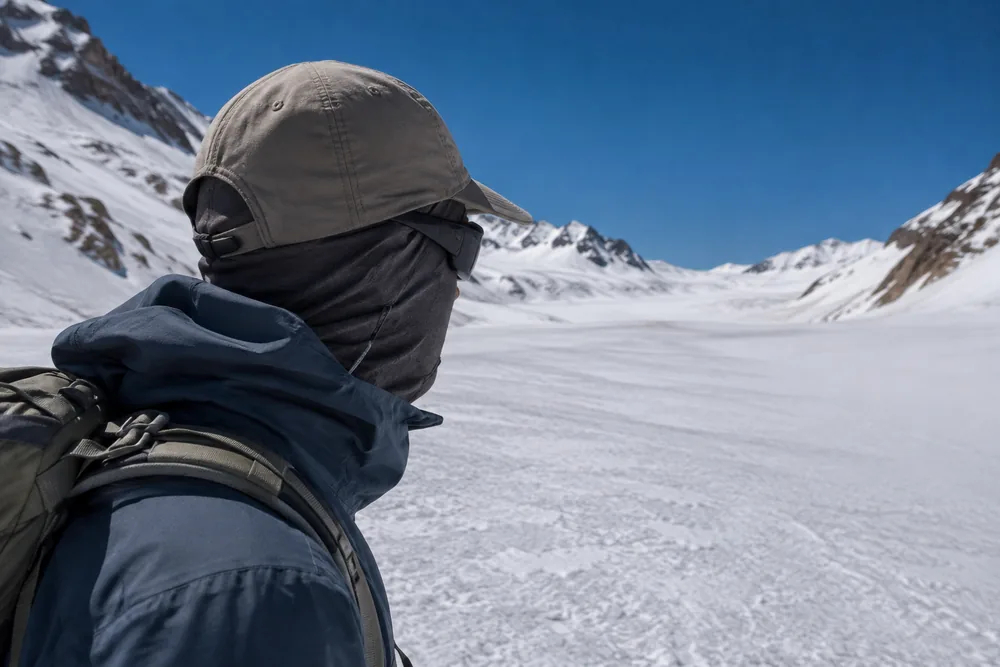
Snow reflects more than 80 percent of the ultraviolet that hits it, and the eye takes that dose from below where no hat brim reaches. The result is sunburn on the cornea that arrives six to twelve hours later, long after the decision that would have prevented it.
You cannot feel this one happening. That is the entire problem with it.
Snow underfoot
The ground stops being a surface and becomes a second light source, throwing ultraviolet back up into your eyes from an angle no hat brim covers.
Altitude
Less atmosphere overhead means more ultraviolet arriving, and the effect compounds with every thousand metres you climb.
Flat overcast light
The dose carries on while the glare that would have made you reach for sunglasses disappears entirely.
Put any two of those together and the day that felt fine ends with you sitting in the dark at nine in the evening.
How does snow blindness actually happen?
It is sunburn. Not like sunburn, not a useful analogy for sunburn, but the same injury on a different surface.
The medical name is photokeratitis, and it means ultraviolet damage to the cornea, which is the clear layer over the front of the eye. Skin and cornea are both exposed living tissue, and both burn.
Once you have that, everything else on this page follows, starting with the delay.
Sunburn on your arms does not hurt at the beach either. The damage completes hours before the pain arrives, and for the eye that gap is typically six to twelve hours.
Which means the day gives you no feedback at all. You walked across a snowfield, felt nothing unusual, ate dinner, and then somewhere around the time you were getting into a sleeping bag it started.
What it feels like is unmistakable once it lands. Severe pain, streaming eyes, an inability to tolerate any light at all, blurred vision, and the specific sensation that both eyes are full of sand.
Headache is common, and so are halos around any light you can bear to look at.
The hard part is that nothing you do at this point undoes anything. The exposure finished hours ago, the injury is already there, and the next section onward is about a day you have not had yet.
The dose comes off the ground, not out of the sky
The reason snow is different from every other bright surface is that it sends most of the light back.
The arithmetic of a snow day
- 80%+Of ultraviolet reflected by snowThe ground becomes a second source, aimed upward at your eyes
- 10-12%More ultraviolet per 1,000 m of altitudeA gain that looks modest on a map compounds all day
- Both at onceA high snowfield or glacierWhich is why glacier travel is the classic setting for this
Fresh snow reflects more than old grey snow, so the figures move with conditions rather than being fixed. The direction of the effect never changes.
The upward component is what makes this its own problem. A hat brim, a hood and the bones of your own face all deal with light arriving from above, and none of them does anything about light coming off the ground.
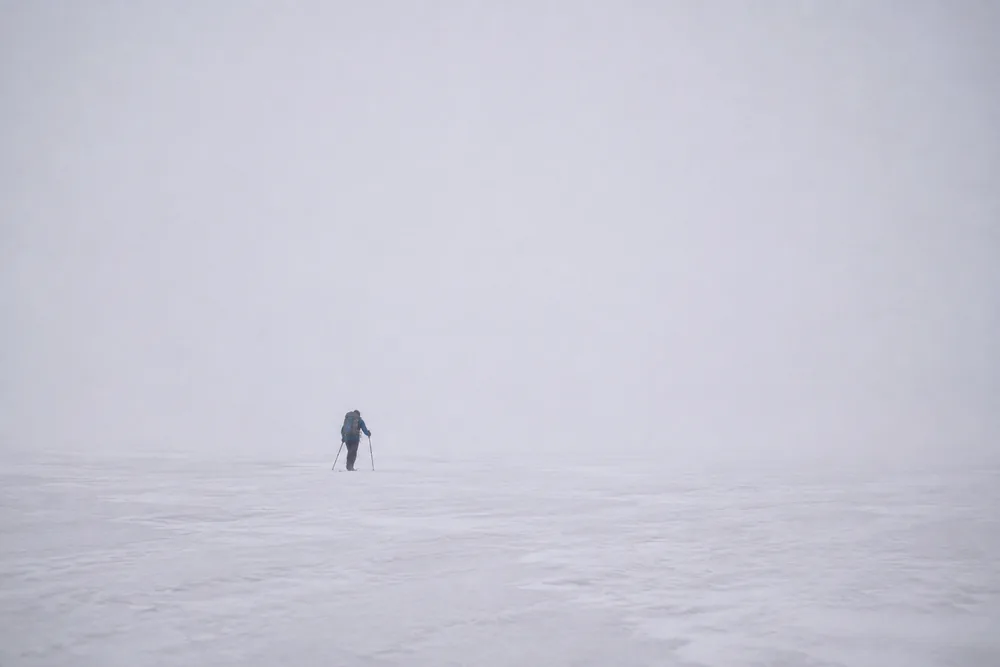
That image is the trap worth naming on its own.
Cloud scatters and passes a great deal of ultraviolet while removing almost all of the visible glare, so an overcast day on snow delivers the dose without producing the squint that would have made anyone reach into a pocket.
It is not only a winter problem either. Water and pale sand reflect strongly enough to matter, which is why the same injury turns up after long days on a boat or a bright beach.
Good sunglasses still fail on a glacier
Picture where the light is coming from and the eyewear question answers itself.
On a snowfield, a large share of the ultraviolet reaching your eyes arrives from below and from the side, having bounced off the ground. An ordinary pair of sunglasses is a lens held in front of your eyes with the space underneath and beside it left open.
Good frames, expensive lenses, correct tint, and a clear path straight to the cornea from underneath.
There is a second failure that runs the other way, and it is worse. A dark lens with no ultraviolet filtering makes your pupils open wider behind it, which lets more ultraviolet in than wearing nothing at all.
Darkness and protection are simply different properties. A tinted lens tells you nothing about its UV filtering, and only the label does.
- Labelled as blocking 100 percent of UVA and UVB
- Wrap-around fit, or solid side shields
- Coverage below the eye, not only in front of it
- A spare pair, or goggles, somewhere in the pack
- Contact lenses do not protect the surface of your eye
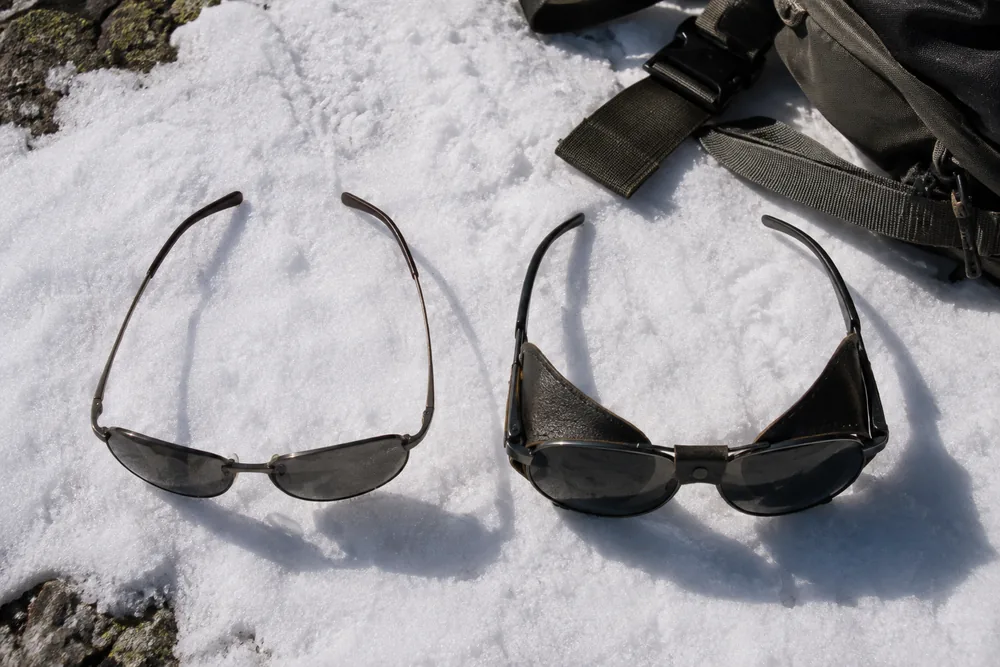
The spare pair earns its weight on any glaciated day.
Losing or breaking your only glasses at the top of a snowfield is not an inconvenience, because you still have to cross the snow to get down, and doing that unprotected is how the injury happens.
Improvised slit goggles, cut from a strip of card or tape, are a genuine emergency measure and a poor one. They work well enough to get somebody off a glacier and are not a plan.
Category 4 is the number to look for on a glacier
There is a printed number for this and almost nobody knows to look for it.
Lenses are graded from category 0 to category 4 by how much visible light they let through. The number is usually stamped on the inside of a temple arm, and it is the closest thing to a specification that eyewear carries.
| Category | Transmits | What it is for |
|---|---|---|
| 2 | Around 18 to 43 percent of light | Ordinary sun, and where most high-street sunglasses sit |
| 3 | Around 8 to 18 percent | Bright sun and ordinary snow, which covers most winter hill days |
| 4 | Under 8 percent | Glaciated ground and high-altitude snow |
| Driving | Category 3 or below | Category 4 is too dark to drive in and illegal for driving in many places |
Category 4 is the glacier rating. If you are going onto a glacier or spending a day high on snow, that is the number you want on the arm, and category 3 is not a near-enough substitute for it.
The driving row catches people out on the way home rather than on the hill.
A pair dark enough for a glacier is dark enough to be genuinely unsafe in a car, which is the practical reason for a second, lighter pair in the door pocket rather than a matter of comfort.
One thing the category does not tell you, and this is where it gets confusing. The number describes visible light transmission and says nothing directly about the ultraviolet filtering, so a lens still needs the separate claim to block 100 percent of UVA and UVB.
You are checking two things on the same pair. How dark it is, which is the category, and what it filters, which is the UV marking, and a lens can be excellent at one and silent about the other.
Children, contact lenses and the people who are not average adults
A child is not a smaller version of this problem. Their eyes take more of it.
The lens inside a young eye is clearer than an adult one and transmits more ultraviolet through to the back, which means the same day on the same snow delivers a larger dose to the child walking beside you.
Fit is the other half of it, and it is the part that gets solved badly. An adult pair perched on a small face gaps everywhere, and the gaps are exactly where the reflected light is coming from, so child-sized eyewear that actually fits beats a better adult pair every time.
Two other groups have a lower threshold than the general case.
Anyone who has had recent eye surgery is more vulnerable and should be taking specific advice rather than general guidance, and people on photosensitising medication burn more readily, which applies at the eye as much as at the skin.
The last group is defined by the ground rather than the person. Water and pale sand reflect strongly enough to produce the same injury, so a long day on a boat or a bright beach is the same exposure with a different backdrop.
If the glasses break, you improvise and you go down
Losing or breaking your only glasses in the middle of a snowfield is worse than it first sounds, because the ground you have to cross to get out is the ground that is doing the damage.
You cannot wait for evening. You have to move, and moving unprotected across bright snow is how the injury happens.
- Cut narrow horizontal slits in whatever you haveStiff card, closed-cell foam from a mat, duct tape folded on itself, even bark. Two slits, a couple of millimetres high, no wider than they need to be.
- Hold or tie them close to the eyeThe gap between the shield and your face is where the light gets in, so close beats comfortable here.
- Pull a hood forward and use a brimFree, immediate, and it removes part of the reflected component before you have cut anything.
- Shorten the exposure rather than continuingThe improvisation reduces the dose and does not remove it, so the remaining lever is time on the snow.
- Rope up or be guided if vision is badly restrictedSay out loud that you cannot see properly, because the party has to travel differently now.
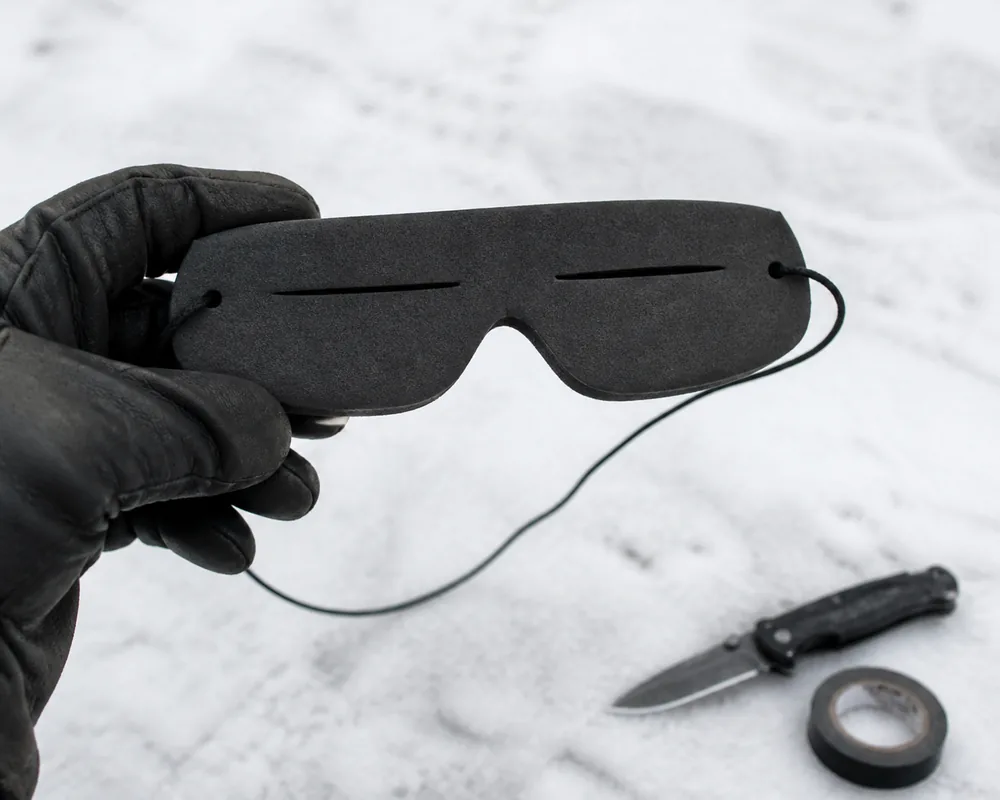
The restricted vision is a real cost rather than an inconvenience, and it is the reason this belongs at the bottom of the page rather than as a substitute for carrying a spare.
Squinting through a two-millimetre slit on crevassed or steep ground introduces a hazard that can easily be worse than the one you are managing. On easy ground it is a nuisance, and on serious ground it changes how the party has to move.
None of it reliably prevents photokeratitis either. It buys you a descent with less damage than none, and that is the whole claim.
Once it has started, you are managing pain rather than damage
Get out of the light and close your eyes.
That is the first and most effective thing available, partly because it stops any continuing exposure and partly because light is what hurts. A tent with the door shut, a hut room with the curtains drawn, or a buff over closed eyes all work.
- Get into darkness with the eyes closedThe only measure that changes anything, and it works immediately on the pain.
- Take contact lenses outLeaving them sitting on a damaged corneal surface is a straightforward way to make this worse and longer.
- Cool compresses over closed lidsA damp cloth, changed as it warms. Comfortable, harmless and genuinely helpful.
- Use artificial tears oftenFrequency matters more than which brand. This is what takes the edge off the grit sensation.
- Take simple oral pain reliefThere is no prize for enduring this, and it hurts properly for the first day.
One instruction is worth isolating because the urge is overwhelming.
Do not rub your eyes. The surface is already abraded, and rubbing a damaged cornea adds injury to something that was going to heal on its own.
Every one of those measures is comfort rather than repair. None of them shortens the injury, and it is worth knowing that so nobody spends the night looking for something that works better.
There is a group problem hiding in this too. Somebody with snow blindness cannot navigate, cannot lead, cannot drive and cannot really look after themselves for a day, which makes it a trip decision rather than a personal misfortune.
How long until you can see properly again?
Most of it is over in a day or two.
- Usual recovery
- 24 to 48 hours
- Severe exposure
- Up to about a week
- Permanent damage
- Not the usual outcome, because the cornea regenerates
- When to be seen
- Worsening pain after 48 hours, discharge, or vision that does not return
The reason for that timeline is the tissue itself. The corneal surface is one of the fastest-healing surfaces in the body, which is why a genuinely alarming injury resolves without leaving anything behind.
Recovery is not linear and the second morning is often better than the first evening by a long way. Vision comes back as the surface closes over.
The name overstates things slightly, which is worth saying to anyone frightened by it. Most people with snow blindness can still perceive light and shapes, and what they cannot do is open their eyes without pain.
A few findings mean it is not behaving normally. Pain that is getting worse after two days, any discharge from the eye, or vision that has not started to return all need looking at by someone qualified rather than waited out.
Sources
The description of photokeratitis as ultraviolet damage to the cornea analogous to sunburn, the symptom picture including pain, watering, light sensitivity and blurred vision, and the management by resting in the dark with artificial tears and cool compresses come from: American Academy of Ophthalmology, photokeratitis and snow blindness.
The figure that snow reflects more than 80 percent of ultraviolet, and that intensity rises 10 to 12 percent per 1,000 metres of altitude, comes from: Global Rescue, protecting your eyes from photokeratitis in high-risk conditions.
The onset window of roughly 6 to 12 hours after exposure, and the recovery timeline of 24 to 48 hours in most cases and up to a week in severe ones, come from: Snow blindness: symptoms, treatment and prevention guide.
The guidance on eyewear blocking 100 percent of UVA and UVB, and on the value of goggles or wrap-around protection in reflective environments, comes from: A guide to snow blindness.
The lens category system, the under 8 percent transmission figure for category 4, and the recommendation of category 4 for glaciated activity come from: Northwest Alpine Guides, glacier glasses information guide.
AnswersQuestions readers ask
What is snow blindness?
Photokeratitis, which is ultraviolet damage to the cornea. It is the same injury as sunburn, on the clear surface at the front of the eye, and like sunburn the damage is done hours before it hurts.
How long after exposure does snow blindness start?
Usually 6 to 12 hours, and sooner under very strong ultraviolet. That delay is why nobody puts glasses on in time: the day gives no feedback at all while the damage is happening.
Can you get snow blindness on a cloudy day?
Yes, and it is a classic way to get it. Cloud passes a great deal of ultraviolet while removing the visible glare that would have made you reach for sunglasses.
Why do ordinary sunglasses not prevent snow blindness?
Because snow reflects more than 80 percent of ultraviolet upward, and an ordinary frame is open below and at the sides. You need 100 percent UVA and UVB protection plus wrap-around coverage or side shields.
What lens category do you need on a glacier?
Category 4, which transmits under 8 percent of visible light. Category 3 covers bright sun and ordinary snow. Category 4 is also too dark to drive in and illegal for driving in many places, so carry a lighter second pair.
What can you do if your sunglasses break on a glacier?
Cut two very narrow horizontal slits in stiff card, closed-cell foam or folded tape and tie them close to your eyes, pull a hood forward, and shorten the time on snow. It buys a descent with less damage, it does not reliably prevent the injury, and the restricted vision is its own hazard.
Are children more at risk of snow blindness?
Yes. A young lens is clearer and transmits more ultraviolet to the back of the eye, so the same day delivers a larger dose. Child-sized eyewear that actually fits beats a better adult pair that gaps at the sides.
How do you treat snow blindness?
Get into darkness with the eyes closed, take contact lenses out, use cool compresses over closed lids, use artificial tears frequently, and take simple pain relief. Do not rub the eyes. None of it speeds healing, it all just makes the night bearable.
How long does snow blindness last?
Most cases resolve in 24 to 48 hours as the corneal surface regenerates, and severe exposures can take up to about a week. Permanent damage is not the usual outcome.