
What Should You Do in the First Hour After Getting Lost?
Protect the last known position, make the stay-or-move decision, and give rescuers a location that stays useful.
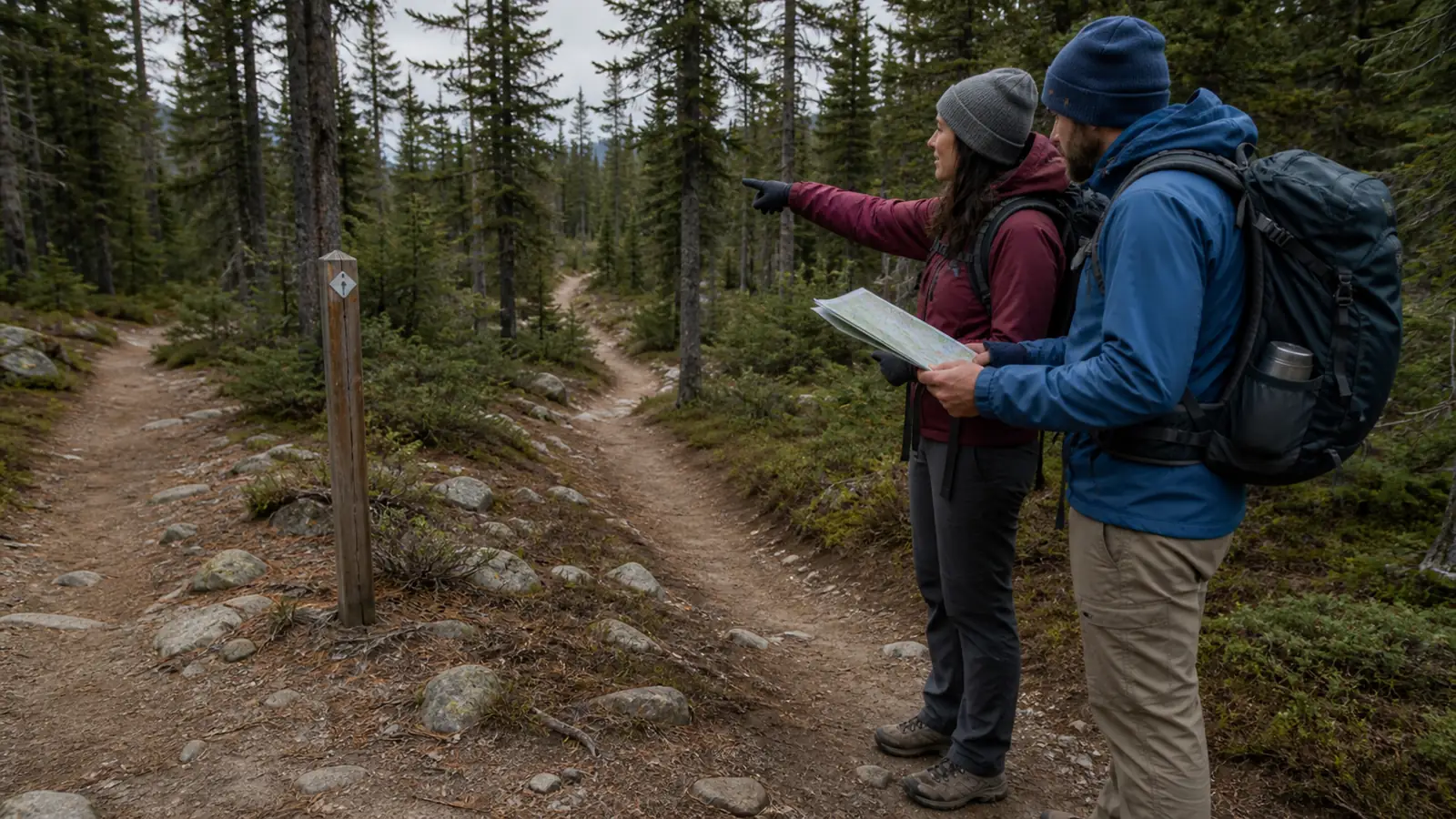
Getting lost becomes harder to solve with every unsupported step. Stop, preserve the current position, and move only when a short safe route has evidence behind it.
Getting lost does not begin when you have no idea where you are. It begins when the trail, time, or terrain stops matching what you expected and you can no longer explain the mismatch.
Stop walking at that point. Keep the group together, mark the position, and decide from evidence whether a short retrace is safe or whether this spot should become the place rescuers look for you.
Your location is now a resource. Every unsupported step spends it by widening the area between the last place you were known to be and wherever you go next.
What should you record before taking another step?
- Save your current coordinates and the time :: Take a screenshot or write them down before battery, weather, or movement changes the record
- Count everyone and check for injury :: Do not create a second lost group by sending one person to scout
- Name the last place you were certain :: Use a junction, bridge, campsite, viewpoint, stream crossing, or other feature you could recognize again
- Reconstruct the gap :: Record direction, elapsed time, slope, recent turns, and the last expected feature that failed to appear
- Check the limits around you :: Daylight, weather, water, insulation, injuries, terrain, and battery can rule out movement before navigation does
Sit down or put your pack on the ground so the decision is deliberate.
A person who keeps walking while checking a phone can add hundreds of metres to the uncertainty without noticing the distance.
Record the coordinates shown by the phone, GPS, or satellite messenger and note which device or app produced them.
A coordinate is useful even when it is imperfect, while a remembered location described later as “somewhere past the ridge” is much harder to search.
Take a screenshot and write the numbers on paper if you can. Add the time, battery level, weather, and whether the position marker appears to be moving while you stand still, since that movement hints that the reading is imprecise.
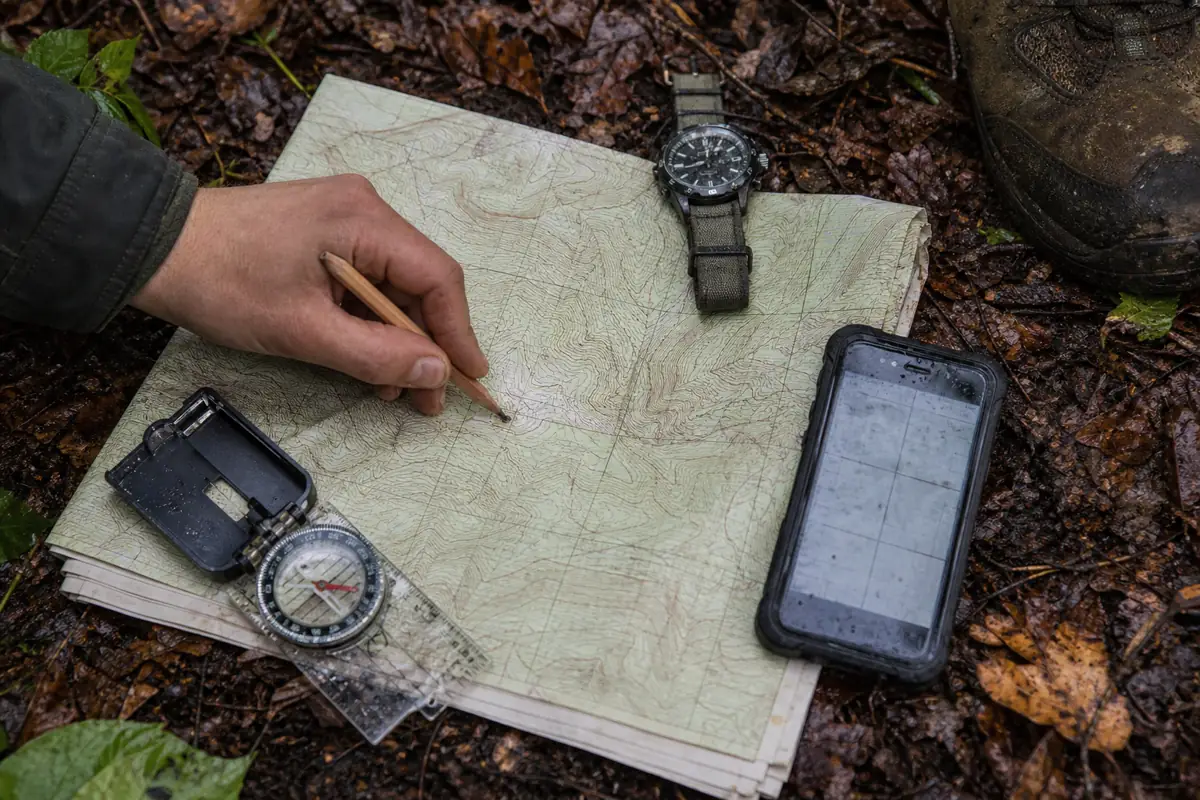
Then work backward as a group. Ask each person for the last place they independently recognized, the last junction, the last time they checked the route, and what terrain should have appeared next.
Agreement matters more than confidence.
One loud person remembering a turn is weaker evidence than two people separately identifying the same bridge or switchback.
Do not let one person walk ahead to “have a quick look.” Scouting without a distance limit, turnaround time, and continuous contact splits the party and gives searchers two moving problems.
Check the body and the sky before the map gets the final say. An injured ankle, an exhausted partner, fading light, incoming rain, a cold wind, or dangerous ground can make a theoretically correct route unsafe to travel.
When is retracing safer than staying put?
Movement earns its place only when you can name the destination, explain why the terrain to it is safe, and define the point where you will reverse. “There should be a road downhill” fails all three tests.
| Choice | Evidence required | Cancel the move when |
|---|---|---|
| Short retrace | The exact route back is visible or unmistakable, the last confirmed point is close, and every person can travel safely | The trail fades, the party disagrees, the return takes longer than expected, or light and weather deteriorate |
| Escape immediate danger | A nearby position clearly removes you from fire, rising water, rockfall, avalanche exposure, lightning exposure, or severe wind and cold | The route crosses a worse hazard or the safer position cannot be seen or described |
| Reach a visible nearby feature | A road, occupied building, broad clearing, or obvious trail is directly visible across safe ground | Reaching it requires steep descent, brush, water crossing, cliffs, or loss of the current location |
| Stay put | Your route is uncertain, help has your coordinates, someone expects your return, or injury, darkness, exhaustion, and terrain make travel risky | The current position develops an immediate hazard that a short move can clearly solve |
Look for continuity rather than a promising direction. Footprints, blazes, or an unbroken trail back to a named point support retracing; a drainage that merely appears to lead somewhere does not.
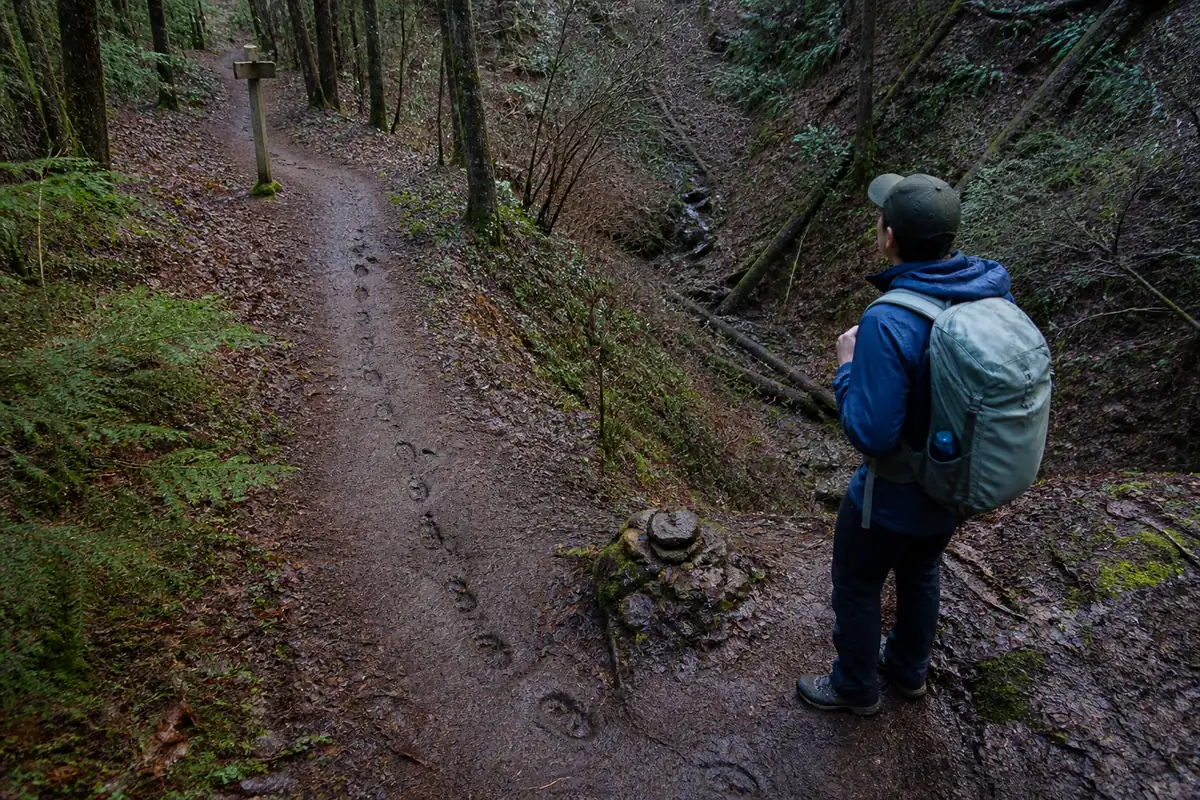
Retrace a short known error
Retracing is reasonable when the mistake is small and still physically traceable.
Examples include returning along an obvious trail to the junction you passed a few minutes ago or following your own clear footprints across safe ground.
Set a short time or distance limit before moving, and leave a visible note or marker at the stop point without damaging the site.
If the known feature does not appear within that limit, return to the marked position rather than extending the guess.
National Park Service guidance allows safe retracing as an attempt at self-rescue. The important words are safe and retrace, because cross-country travel toward where a trail might be is a new route, not a reversal.
Move only out of immediate danger
Staying at the original point is not absolute. Fire, rising water, a crumbling slope, rockfall, an exposed ridge during lightning, or rapidly worsening cold can require a short move to the nearest safer ground.
Keep that movement as small and legible as the hazard allows.
Record the new coordinates, leave the direction and time at the old point if safe, and update emergency services or a contact so the search does not continue around an empty location.
Climbing for phone reception is rarely a good reason by itself. It can exchange a stable position for steeper terrain, more exposure, and a location nobody else knows.
Stay when movement relies on a guess
Stay when you cannot identify a specific destination or a safe line to it.
Stay when it is dark, someone is injured or exhausted, the terrain is technical, or a responsible person knows your planned route and overdue time.
Once rescuers have your position, moving without their instruction is especially costly.
The coordinates they received become stale, tracking teams may follow the old direction, and aircraft may search a place you have left.
Do not treat streams and drainages as automatic roads to civilization. They can narrow into waterfalls, cliffs, deep brush, cold crossings, and canyons where movement and detection both become harder.
A useful rescue message describes both place and plan
Contact local emergency services when the group cannot return safely, when injury or exposure is developing, or when delay will make the exit dangerous. Lead with the emergency and location before explaining how the wrong turn happened.
- State that you are lost and give the coordinatesName the coordinate source or app and describe nearby terrain or landmarks
- Give the last confirmed place and planned routeInclude the trailhead, intended destination, direction of travel, and the last feature everyone recognized
- Describe the people and current risksReport group size, ages when relevant, injuries, clothing colors, shelter, water, weather, and terrain hazards
- State the movement planSay that you will stay at the reported position or explain the immediate hazard forcing a short move
- Repeat instructions backConfirm whether rescuers want the phone on, scheduled check-ins, signals, or no further movement
- Preserve communication powerDim the screen, close unnecessary apps, keep the device warm and dry, and use airplane mode only if it does not conflict with responder instructions
Coordinates need context because device accuracy varies.
A message such as “two adults, one injured knee, 42 percent phone battery, stopped in dense conifers about twenty minutes beyond the last signed junction” gives responders more to work with than a pin alone.
If an emergency call will not connect, try the other communication method you already carry.
A two-way satellite messenger can send the situation and receive instructions, while a registered 406 MHz personal locator beacon sends a distress alert and location but does not provide the same conversation.
Follow the device instructions. NOAA states that a 406 MHz beacon is for grave and imminent danger, and once activated it should remain positioned as directed rather than being repeatedly tested or switched on and off.
Tell responders before any necessary movement. If communication drops, leave a durable note at the reported point with names, date, time, direction, intended destination, reason for moving, and the conditions that would make you return.
How do you make a fixed location easier to find?
A comfortable spot hidden under dense trees may be difficult to see, while the middle of an open ridge may be unsafe in wind or lightning.
Choose the closest place that improves visibility without sacrificing shelter or crossing hazardous ground. Better sightlines help only when the group can remain there safely.
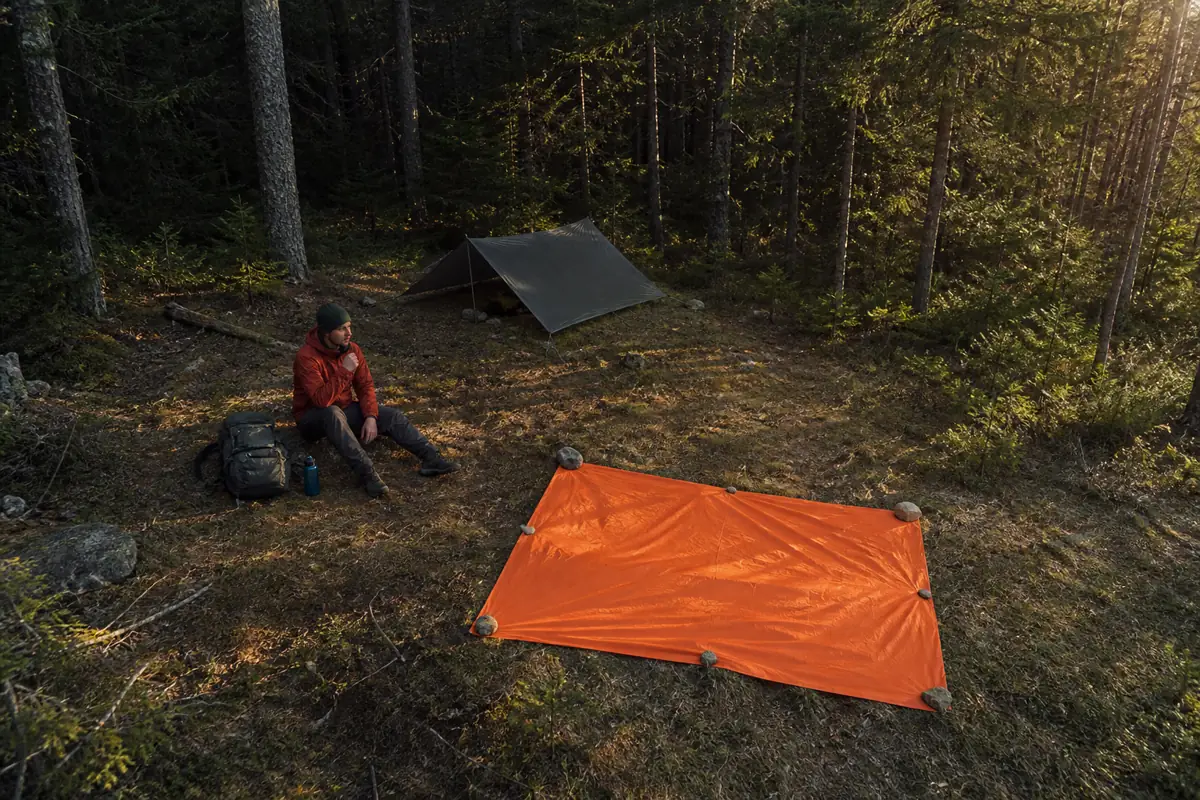
Spread the brightest clothing, rain cover, sleeping pad, or emergency blanket where it contrasts with the ground and canopy. Secure it so wind does not carry away equipment that you need for insulation.
Use three whistle blasts, three shouts, or three flashes, then pause and listen. The U.S. Forest Service teaches groups of three as a distress pattern, but local conventions vary and any regular repeated signal is more recognizable than random noise.
A whistle usually carries farther per breath than shouting and saves your voice. Signal at intervals, after hearing people or aircraft, and during quieter periods when sound carries, instead of blowing continuously until you are exhausted.
At night, a headlamp can sweep toward an aircraft or ground team without leaving shelter. Avoid shining a powerful light continuously into a pilot's line of sight.
After signaling, listen. Search teams may call, whistle, use sirens, or approach from a direction you did not expect, and constant noise can cover the reply.
Prepare to wait longer than you expect
Search and rescue can take hours or days, depending on terrain, weather, distance, and available teams.
Build the waiting plan around the environmental threat likely to hurt someone first.
- NowMove only as far as needed to leave immediate exposure, treat injuries, put on dry insulation, and get off cold or wet groundThe group stops losing heat, water, and useful daylight while the position remains stable
- Before dark or worsening weatherImprove the simplest shelter you can manage, secure bright signals, organize water, and place the headlamp and whistle within reachEssential work finishes before visibility and dexterity decline
- At planned communication checksSend condition or weather changes and receive instructions, then return the device to a protected low-power stateResponders keep current information without needless battery drain
- Whenever conditions changeReassess cold, heat, rain, injury, water, slope stability, falling branches, and rising streamsA small safety move can happen before the waiting site becomes dangerous
- Before unavoidable movementRecord time, direction, destination, reason, and return rule at the old position and transmit the same update if possibleSearchers can connect the old point to a deliberate route instead of an unexplained disappearance
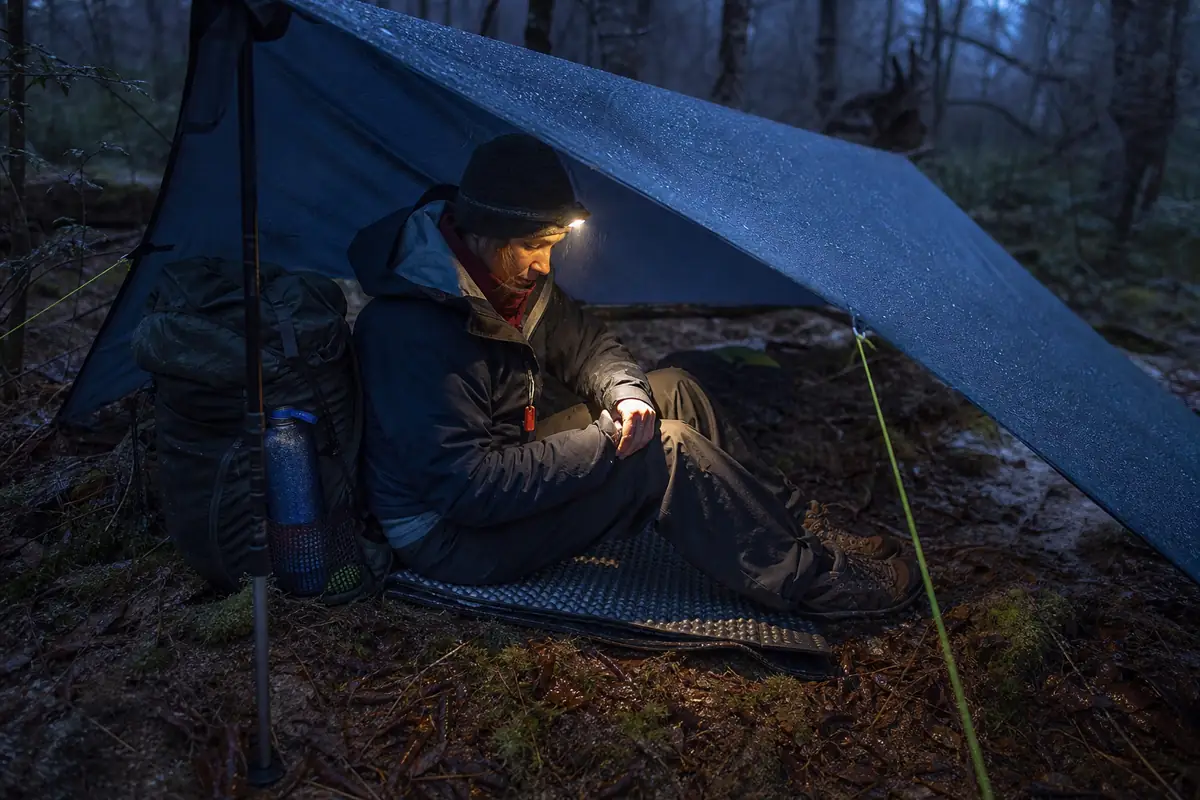
To slow hypothermia in cold or wet conditions, block wind, replace wet layers when possible, and insulate underneath as well as overhead. A pack, sit pad, spare clothing, or dry vegetation contained in a groundsheet can reduce direct heat loss to the ground.
In heat, seek shade and airflow, reduce exertion, and guard against dehydration instead of turning a signaling effort into more heat exposure.
Treat injuries early because pain, swelling, and reduced mobility can make a later safety move impossible.
Use known safe water first and follow the treatment method you carry for uncertain sources.
Do not spend the first useful hours roaming for food, since exposure, injury, water, and findability usually change the immediate outcome sooner.
Keep a simple log of time, weather, physical condition, signals heard or made, and communications. It prevents repeated debates and gives rescuers a clear account if the situation changes.
What if nobody knows your route?
The case for staying is strongest when someone expects you and knows where the search should begin. If nobody has your route, no message or beacon went out, and the current site will become unsafe when supplies or weather change, indefinite waiting may eventually carry its own risk.
That does not make wandering useful. Deliberate self-rescue still needs a specific reachable destination, safe terrain, enough daylight and physical capacity, a way to hold direction, and a written trace from the old position.
Prefer a known trail, road, building, or other confirmed feature over a guessed direction toward water or a town. Stop the attempt when the terrain, time, or observations stop matching the plan, and return to the marked point while that route remains reversible.
If injury, darkness, exhaustion, worsening weather, cliffs, floodwater, or dense terrain defeats those conditions, the safer job remains shelter and signaling. A difficult wait is still more searchable than an unknown route made from hope.
Sources
The stop, locate, safe-retrace, call, stay-put, shelter, and warmth sequence follows the U.S. National Park Service Outdoor Emergency Plan.
Conditions that favor staying put, including darkness, injury, and exhaustion, and the warning against aimless travel come from the U.S. Forest Service outdoor recreation safety guidance.
The group-of-three distress pattern is documented by the U.S. Forest Service in its Raccoon Hollow Trailhead safety guidance.
The function and limitations of 406 MHz personal locator beacons follow NOAA SARSAT guidance on emergency distress beacons and beacon use.
AnswersQuestions readers ask
What should you do first when you realize you are lost?
Stop walking, keep the group together, mark your coordinates and time, and identify the last place you were certain of your route. Check daylight, weather, injuries, water, insulation and battery before deciding whether any movement is safe.
Is it better to stay put or retrace your steps?
Retrace only when the exact route back is visible or unmistakable, the last confirmed point is close, and the whole group can travel safely. Stay put when the route is uncertain, help has your coordinates, someone expects you, or darkness, injury, exhaustion and terrain make travel risky.
Should you follow a stream downhill when lost?
No, not as a default. Drainages can lead into waterfalls, cliffs, deep brush, cold crossings and canyons. Move only toward a specific known feature over safe terrain with a reversal point, not because downhill feels likely to reach civilization.
What should you tell rescuers when you are lost?
Give current coordinates and their source, the last confirmed place, planned route, group size, injuries, clothing colors, shelter, water, weather, terrain hazards and whether you will stay or must move. Tell responders before your location changes.
How can a lost hiker make a waiting place easier to find?
Choose the nearest safe opening, spread bright material where it contrasts with the ground, and use repeated whistle, light or voice signals followed by quiet listening. Stay close to shelter and the position reported to rescuers.
What if nobody knows your route and no search is likely?
Indefinite waiting may eventually become unsafe, but movement still needs a known reachable destination, safe terrain, daylight, physical capacity and a reliable direction. Leave a written time, direction, destination and return rule at the old position before any unavoidable move.