
Common Backpacking Mistakes That Remove Your Exit Margin
Trace late camp, water, pack, foot, and wet-gear failures back to the first decision that removed the group's margin.
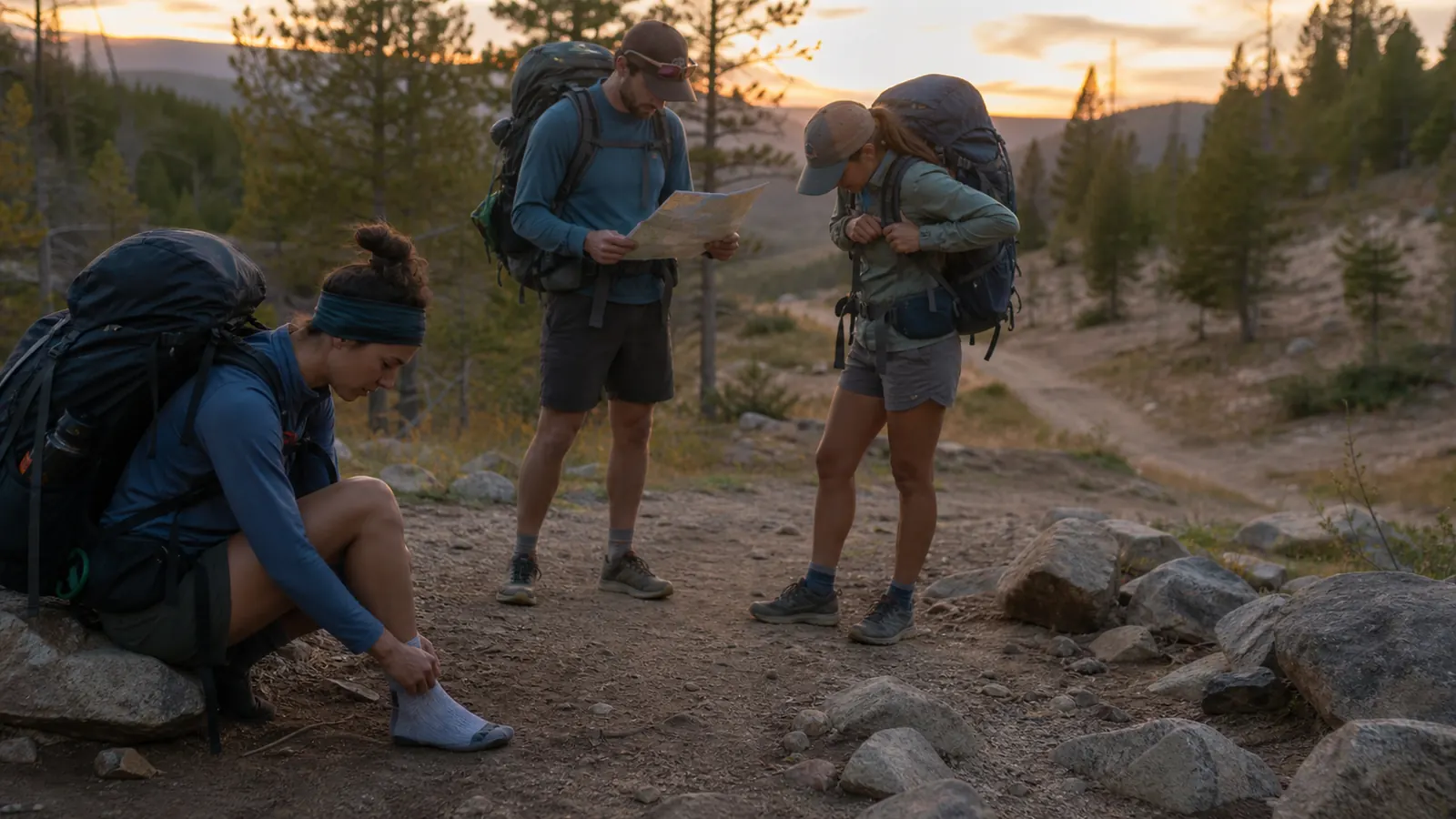
You can usually trace a backpacking problem to a decision made before the symptom appeared. An unverified source becomes a water shortage, a fast first hour becomes a dark camp, and a postponed hot spot becomes a painful walk-out, so the useful correction starts at the first weak link.
Plan
An unverified camp, water source, forecast, access point, or transport deadline enters the route.
Load
Fit, balance, access, or a critical overnight function fails before total weight becomes the issue.
Move
Early pace, long stops, and postponed corrections consume evening margin.
Camp
Shelter, warmth, water, feet, food, and storage are attempted without an order.
Recover
Wet insulation, damaged skin, poor food intake, or lost sleep removes the second day.
Decide
The group follows the original itinerary after its assumptions have failed.
A visible failure is often the end of a longer chain. The cold dinner at 9 at night may have begun with an unrealistic start, a fast first hour, one missed water stop, and a pack that required a full unload for every layer.
Trace the first lost margin. Repairing the introduction point prevents more trouble than managing only the final symptom.
Backpacking mistakes arrive in chains, not alone
When a problem appears, you should start with the outcome and work backward. Ask what happened immediately before it, which choice made that step likely, and when the group still had a cheap alternative.
A late camp is not one mistake. A weak first backpacking plan can combine a late trailhead, poor pack access, uncertain navigation, and missing water time.
The same interaction happens with cold.
A failed rainy backpacking system can combine wet layers, slow shelter setup, too little food, and wind. Winter sleep failures can begin with ground insulation or damp layers long before the sleeping bag feels inadequate.
You should look for the first lost margin rather than the person to blame. Backpacking systems are shared, and a useful review changes the plan, equipment, timing, or group routine.
Name the early signal. It may be falling behind the planned decision point, passing a source with too little water, opening the dry core in rain, ignoring a hot spot, or losing confidence in location.
Name the last cheap correction too. Filling water, stopping for feet, adding a layer, choosing the nearer camp, or turning around can feel inconvenient before it becomes obviously necessary.
You can use the chain during the trip, not only afterward.
When one assumption fails, pause and check the next systems it supports before continuing as if the rest of the itinerary remains unchanged. A multi-day trekking mistake review becomes even more useful because a weak decision can survive into another morning.
One failure changes others. A missed hour can alter water, weather, camp, food, and exit choices at the same time.
Most mistakes trace back to something never tested
A map shows potential route features, not current proof. A blue line may be dry, a campsite may require a permit, a road may close, and a shuttle may stop before the group's conservative return.
Mark uncertain facts while planning. Hiding them inside confident language makes it harder to choose a backup or notice when new information changes the route.
Assign every unknown to a person and a deadline. One person checks water, another verifies permits or access, and the group holds departure if an answer remains unresolved when transport or cancellation becomes costly.
Water deserves current support. Old reports can reveal where people once collected, but source flow, access, treatment conditions, and local advisories may differ now.
Camp legality and food-storage rules change what the group carries and where it can stop. A route-based packing list must include the required container before dusk.
Forecasts are not guarantees, yet they should change exposure, clothing, water, start time, and turnaround decisions. Check the broader seasonal hazard as well as the departure forecast.
| Untested assumption | Field symptom | Earliest useful repair |
|---|---|---|
| Water will be flowing | Bottles are low at the last source | Verify current reports and carry for a dry alternative |
| The campsite is open | Group reaches a closed or illegal area | Confirm official rules before mileage is chosen |
| Loaded pace matches day-hike pace | Camp hours disappear | Measure pace with the complete load |
| The road or shuttle will work | Exit has no transport | Verify access and carry a backup return plan |
| Weather will stay mild | Exposure exceeds clothing or shelter | Lower the route ceiling from the forecast and seasonal range |
| Phone service will continue | Map, permit, or contact becomes unavailable | Store offline information and share the trip plan |
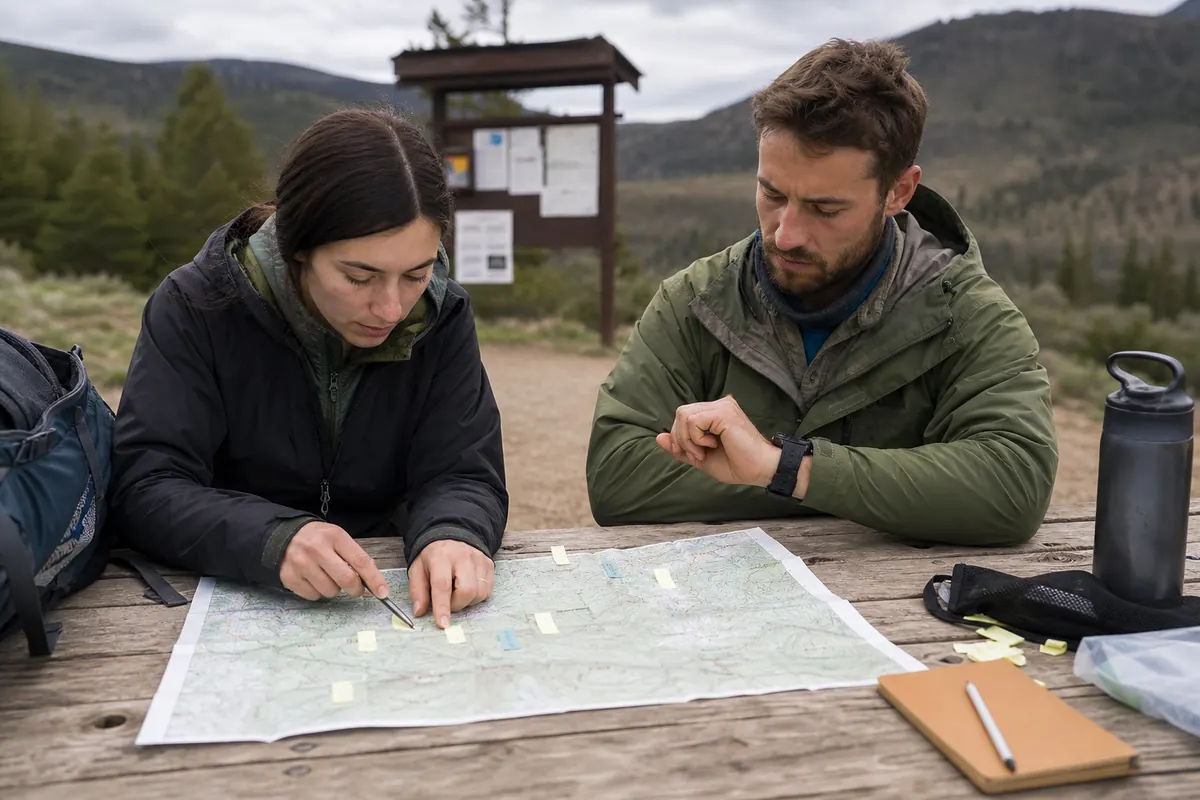
Pace is another assumption. A loaded backpacking baseline often takes longer than the same distance with a daypack.
Group ability should be measured by the least experienced loaded traveler, not averaged. A plan that requires someone to hurry removes attention from footing, food, water, and compass navigation.
During planning, you should ask what happens when two assumptions fail together.
A dry source can be manageable with daylight, while a dry source reached after the turnaround deadline may require an immediate exit. Backups should meet at the same decision point rather than exist as unrelated notes.
You need to recheck changing facts near departure. A correct answer during early planning can still become wrong after a closure, storm, dry period, fire restriction, or transport change.
Label what is unknown. An honest gap can produce a backup, while a hidden assumption enters the trip as false certainty.
Can a light backpack still be packed badly?
Total weight cannot show whether the pack fits, pulls backward, shifts sideways, leaks, or buries time-sensitive equipment. A lighter number can still produce poor movement.
Fit the actual loaded pack and walk long enough for pressure to appear. The backpack fitting sequence should correct slipping, numbness, restricted breathing, and forward lean.
Balance dense items close to the back and stabilize them. A heavy bottle on one side or food far behind the body can alter foot placement on uneven ground.
- Hipbelt carries load without slipping or sharp pressure.
- Shoulder straps guide rather than suspend the whole pack.
- Dense items stay close, centered, and unable to shift.
- Water weight is balanced and reachable.
- Rain shell, food, map, light, and foot care do not require a full unload.
- Sleep insulation remains sealed away from wet equipment.
- Every critical system is present despite the low total weight.
- Normal stride survives at least one realistic practice walk.
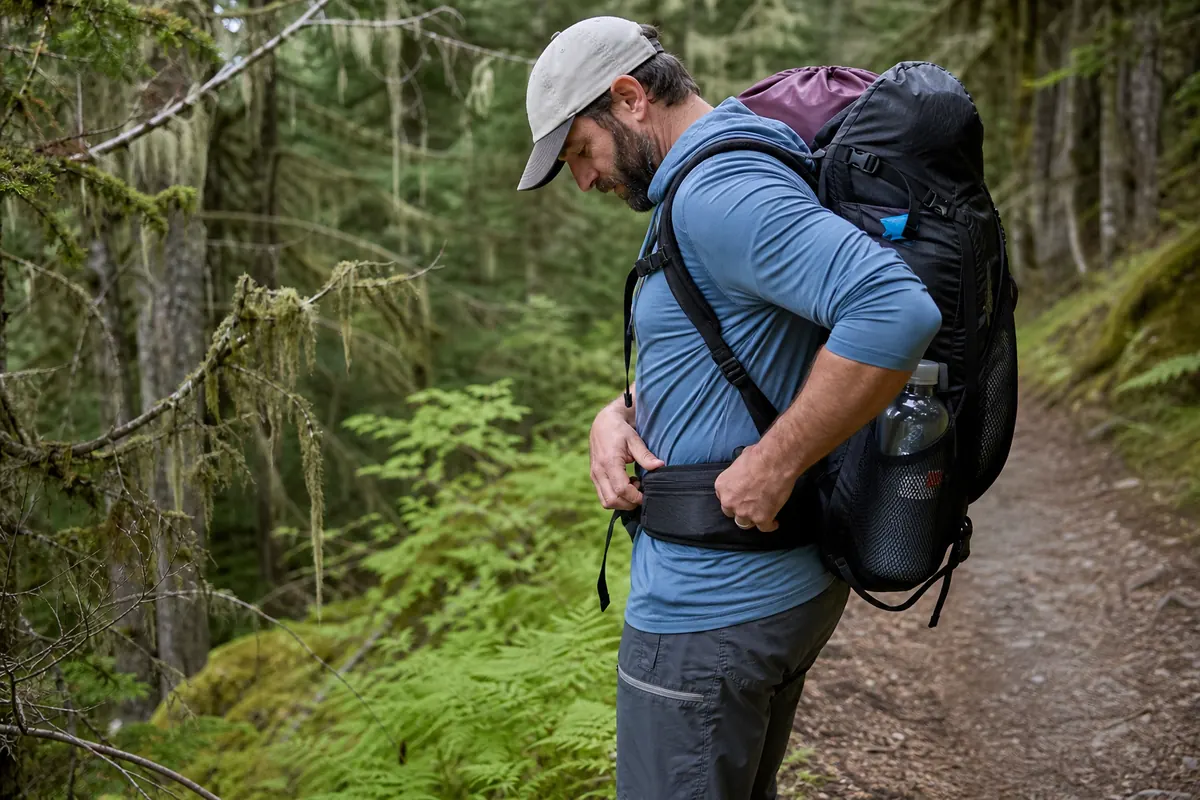
Access is part of packing. If every food, layer, map check, or foot response requires opening the dry core, the pack creates delay and weather exposure throughout the day.
Do not remove a critical function just to meet a percentage target. Shelter, water treatment, navigation, light, first aid, repair, warmth, and required storage need coverage before the number can be judged.
A shakedown should include camp use and repacking. Some equipment fits neatly at home but expands, becomes wet, or no longer returns to its original package after use.
You should notice whether one correction creates another problem. Moving water forward may improve balance but block ventilation, while putting a shell outside may improve access but expose it to loss.
Retest the complete relationship rather than declaring one symptom fixed.
Test behavior, not the scale. A useful load preserves gait, balance, access, dryness, and every route-critical function.
When does a fast start steal the evening?
The final hour before camp often reveals the first hour's mistake. An early pace that cannot be held creates longer rests, greater foot friction, uneven group spacing, and poorer decisions later.
You should start at a pace that allows conversation and observation. Banking distance before fatigue often costs more time during camp setup.
Breaks also need purpose. Stop for water, food, layers, feet, and navigation, then leave before the group cools or a short pause turns into an unplanned meal spread.
Poor access adds hidden minutes. Repeatedly unloading the pack for a shell or snack makes the group reluctant to respond early, so both the delay and the physical problem grow.
- Early warning
- Pace separates the group or changes normal breathing for long periods
- Time leak
- Every short need becomes a full-pack stop
- Foot signal
- Heat, rubbing, or nail pressure appears before the midpoint
- Schedule signal
- The group reaches a named point outside its planned range
- Camp consequence
- Water and shelter work move into darkness
- Correction
- Slow, shorten, or use the planned decision point before evening margin disappears
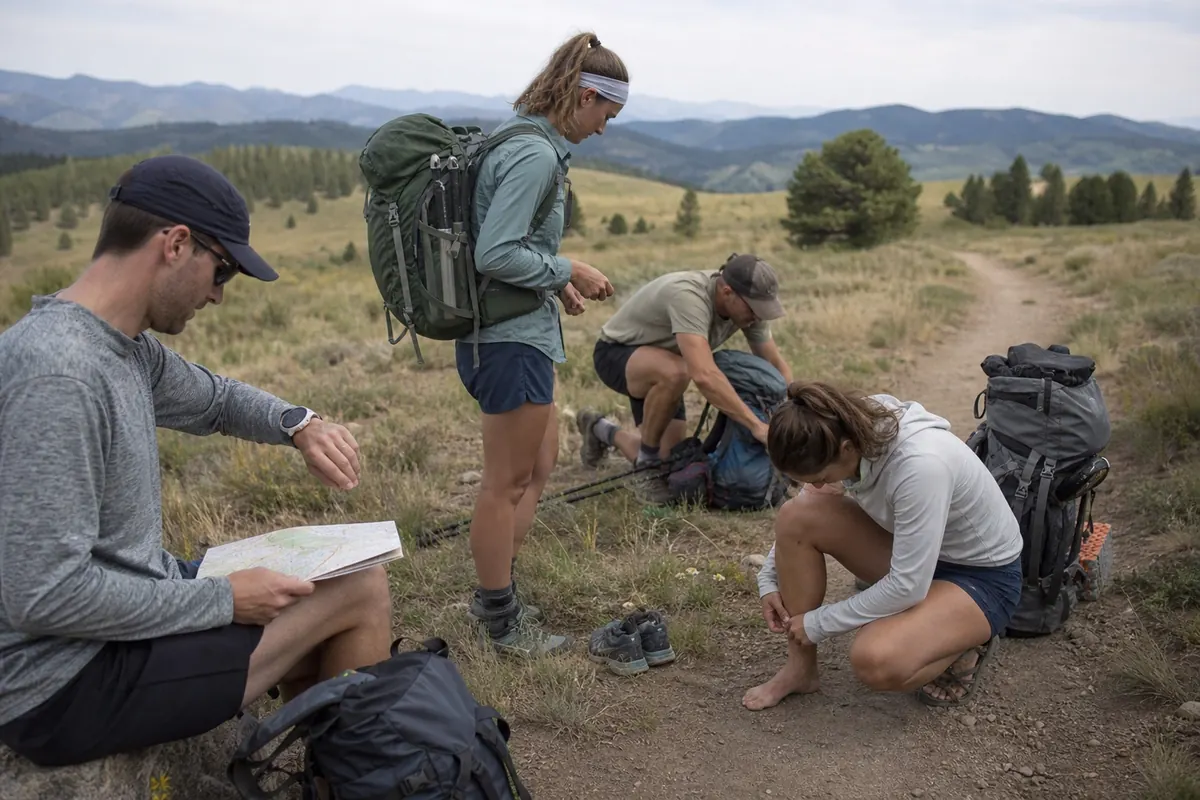
Track actual progress at meaningful points rather than chasing a constant speed. A steep climb, water collection, muddy tread, or a cautious descent can deserve more time than map distance suggests.
The slowest person's steady pace should control the group, with everyone regrouping at junctions. Separation turns normal navigation and communication into another mistake chain.
If the planned camp-ready time is slipping, shorten while a legal alternative or easy exit remains. Arriving late and then rushing water, site choice, food, or storage does not recover the lost margin.
The group should say the delay aloud when it first appears. Silence encourages each person to assume someone else still believes the plan is on time, and the correction arrives later than the evidence.
Reset the next checkpoint after slowing. A pace correction without a new camp or turnaround estimate can improve comfort while leaving the same dark arrival untouched.
You should write the revised time where everyone can confirm it.
Protect the evening early. The pace that reaches camp with attention is faster for the whole overnight system than a hard start followed by a rushed night.
Why do water mistakes begin before thirst?
The first water mistake is often passing a credible source with too little capacity for the next segment. Thirst appears later, after the cheap correction is behind the group.
Verify the last reliable source before camp and the first one after it. The backpacking water calculation includes cooking, overnight, breakfast, and treatment losses.
Clear water may still contain germs. Treat uncertain natural water and keep the dirty side of collection and filtration away from clean bottle openings.
Filters can clog, freeze, crack, or become contaminated. Chemical backup requires correct dosing and contact time, so carry and practice an option that still works after the likely primary failure.
Do not wait until bottles are empty to collect. Treatment time, poor access, a slow group, or weak flow can turn a quick map symbol into a long stop.
- Confirm the segmentIdentify the last supported source, camp demand, and next source.
- Fill before commitmentLeave the source with capacity for the whole unsupported interval.
- Separate dirty and cleanUse marked containers and a repeated handling routine.
- Treat correctlyFollow the method's limits, contact time, maintenance, and temperature guidance.
- Protect the backupKeep it independent from the part most likely to fail.
- Recount at a decision pointCompare safe water, distance, heat, and group pace.
- Change the routeExit or use the dry alternative before rationing becomes the plan.
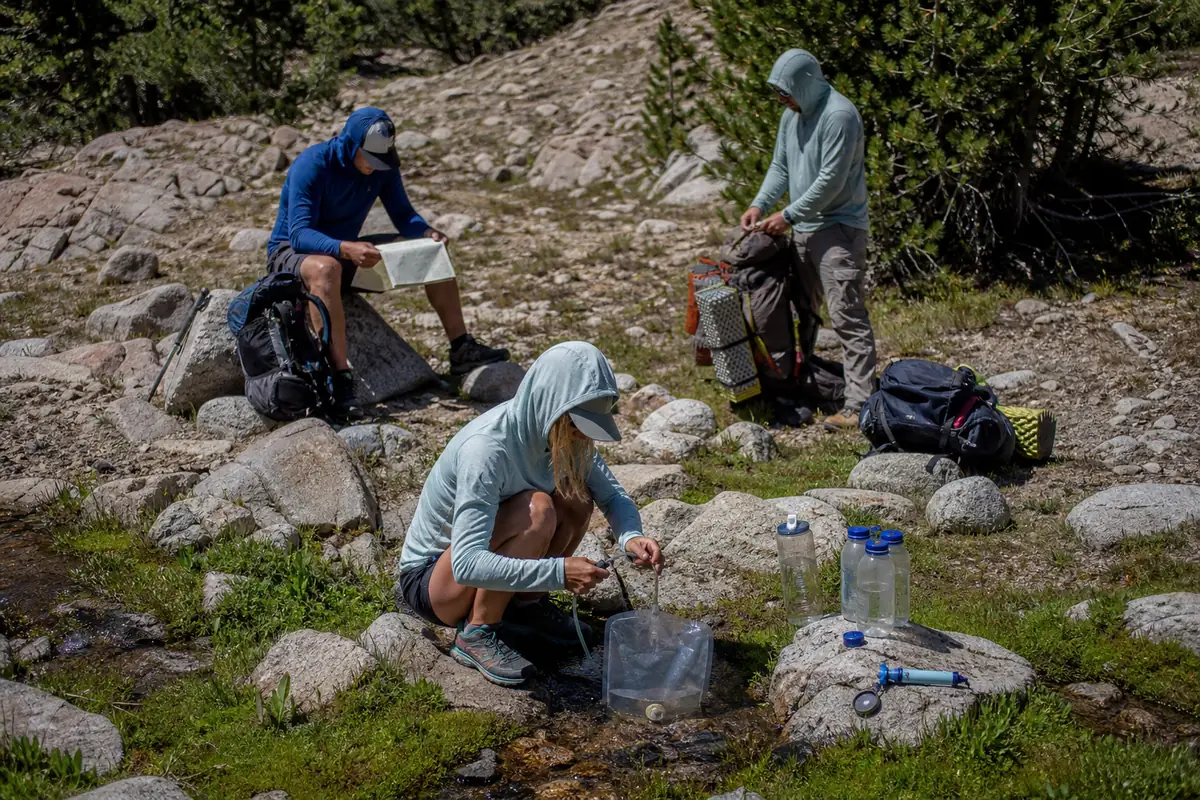
Rationing can reduce drinking while the body is still losing water through effort and heat. When the plan lacks capacity, change the route rather than treating insufficient water as a discipline problem.
Group water should remain visible to the group. A shared total spread across several packs can look adequate until one person walks ahead, one container leaks, or the stove water is used without anyone updating the remaining amount.
Meal choices can deepen the gap. A dry camp dinner and breakfast may consume a large share of the water that looked adequate for walking alone.
You need to watch for leaks and poor access. A bladder can empty inside the pack, while a bottle that is hard to reach may discourage regular drinking and hide the remaining amount.
Fill before the gap. Water problems are cheapest to correct while a credible source and a route alternative are still present.
Camp mistakes land when attention is already spent
Every open bag at dusk is a sign that camp has no order. Equipment spreads, dry layers touch wet ground, small parts disappear, and food remains unsecured while the group decides what to do next.
Pause before unpacking. Confirm that the site is legal, durable, outside drainage, away from obvious overhead hazards, and suitable for the expected weather.
Shelter leads when weather threatens. In stable conditions, urgent water may come first when the source requires daylight or a longer trip.
You should add the needed dry or warm layer before the body cools during slow work. Damp movement clothing can become a problem once heat production falls.
- Confirm the legal site, drainage, overhead hazards, and weather exposure.
- Build shelter or collect urgent water while light remains.
- Protect the dry sleep core from wet ground and open packs.
- Change or add layers before shivering begins.
- Treat enough water for dinner, overnight, and morning.
- Inspect and dry feet before skin damage grows.
- Cook a familiar meal before appetite disappears.
- Secure food, trash, toiletries, and every scented item.
- Stage headlamp, morning clothing, map, and first food.
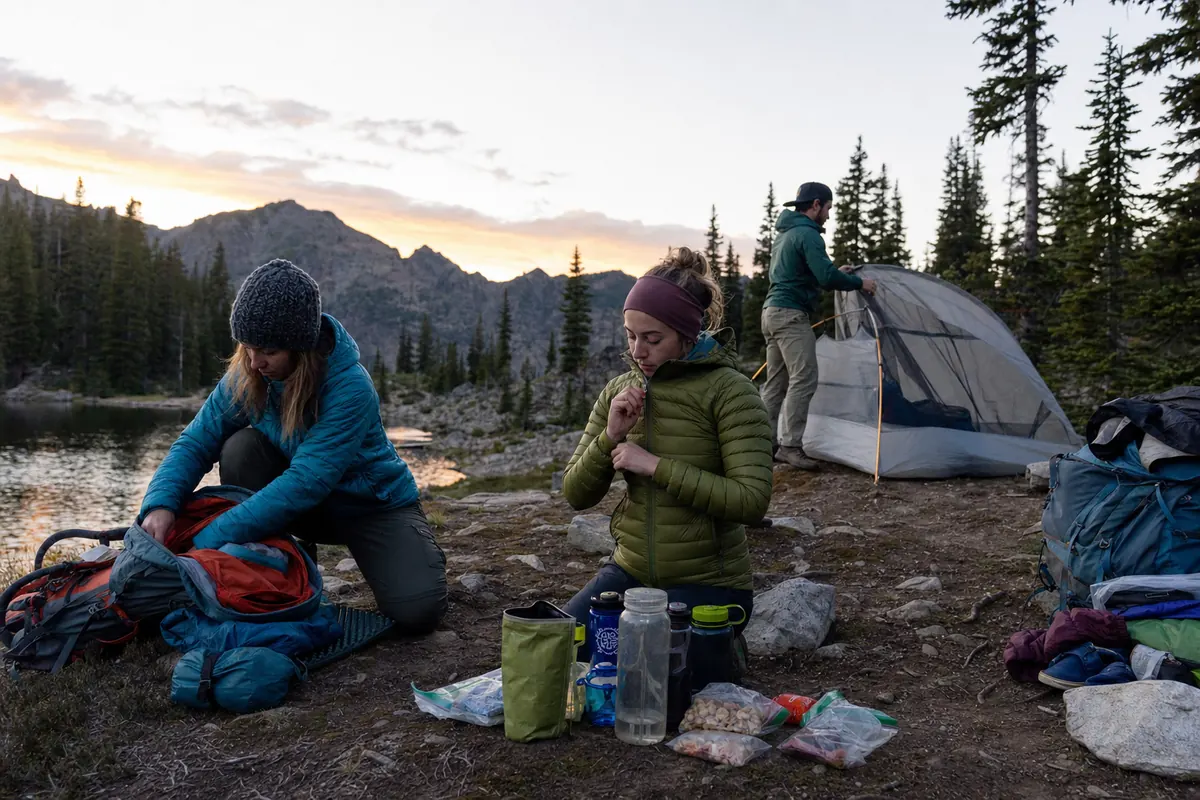
Keep one clear working area rather than spreading the load across the whole site. When a task finishes, close or contain its equipment before the next system opens.
You should inspect your feet while there is time to dry and protect them. A beginner camp routine should protect that task before darkness.
Choose a meal already tested with the stove, pot, water, fuel, and appetite expected after effort. An elaborate first use at camp adds time and uncertainty when both are scarce.
Finish food storage before sleep. Wrappers, toothpaste, drink mixes, cooking residue, and trash belong under the same current local rule as dinner.
Camp needs an order. Protect the night first, then add comfort after shelter, warmth, water, feet, food, and storage are stable.
How do wet insulation and ignored feet affect tomorrow?
Sleep insulation and foot skin fail quietly. One absorbs moisture inside the pack, while the other softens, rubs, or develops a hot spot under damp socks.
Seal sleeping insulation and dry clothing inside a dependable liner. A pack cover can reduce direct rain but cannot protect against every opening, wet item, seam, or puddle.
Keep wet shelter, rainwear, filter parts, and damp clothing outside the dry core. One convenient shove into the main bag can contaminate the only warm recovery system.
You need to stop at the first hot spot. Clean and dry the area, adjust socks or lacing, apply the practiced protection, and reassess whether footwear or pace is still appropriate.
Damp skin becomes more vulnerable to friction. At camp, remove wet socks, inspect between toes and around nails, allow skin and footwear to air where conditions permit, and keep a dry sleep pair protected.
Persistent shivering, fumbling hands, confusion, slurred speech, or drowsiness are hypothermia warning signs that require shelter, warmth, urgent reassessment, and appropriate medical help.
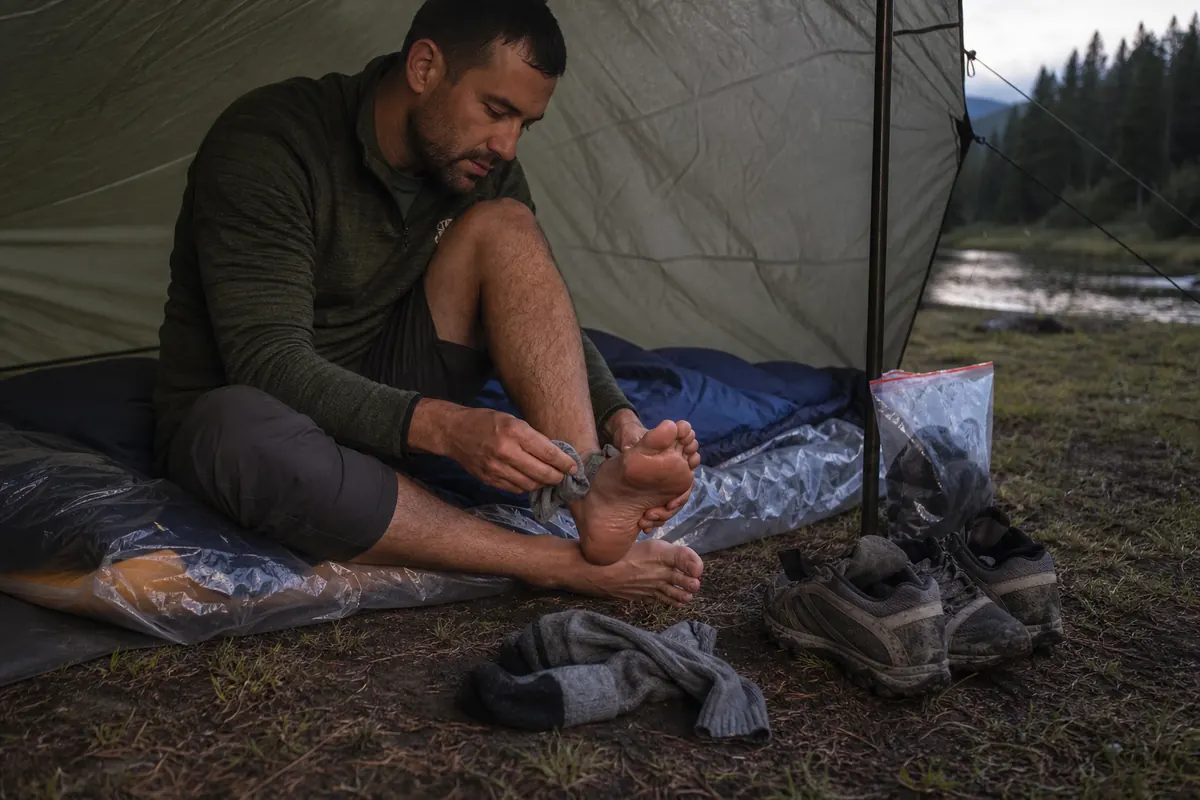
You should check your morning gait without the full pack. Sharp pain, swelling, open skin, numbness, or compensation deserves a shorter plan and may require appropriate medical care.
Do not normalize wet or painful sleep as the price of an overnight. A failed night should change shelter, site, moisture protection, footwear, route conditions, or the decision to continue.
Tomorrow begins tonight. The dry core and healthy feet are not comfort extras because they determine whether the group can move and decide normally after waking.
What should change after a backpacking mistake?
You should record facts before memory turns the trip into a simple success or failure. A multi-day review should also note which small failure survived into day two.
Your review should trace the problem to its first introduction.
A late camp may require an earlier start or shorter route, not a faster walking goal. A winter sleep failure may begin with the pad or damp layers, not only the bag.
Separate controllable decisions from changing conditions. Rain, a slow source, or a fallen branch may not be preventable, but the start time, reserve, turnaround, alternate camp, and response to the new fact remain part of the review.
This keeps the lesson specific without pretending every difficult event was caused by poor judgment.
You should change one main variable and repeat a controlled test. Replacing shelter, pack, footwear, menu, route, and schedule together hides which correction worked.
Keep necessary emergency equipment even when unused. Remove or replace an item when evidence shows duplicate function, poor fit, unreliable operation, or no connection to a credible route need.
Repair the first decision. A mistake becomes useful when the next route, load, timing, or camp routine changes in a way that can be tested.
Sources
The National Park Service advises matching duration and difficulty to the group's fitness and skill, checking weather and current conditions, planning transport, carrying essentials, and sharing a trip plan: NPS Trip Planning Guide.
The NPS Ten Essentials organize navigation, light, sun protection, first aid, repair, fire where permitted, shelter, extra food, extra water, and clothing as systems for delays and changing conditions: Ten Essentials.
The CDC explains that natural water can look clear and still contain germs and recommends appropriate treatment when safety is uncertain: Preventing Drinking Water-Related Illnesses.
Leave No Trace recommends knowing regulations and hazards, preparing for severe weather and emergencies, and planning food and waste before the trip: Plan Ahead and Prepare. Current facts beat old assumptions when access, camping, water, weather, fire, storage, or transport can change.
Step by stepPractical steps
- Name the visible failure, then trace it backward to the first route, load, pace, water, camp, or recovery decision that removed margin.
- Identify the early signal and the last cheap correction that was still available.
- Change the route while daylight, water, warmth, normal gait, and a known exit remain.
- Record actual times, water, food, wet equipment, feet, pack behavior, and decision points after returning.
- Change one upstream variable, repeat a controlled test, and keep the route within the new evidence.
AnswersQuestions readers ask
What is the most common backpacking mistake?
The most damaging mistake is leaving an important assumption unverified, such as water, camp legality, loaded pace, weather, access, or transport. It often starts several later failures.
Is carrying too much weight the main backpacking mistake?
Too much weight can matter, but poor fit, imbalance, bad access, shifting contents, or a missing critical system can make even a lighter pack fail.
Why do backpackers arrive at camp late?
Late camp often combines a late start, fast unsustainable pace, long breaks, difficult pack access, water delays, navigation uncertainty, and no early turnaround decision.
When should I stop for a foot hot spot?
Stop as soon as heat, rubbing, damp skin, nail pressure, or discomfort appears. Correct socks, lacing, moisture, protection, or pace before pain changes gait.
How should I learn from a backpacking mistake?
Record the facts, trace the problem to its introduction point, change one route or system variable, and retest it before adding more difficulty.