
How to Choose a Campground That Fits the Whole Trip
Filter campgrounds by current rules, access, equipment, facilities, exposure, and exit before comparing individual sites for comfort.
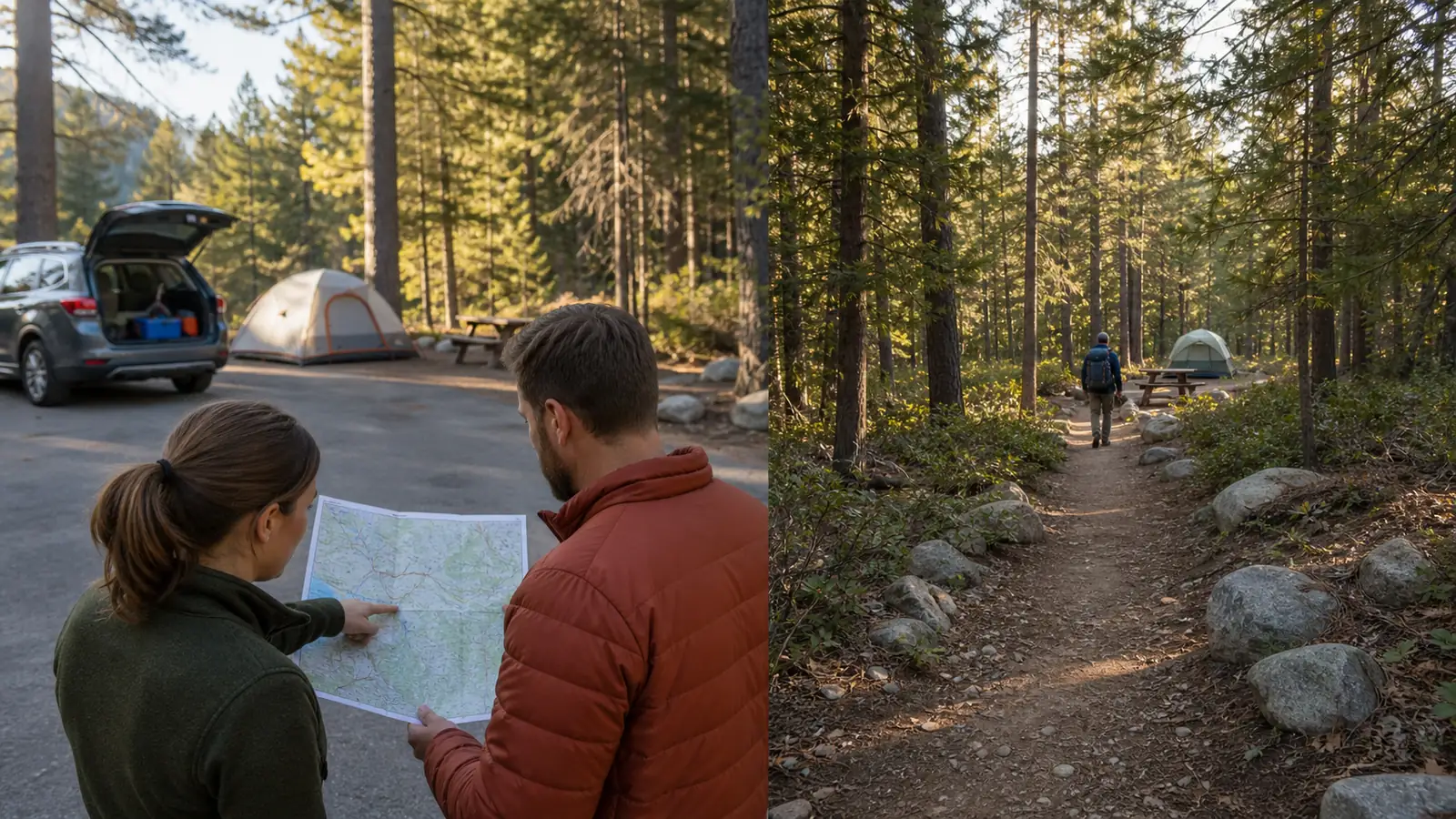
Choose a campground in two stages. First remove facilities that fail the group's access, equipment, rules, dates, water, sanitation, or exit needs, then compare individual sites for pad dimensions, drainage, wind, overhead hazards, road traffic, light, noise, and distance to facilities.
- Official status
- Exact facility dates loop site type and current rules
- Group fit
- People pets mobility supervision sleep and medication
- Equipment fit
- Tent footprint vehicle dimensions parking and carry distance
- Facility fit
- Water toilets storage power and access features
- Exposure and exit
- Weather drainage branches road gate and backup
One distinction in campground basics separates the facility from the individual campsite.
The campground controls the reservation system, roads, rules, toilets, water, food storage, fire use, and available site types. The individual numbered site controls the exact pad, parking, nearby traffic, shade, exposure, light, and noise.
Pick in that order. A beautiful pad cannot create potable water, allow a prohibited pet, fit an oversized vehicle, or reopen a closed access road.
Should you choose the campground or the campsite first?
Begin with hard requirements, not photographs. Dates, legal occupancy, access, group size, vehicle or tent dimensions, mobility needs, pets, water, toilets, food storage, and a safe route home can remove an option immediately.
Preferences come second.
Shade, view, privacy, a short toilet walk, quiet, cell service, showers, or power can improve a trip. Most have tradeoffs.
A site beside the toilet reduces walking but increases foot traffic, doors, lights, and early activity.
Trip purpose can change the priority order.
Short drives and simple toilet access often matter most to new campers because each removes work on arrival. A group planning dawn activities may value quiet sleep and a direct legal route out.
The requirements still need to be concrete.
Keep the two stages separate on paper. Mark each campground pass or fail.
Only after it passes should you compare loops and numbered pads.
Hard filters come first because comfort cannot repair a failed requirement.
Five requirements decide whether a campground works
Name who is going and what each person needs. Children need shorter toilet routes, predictable sleep, and a named adult during family camping because those needs change the site layout.
Pets add leash, storage, and supervision constraints, so dog-friendly camping changes which sites work.
A group that needs frequent toilet access has a different map preference from adults seeking a dark quiet edge.
Measure the largest equipment.
Record tent footprint including vestibules and guylines. For a trailer or recreational vehicle, use exact vehicle length, height, width, slide-out, tow, electrical, and maneuvering needs from the operator and facility requirements.
- Define the groupCount people and record mobility, sleep, supervision, pet, and health needs.
- Measure the equipmentWrite exact tent, vehicle, trailer, and parking dimensions.
- Set legal filtersConfirm dates, group size, pet, fire, food, vehicle, and stay rules.
- Set facility filtersDecide which water, toilet, power, storage, or access features are essential.
- Set the exit filterRequire a route and backup the group can use in expected conditions.
- Rank preferencesAdd privacy, shade, view, signal, showers, and activity access only after the pass list.
Avoid the vague label easy access. Write a maximum carry distance, stair restriction, required accessible feature, or parking relationship.
Specific needs can be matched against an official listing or confirmed with staff.
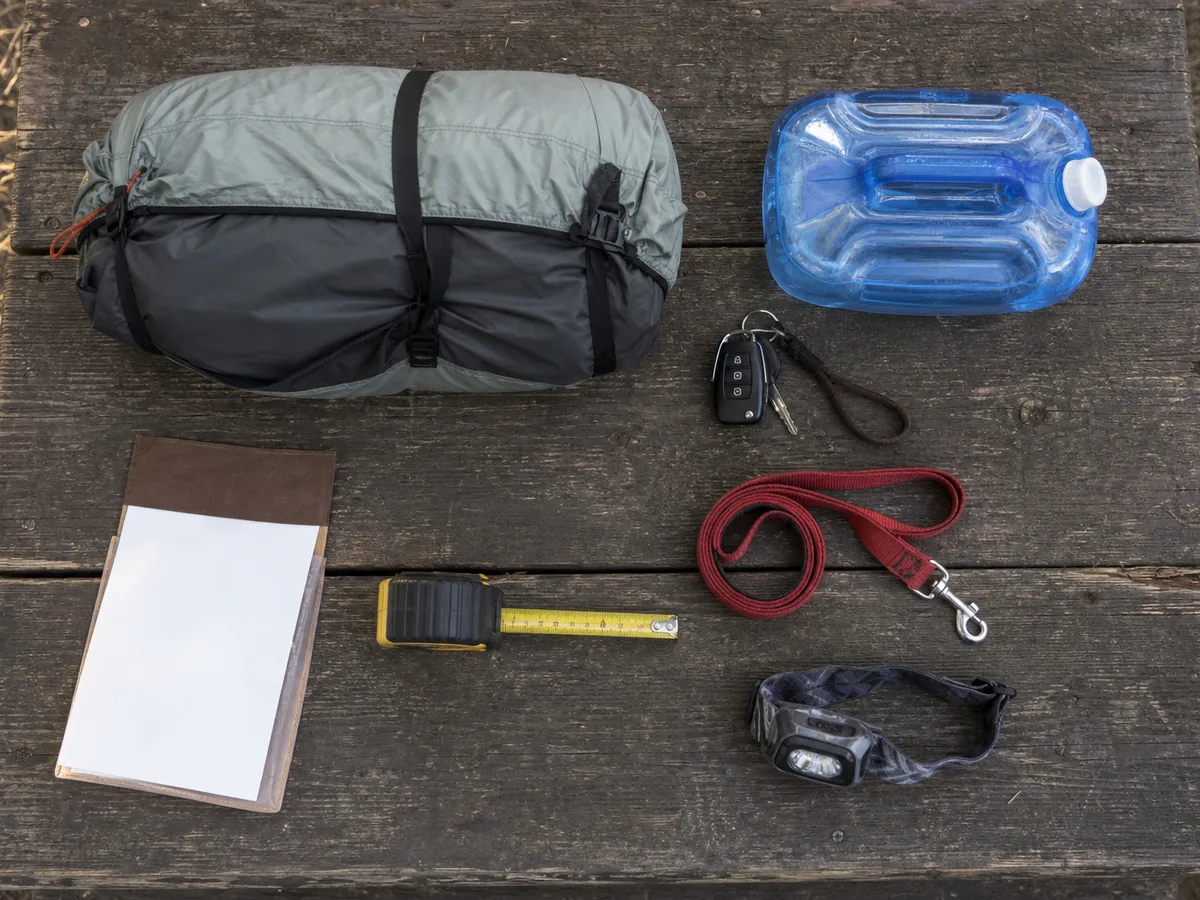
Set the arrival window.
A complicated tent, walk-in carry, or unfamiliar road requires more daylight in a first camping trip plan so setup finishes before dark. A campground that permits late arrival may still be a poor fit when safe setup requires seeing the site.
A requirement must be measurable before a listing can satisfy it.
Test each requirement against a consequence.
If no potable water means the vehicle cannot carry enough, water is a hard filter. If no shower only changes comfort, it is a preference.
If a long toilet walk affects medication, mobility, or a child at night, record a maximum acceptable route instead of calling a close toilet "nice to have."
This consequence test prevents two common errors. It stops a long amenity list from hiding one unusable feature, and it stops a scenic photograph from outranking legal access or a safe exit.
How do you verify a campground before booking?
Match the full name, managing agency, loop, season, and site type.
Similar campground names can exist in different parks or forests. An old article may describe a previous reservation system, water status, fire rule, or road condition.
Confirm whether the dates are reservable, first come first served, permit-only, closed, or partly open. Read cancellation, check-in, late-arrival, occupancy, extra-vehicle, and checkout terms before payment.
| Official fact | What to verify | Consequence if wrong |
|---|---|---|
| Open dates | Facility, loop, and arrival date | Locked gate or invalid reservation |
| Site type | Tent, walk-in, vehicle, trailer, group, or accessible | Equipment or group cannot legally fit |
| Access | Road surface, gate hours, parking, carry, and restrictions | People or gear cannot reach the pad |
| Water and toilets | Current availability and exact type | New supply and sanitation plan required |
| Food storage | Locker, vehicle, container, disposal, and local rules | Food system may be illegal or unsafe |
| Fire use | Current restriction, approved equipment, and fuel | Cooking or evening plan may fail |
| Pets and group size | Species, leash, areas, people, and vehicles | Reservation may not cover the party |
| Fees and passes | Site fee, entrance fee, and payment method | Unexpected cost or denied entry |
Save the confirmation, map, rules, contact, and directions offline.
Record what is not guaranteed. A listing that says water is seasonal or signal is limited requires a backup, not optimism.
Check the reservation for site assignment.
Some facilities reserve an exact number. Others assign on arrival or guarantee only a site type.
Do not build the whole plan around a photograph when the booking does not promise that pad.
Call or message the managing agency when a requirement remains unclear.
Ask with dates and exact dimensions. State the full tent footprint and vestibule size, then ask whether they fit the designated pad.
That answer is more useful than a general claim that the site is large.
Recheck alerts shortly before departure. Fire restrictions, smoke, weather, water notices, road damage, and closures can change after booking.
The exact official listing owns the facts for that stay.
Compare the official page with the booking confirmation immediately. The campground, loop, site type, dates, party size, vehicles, and equipment must agree.
Resolve a mismatch while support is open rather than discovering it at a gate or occupied pad.
For first come first served camping, find the real registration method, payment method, maximum stay, and how an occupied site is marked.
Build a backup that works when every suitable site is taken. Arriving earlier is not a guarantee and should never require unsafe speeding or a rushed night setup.
Site type follows how you arrive and how you sleep
The label on a campground listing can change the whole packing and access plan. Drive-in, walk-in, group, tent-only, RV, and accessible sites are not interchangeable, even when their photos show a similar table and fire ring.
A drive-in site usually provides a parking spur at or near the numbered pad, but the listing still controls vehicle count, spur length, surface, and whether a trailer or recreational vehicle is allowed. Do not assume that every item can remain in the vehicle or that doors and slide-outs can open fully.
A walk-in site separates parking from the pad. Check the stated carry distance, grade, stairs, surface, cart availability, and number of trips.
A short path can become a major constraint when each cooler, water container, shelter, and sleep item must cross it several times.
Tent-only describes permitted equipment, not guaranteed tent fit. Compare the designated pad with the full footprint, vestibules, doors, and legal guyline space.
Ask staff when a critical dimension is missing rather than extending the shelter into vegetation, a path, road, or neighboring site.
An RV site needs more than a length number. Confirm vehicle and trailer limits, turning room, parking position, slope, hookups, generator rules, slide-out clearance, tow-vehicle placement, and any low branches or narrow internal roads stated by the facility.
A group site may have a minimum or maximum party size, a separate parking limit, tent limit, shared facilities, and rules for additional vehicles. Booking it for a small party can be prohibited, while dividing a large group among ordinary sites may break occupancy or gathering rules.
An accessible site should be matched through the official feature description. Look for the actual relationship among parking, pad, table, toilet, water, routes, slopes, and surfaces.
The word accessible alone does not tell you which features meet one person's needs.
| Site type | Verify before booking | Common mismatch |
|---|---|---|
| Drive-in | Spur dimensions vehicle count and equipment permission | Vehicle fits the listing but doors gear or trailer do not fit the spur |
| Walk-in | Carry distance grade surface stairs and carts | Group packs for beside-car access |
| Tent-only | Full pad size shelter rules and parking | Tent body fits but vestibule or guylines do not |
| RV | Length height width slope turns hookups and slide-outs | A single length filter hides clearance or maneuvering limits |
| Group | Minimum and maximum people tents vehicles and shared space | Party size or parking breaks the reservation terms |
| Accessible | Named routes surfaces slopes parking toilets and tables | A general label does not support the person's specific need |
Check whether the reservation guarantees that exact type or only a broad category. Some facilities assign a site at arrival, so the plan must work across the stated category rather than depending on one photographed pad.
Read the confirmation after payment. The facility, loop, site number or category, dates, party size, vehicle count, and equipment type should match what you selected.
A confirmation that changes any one of those facts deserves correction while support is available.
If staff offers a substitute, run the hard filters again. A free upgrade to a larger pad may still fail toilet access, pet rules, generator limits, parking, or the route out.
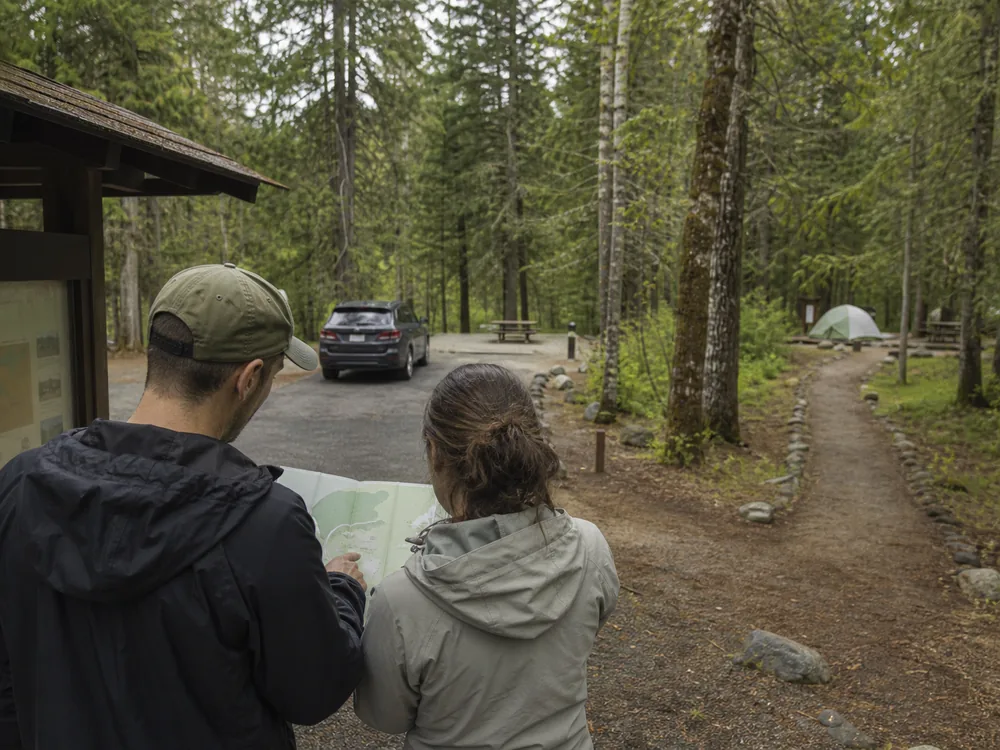
The site type also changes closeout. A walk-in group needs time for repeated carries.
An RV needs a departure check for hookups, stabilizers, awnings, clearance, and tow connections under the equipment instructions.
When two listings remain, choose the type that removes the hardest physical or legal failure. A view is replaceable.
A usable parking relationship, safe carry, correct pad, and legal equipment fit are not.
Site type sets the work between the road and sleep, so verify it before comparing scenery or price.
How much campground access can your group manage?
Trace the trip from the public road to the sleeping pad. Include road surface, steep grades, narrow turns, low clearance, seasonal gates, parking limits, and the distance from the parked vehicle to the site.
"Car camping" does not always mean the car sits beside the tent.
A walk-in site may use a shared parking area and a path with steps, roots, mud, or a grade. Each water container, cooler, shelter, and sleep item must travel that path.
- Road
- Surface, seasonal limits, grades, clearance, and vehicle restrictions
- Parking
- At-site or shared, number of vehicles, overflow, and extra fees
- Carry
- Distance, grade, stairs, surface, carts, and number of trips
- Pad
- Usable dimensions for tent, vestibule, doors, and legal guylines
- Mobility
- Official accessible features, route, toilet, table, and parking relationship
- Exit
- Gate hours, weather limits, fuel, charging, and alternate route
For trailers and recreational vehicles, a site length alone is incomplete. Turning room, slope, hookups, slide-outs, tow vehicle position, tree clearance, and campground rules all matter.
Follow the facility and equipment instructions.
For a tent, compare the designated pad with the shelter, vestibule, and guylines on your camp packing list before booking. Do not plan to extend guylines into a road, neighbor's site, protected vegetation, or public path.
Count trips as well as distance. A 200-yard walk-in path may be easy once and demanding six times with water, food, shelter, and bedding.
Reduce equipment or choose closer access before expecting the group to absorb repeated carries.
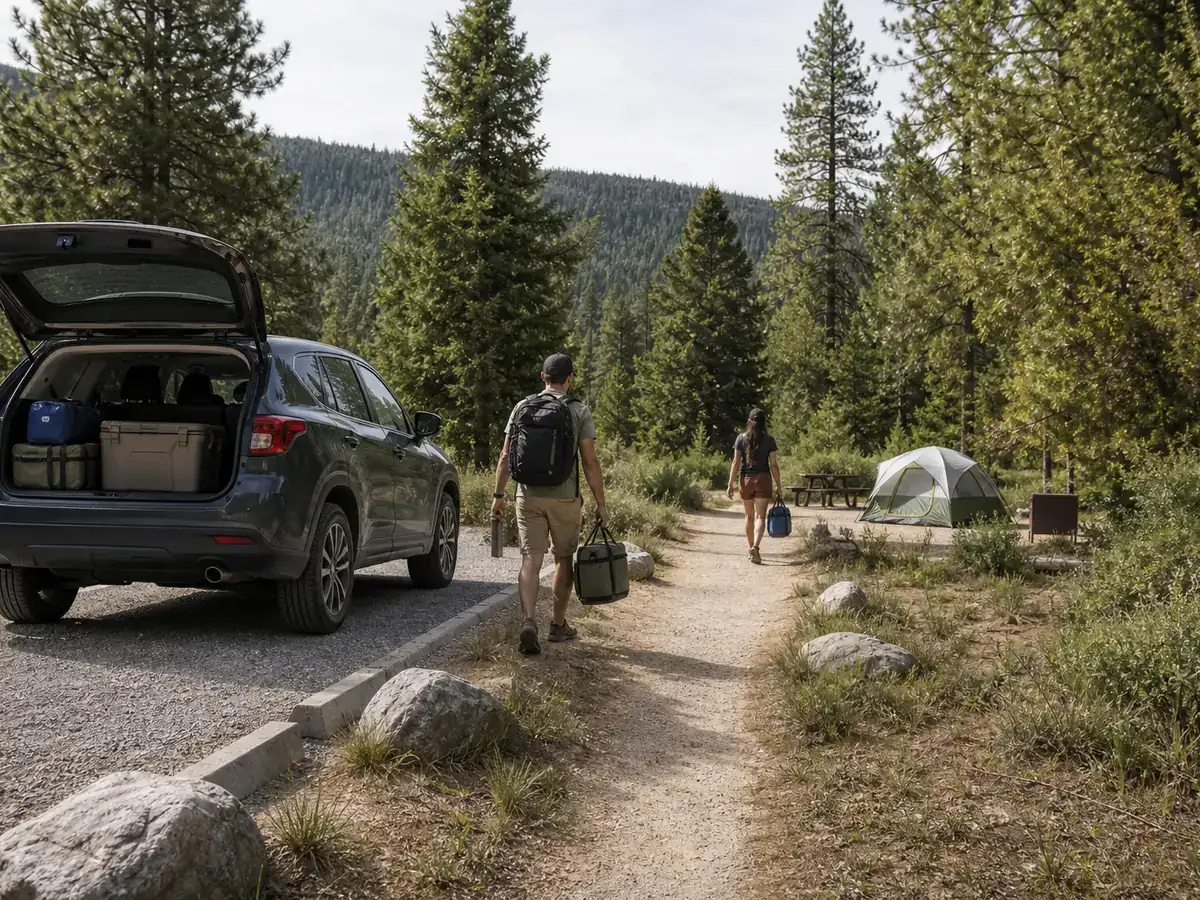
Access includes every carry between legal parking and sleep.
Only a few facilities are genuinely essential
Potable water changes how much the group must transport or treat. Toilet type changes hygiene and nighttime movement.
Required food lockers can solve storage only when their dimensions and shared-use rules fit the plan.
Essential
A missing feature makes the trip unsafe, inaccessible, or illegal for this group.
Substitutable
The group can carry or use a tested legal alternative without overloading access.
Comfort
The feature improves the stay but does not control whether the trip works.
Unknown
Current status must be verified or covered by a complete backup.
Showers, power, signal, and camp stores can be helpful without being reliable.
Hours, outages, stock, and coverage change. Do not let an optional service carry an essential medication, food, communication, or charging plan without confirmation and backup.
Trash service also changes closeout. If the facility requires pack-out, the vehicle needs secure space for all waste and scented material.
If bins exist, use only the approved containers and schedule.
A facility matters by consequence, not by how attractive it looks in a filter list.
What can a campground map reveal about noise and access?
Once a campground passes, compare individual sites. Map the shortest paths to the toilet, water, trash, host, road, playground, beach, trail, generator area, and exit.
Each nearby feature brings both convenience and activity.
A toilet can mean shorter night walks plus doors, voices, hand dryers, vehicle stops, and path lights.
A road edge can simplify loading while adding headlights and traffic. Even good campground etiquette cannot remove every normal facility sound.
Look at neighboring site orientation where maps and verified photos allow it.
Doors, tables, fire rings, parking spurs, and paths influence privacy more than raw distance. Never assume vegetation creates a private area that can be occupied.
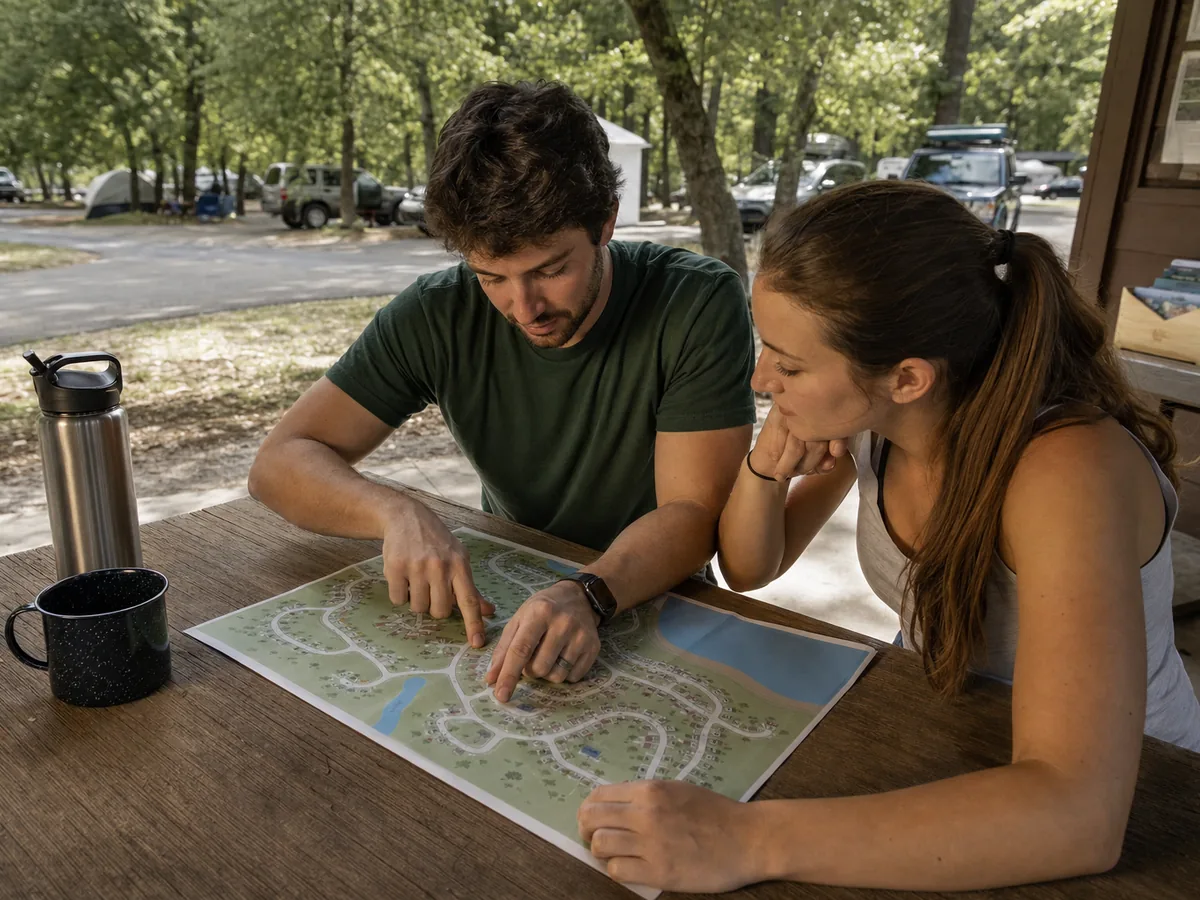
Check generator rules and loop design. A posted quiet period does not guarantee silence at other hours.
If daytime sleep or a very early bedtime matters, distance from generator-permitted sites may be a real filter.
Choose the map tradeoff deliberately instead of expecting one site to be close and isolated at once.
When should weather or access rule out a campground?
Use current maps, alerts, forecasts, and site information to screen exposure. A campground safety check should cover flood-prone access, open wind, extreme sun, coastal conditions, falling branches, steep edges, and roads that become difficult in rain or snow.
- Overnight weather fits the tested shelter and sleep system.
- Legal pad is not a low point or obvious runoff channel.
- No known overhead hazard can reach the occupied area.
- Wind and sun exposure fit the group and equipment.
- Road and gate remain usable for the forecast period.
- Safer shelter or an early departure remains possible.
Site photographs cannot prove current tree condition, drainage, or pad dimensions.
Rain can turn low ground into runoff, so wet-weather camp checks should begin before the shelter opens.
Snow, ice, and frozen roads change the exit, so winter campsite checks need a separate decision. Inspect on arrival and ask staff for a legal alternative when a visible hazard changes the choice.
Season changes the same loop. Leaf cover, sun angle, insects, water level, snow, gate hours, and neighboring demand can make an old review or summer photo poor evidence for the current dates.
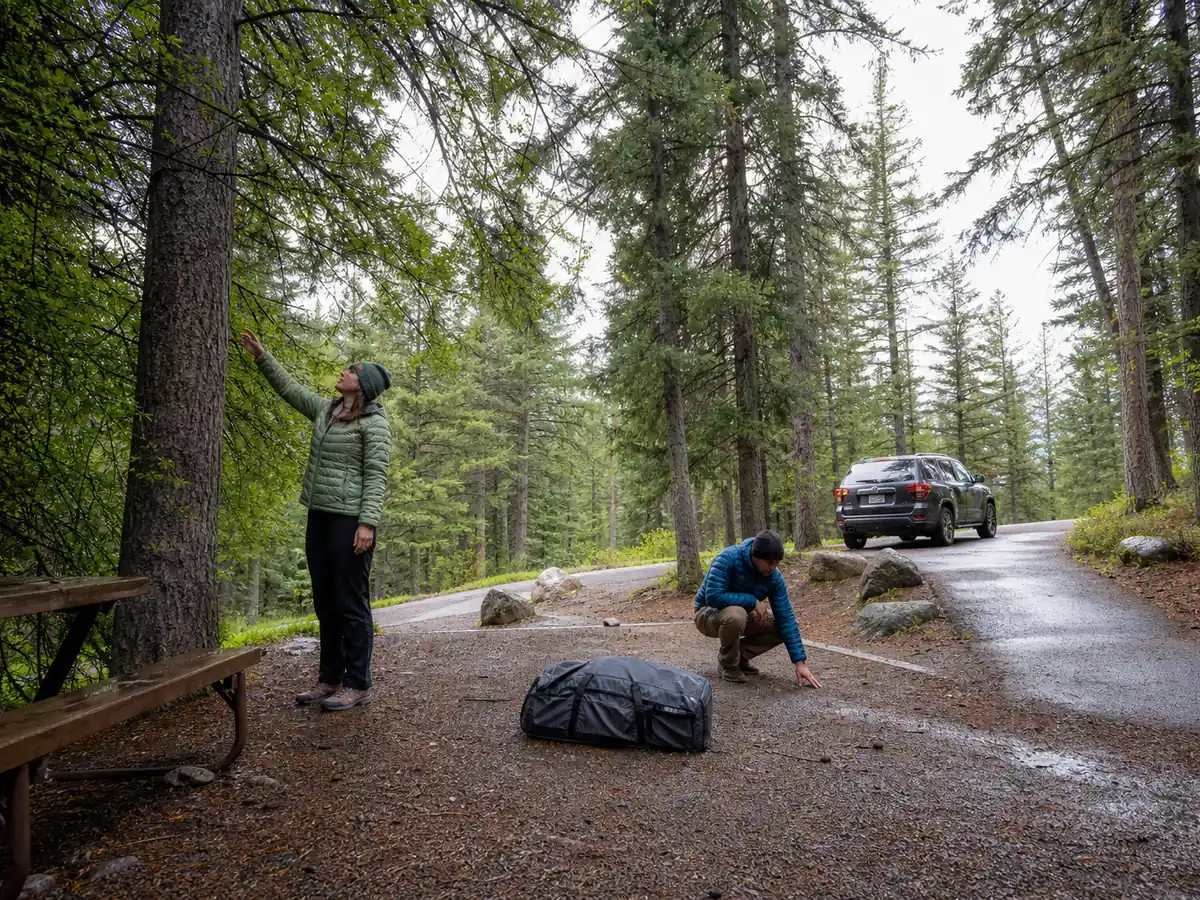
Do not reserve a difficult exit merely because the view is better. Keep departure especially simple when camping alone, but give every first trip a route out without a long walk, technical road, river crossing, or narrow weather window.
The exit is part of the campsite even when it lies miles away.
How do you choose the final campground and a backup?
Compare the final options against the five nonnegotiable requirements.
Remove any site that still depends on an assumption. Then use price, scenery, privacy, and convenience to choose among the options that genuinely work.
Keep the backup current until arrival.
Save its availability rules, route, cost, and closing time. If strong wind is expected, choose a backup that avoids a wind-exposed tent pitch after arrival.
A vague idea to "find somewhere else" is not useful after a closure or late arrival.
Book the site that works on an ordinary difficult day, not only in the best weather and perfect arrival.
Sources
The National Park Service explains reservations, fees, water, fires, group size, food storage, facilities, exposure, traffic, and equipment fit: Finding and Setting Up a Campsite.
Its safety planning guide covers setting, season, access difficulty, duration, group limits, current rules, conditions, and backup plans: Camping Safely Before the Trip.
Recreation.gov provides official federal facility and reservation information for participating locations: Camping.
Step by stepPractical steps
- Write measurable group, gear, legal, facility, and exit requirements.
- Remove campgrounds that fail any nonnegotiable requirement.
- Verify the exact facility, loop, dates, rules, status, and access officially.
- Trace the vehicle and every carry from the road to the pad.
- Compare numbered sites for dimensions, traffic, noise, light, exposure, and facilities.
- Book the best verified fit and keep one workable backup.
AnswersQuestions readers ask
What should I look for when choosing a campground?
Start with dates, legal use, access, group and gear fit, current water and toilet status, food and fire rules, weather exposure, and a usable exit. Compare scenery and comfort only among options that pass.
What is the difference between a campground and a campsite?
The campground controls roads, rules, facilities, reservation systems, and available site types. A campsite is the individual numbered pad with its own dimensions, parking, exposure, traffic, light, and noise.
How close should a campsite be to the bathroom?
Choose based on the group's nighttime mobility and sleep needs. A shorter walk adds convenience but often brings more doors, voices, lights, and foot traffic.
How do I know whether my tent will fit?
Measure the full tent footprint including vestibules, door clearance, and legal guyline space. Compare it with official pad dimensions and ask staff a specific question when the listing is unclear.
Should I trust campground reviews?
Use reviews only for subjective patterns such as noise or shade. Verify current rules, openings, access, fees, water, fire, food storage, dimensions, and alerts with the managing agency.