
Snakebite: Everything in the Kit Makes It Worse
There is one treatment for envenomation and it is in a hospital. The rest is getting there without adding damage.
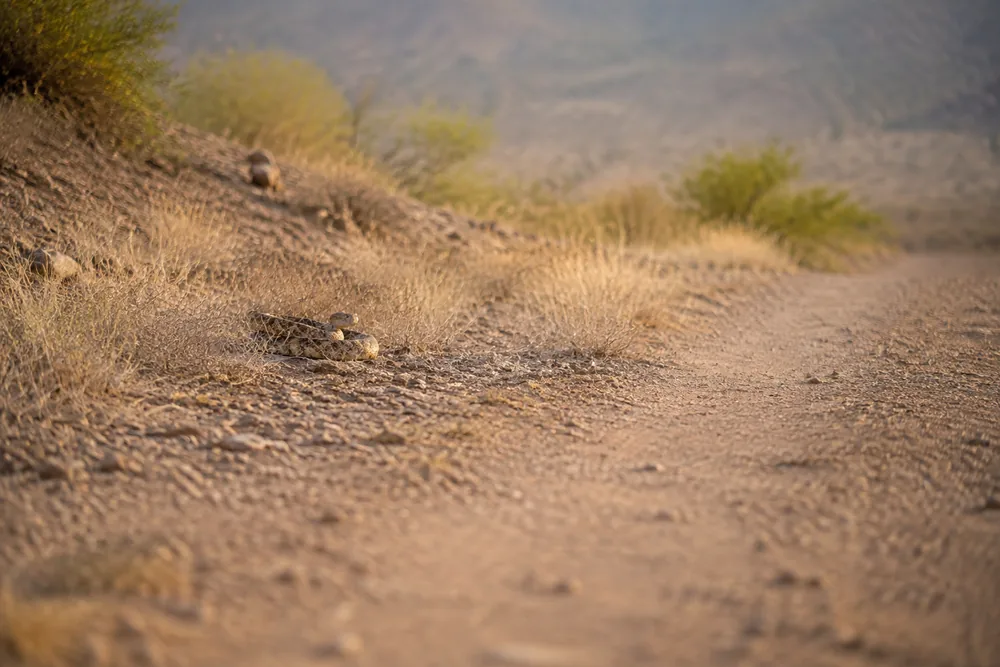
Suction extractors remove under 0.04 percent of injected venom, tourniquets concentrate a cellular toxin exactly where it destroys tissue, and ice adds a cold injury to tissue already in trouble. What is left is a pen, a clock, and a route to antivenom.
The most useful thing this page can do is take things away from you.
Everything in the kit sold for this either does nothing or makes the injury worse. What is left is short, and most of it is about getting to a building with antivenom in it.
Which of the things in your kit should you use?
Start with the extractor, because it is probably the item in your pack right now.
It has been measured. Suction devices, including the widely sold pump-style extractor, remove less than 0.04 percent of injected venom, which is a rounding error, and the suction itself can damage the tissue underneath.
That is not a marginal result that leaves room for trying anyway. It is a device that does nothing while occupying the minutes you should be walking.
| What people reach for | What it actually does |
|---|---|
| Suction extractor | Removes under 0.04 percent of venom and can damage the tissue it is pressed against |
| Tourniquet or constricting band | Concentrates venom in the limb, and pit viper venom pools where it does the most tissue damage |
| Cutting the bite | Adds a wound and an infection risk, and removes no venom |
| Ice or a cold pack | Worsens local tissue injury on top of what the venom is already doing |
| Alcohol, aspirin or ibuprofen | Alcohol clouds assessment. The other two affect clotting the venom is already disrupting |
The tourniquet deserves the extra sentence, because it is the one people are proudest of.
A tourniquet does not buy time. Pit viper venom is largely a cellular toxin, and holding it inside a limb concentrates it exactly where it destroys tissue, which trades a systemic problem you may not have had for a local one you will certainly keep.
Ice runs on the same false logic. The instinct is that cold slows things down, and what it actually does is add a cold injury to tissue that is already being digested.
One qualification, because the internet will offer it. Pressure immobilisation has a genuine role for some elapid bites elsewhere in the world, and it is not the guidance for North American pit vipers, so advice imported from Australia does not transfer.
Take all of that away and what remains is a short list. It is in the next section, and none of it is treatment.
The first ten minutes are mostly about information
Move away from the snake first.
This sounds obvious and it is routinely ignored, because people stand and stare, or try to photograph it, or decide to kill it for identification. A meaningful number of second bites happen in exactly those minutes.
- Get out of the snake's reachTen metres and behind something is plenty. Nobody approaches the animal for a photograph, an identification or revenge.
- Take off rings, watches and anything tightThere is a short window before swelling makes this impossible, and a ring on a swelling finger becomes its own surgical problem.
- Wash gently and cover itSoap and water if you have them, then a clean dry dressing. That is the entire wound care.
- Mark the swelling edge and write the timeDraw a line at the leading edge with a pen, put the time next to it, and repeat every fifteen minutes as it moves.
- Keep them still, limb about heart levelLoose immobilisation. A splint if you have one, nothing strapped tight, and no elevation or lowering games.
The fourth step is the one worth dwelling on, because it is the only genuine skill on this page.
A hospital arriving at hour two can see how far the swelling has spread. What it cannot see is how fast it got there, and the difference between a limb that swelled to the elbow in twenty minutes and one that took three hours is a different clinical picture entirely.
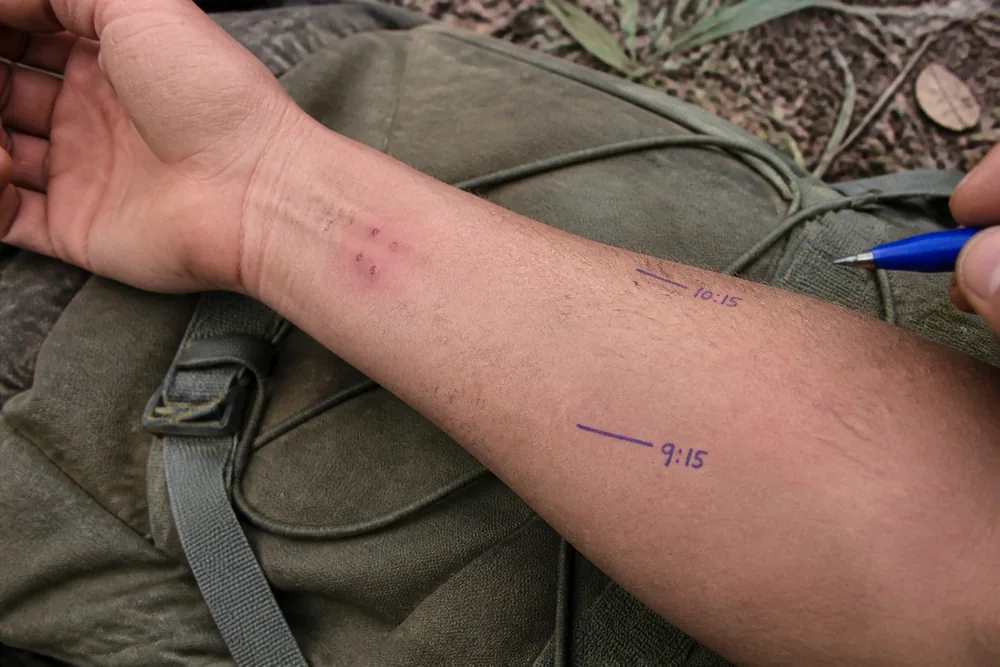
You are the only person who will ever have that information. A ballpoint pen is a more valuable item in this situation than anything sold as a snakebite kit.
Immobilisation needs one caution attached. Loose means loose, and a bandage or splint that ends up tight has quietly become the tourniquet the previous section removed.
Was any venom actually injected?
A venomous snake can bite without delivering venom, and it happens often enough to matter.
A dry bite leaves puncture wounds and very little else. It hurts, it bleeds a little, and the person feels shaken rather than ill.
When venom does go in, the local picture builds: swelling spreading from the punctures, redness, bruising, sometimes blistering, and pain and tenderness well beyond what two small holes should produce.
The systemic signs are the ones that change the urgency. Nausea, vomiting or diarrhoea, trouble seeing or breathing, a rapid heart rate, a weak pulse and falling blood pressure all say the venom has left the limb.
Here is the trap in all of it. Symptoms can take hours to develop, so fifteen quiet minutes prove nothing at all, and a party that stands down because their friend seems fine is making the decision on no evidence.
Every suspected venomous bite goes to hospital regardless of how well the person looks. A dry bite is a diagnosis made in retrospect after hours of observation, not a call made on a trail.
Two things complicate the reading. Coral snake envenomation can produce almost no local reaction and serious systemic effects considerably later, and fear on its own produces a fast pulse, nausea and shaking that look exactly like early systemic signs.
The species changes the outcome, not the plan
Roughly a quarter of pit viper bites deliver no venom at all.
That single figure explains most of the stories people tell. Somebody gets bitten, nothing much happens, and the story becomes evidence that snakebites are overblown, when what actually happened was a dry bite.
Species matters too, and it matters to the eventual hospital course rather than to your next hour.
Severity ranks in a fairly consistent order. Rattlesnake bites are worse than cottonmouth bites, which are worse than copperhead bites, and a copperhead envenomation rarely requires anything beyond observation while a rattlesnake bite may well need antivenom.
You can see why people want to identify the animal. If the outcome varies that much by species, knowing the species feels like knowing the outcome.
It is still not your job on the trail. Everybody with a suspected venomous bite goes to the same place, the marking and the timing are the same, and the minutes spent working out which snake it was are minutes spent not travelling.
One family sits outside the pit viper pattern. Coral snakes are elapids, their venom acts on nerves rather than tissue, and a bite can produce very little to look at while causing serious problems considerably later, which is a good argument against reading the local picture as reassurance.
The hurry buys a four-hour window
This page has been telling you to hurry without saying what for, and the answer is a curve rather than a deadline.
Antivenom works best when it is given within about four hours of the bite. That is the window everything else on this page is organised around.
What the clock is doing to the treatment
- Within about 4 hoursTravel now, and call ahead while you travelThis is where antivenom does its best work, and it is the whole reason for the urgency
- Around 8 hoursKeep going, and keep the timing recordEffectiveness starts falling away, which is what makes the first window worth chasing
- Beyond about 12 hoursStill go, and hand over the marked timingsValue becomes questionable at this point, which is honest rather than encouraging
- At 24 hours in a severe caseGo regardlessAntivenom is still given in severe envenomation a full day later, so a late arrival is never pointless
That last line matters more than it looks. Parties who realise they have lost half a day sometimes conclude there is no point, and that conclusion is wrong.
The other thing worth knowing is what happens after the antivenom, because it is longer than people plan for. Patients are typically monitored for eighteen to twenty-four hours after envenomation rather than treated and sent home, since the effects can rebound.
So the trip is over regardless of how well the person looks by evening. Somebody needs to think about the car, the rest of the group, and where everybody sleeps.
Not every hospital stocks antivenom, which is the practical reason the call is worth making from the trail rather than from the car park. The people you speak to can tell you where to drive.
Walk out, or wait for help to reach you?
There is one treatment for envenomation and it is antivenom in a hospital. Everything in the previous sections is holding measures while you get there.
That reframes the question. It is not whether the person can walk, it is which option puts them in front of antivenom soonest.
Exertion works against you. Moving hard raises circulation and moves venom around faster, so being carried, or a short assisted walk, beats a long forced march wherever the choice exists.
Pros
- Walking out starts closing the distance immediately, and needs no signal, no weather window and nobody else
- In terrain with no vehicle or helicopter access, walking may genuinely be the fastest route to care despite the exertion
Cons
- Walking raises circulation at exactly the wrong moment, and a person who deteriorates halfway is now a harder rescue in a worse place
- Waiting keeps them still and lets the record build, and it costs whatever the response time turns out to be
- A helicopter that cannot fly in the conditions is worse than a slow walk that started an hour earlier
Two transport rules catch people out.
The bitten person does not drive. A snakebite can cause dizziness, visual disturbance or loss of consciousness, and a car with an envenomated driver is a second emergency looking for somewhere to happen.
The other is to call early rather than late. Antivenom is not held at every facility, and a call that lets the receiving hospital prepare, or redirect you to one that stocks it, is worth more than the same call made from the car park.
Everybody else has a job that is not standing there
Watch what actually happens after a bite and you will usually see four people kneeling around one person, all doing the same thing, while nothing else gets done.
Nobody has called, and nobody has worked out where the road is. The clock from the last section is running the whole time.
Stay with them
One person, and only one, keeping the casualty still and running the pen and the timings. This is a full job rather than something done alongside anything else.
Make the call
From wherever there is signal, which is often a few minutes back up the trail or on a rise. Give a location before anything else, then the time of the bite.
Work out the exit
Route to a road, a track or a landing point, decided now rather than halfway through carrying somebody. Somebody looks at the map while the others are busy.
Prepare to carry
If it comes to that, it takes several people and improvised kit. Getting it ready before it is needed is the difference between a carry and a shambles.
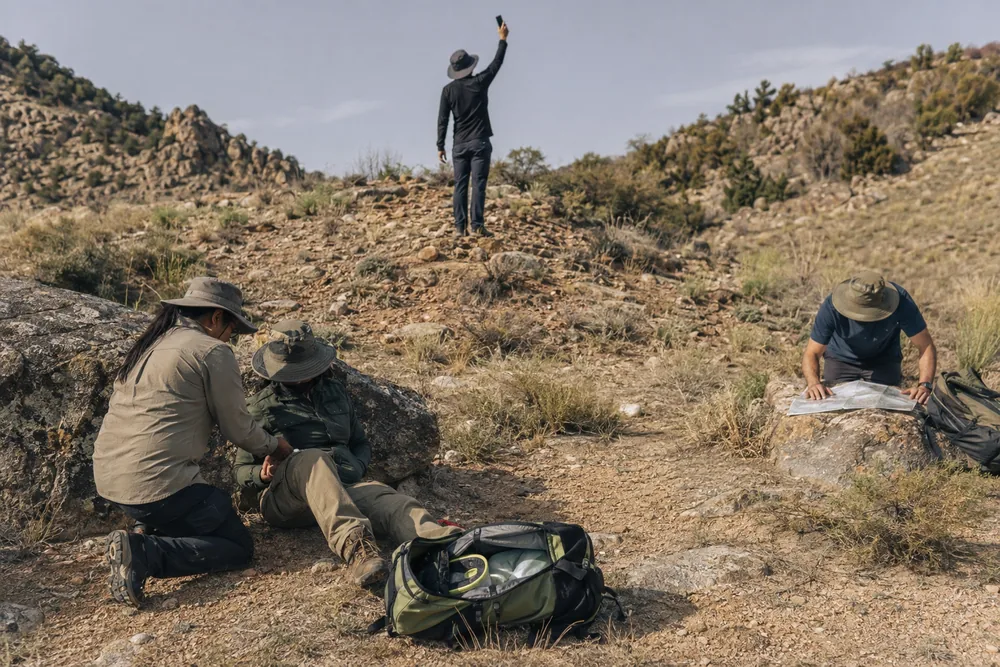
Allocating those out loud takes about ten seconds and it is the single most useful thing a party leader does.
The call moving away from the casualty is the part people resist, because it feels like abandoning them. It is the opposite: the call is the treatment, and standing next to somebody holding a phone with no bars is not helping.
A party of two cannot run these in parallel and has to sequence them instead. That is an argument for calling earlier rather than later, and for accepting a rougher location description rather than waiting until you can give a good one.
Nobody leaves a casualty alone to go for help unless there is genuinely no alternative. If it comes to that, they get left with insulation, water within reach, and a clear description of where the other person has gone.
The photograph of the snake, if somebody safely got one, is genuinely useful to the hospital. It is also the last of the five jobs and it never comes ahead of any of the others.
Most bites are avoidable, and a lot of them are self-inflicted
A large share of snakebites happen to people who were handling, killing, moving or otherwise interfering with the snake.
That is worth sitting with, because it converts prevention from a state of constant alertness into one specific rule. Leave it alone and a large fraction of the risk disappears.
The rest is about hands and feet arriving somewhere you have not looked.
- Leave the snake entirely alone, including for a photograph
- Look before hands or feet go onto ledges, into brush, or under logs and rocks
- Step onto logs and rocks rather than over them, so you see the far side first
- Wear boots and long trousers in snake country
- Put gloves on before moving brush, woodpiles or debris
Where snakes actually are on a trail is worth knowing, because it is not the middle.
Snakes use edges and warm surfaces to regulate temperature, so the margins of the tread, the sunlit rock beside the path and the shade under the overhanging step are where they will be, which is exactly where people put a hand when the trail gets steep.
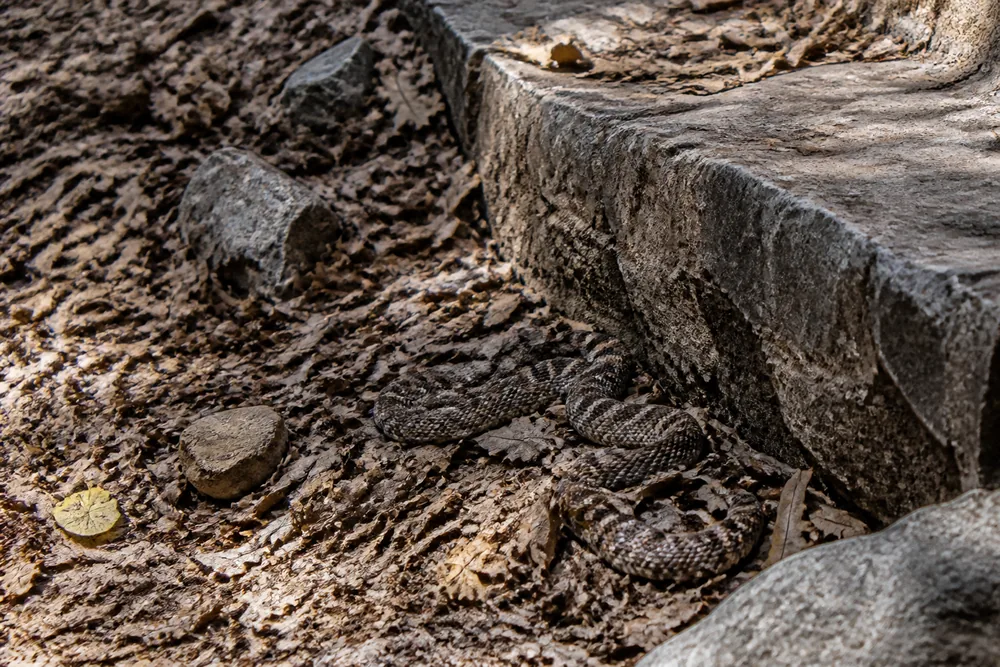
Stepping onto rather than over is a small technique with a real payoff.
Over a log, your foot lands blind on the far side, while onto it you can see the ground before you commit.
None of this is a guarantee. A well-camouflaged snake in leaf litter can be stood on by someone doing everything right, and a strike above the boot line goes through trouser fabric without difficulty.
Sources
The list of things not to do, including tourniquets, cutting, suction, ice and electric shock, along with the local and systemic signs of envenomation, the instruction not to drive yourself, and the prevention advice on boots, long trousers and gloves, comes from: CDC, venomous snakes at work.
The measured performance of suction devices, at under 0.04 percent of injected venom removed, and the finding that the traditional prehospital interventions have proven harmful rather than merely ineffective, come from: Center for Wilderness Safety, venomous snakebite treatment.
The field sequence, including removing jewellery early, marking the leading edge of swelling with the time, immobilising the limb and arranging the fastest transport to a hospital with antivenom, comes from: Asclepius Snakebite Foundation, how to survive a snakebite in the wilderness.
The general first aid summary, including washing and covering the bite and keeping the person calm and still, comes from: Mayo Clinic, snakebites first aid.
The proportion of pit viper bites that are dry, the severity ranking between rattlesnake, cottonmouth and copperhead, the antivenom time window, and the 18 to 24 hour observation period come from: Merck Manual, snakebites.
AnswersQuestions readers ask
Do snakebite suction kits work?
No. Measured testing shows suction devices remove less than 0.04 percent of injected venom, and the suction itself can damage the tissue underneath. The minutes spent using one are minutes not spent travelling to a hospital.
Should you use a tourniquet for a snakebite?
Never. A tourniquet concentrates venom in the limb, and pit viper venom is largely a cellular toxin, so holding it in place is holding it exactly where it destroys tissue.
What should you actually do after a snakebite?
Move out of the snake's reach, remove rings and anything tight before swelling starts, wash and cover the bite, mark the leading edge of swelling with a pen and write the time beside it, keep the person still with the limb about heart level, and get to a hospital.
Why mark the swelling with a pen?
Because it is the one piece of information a hospital cannot reconstruct. Staff can see how far the swelling has spread when you arrive, but not how fast it got there, and a limb that swelled to the elbow in twenty minutes is a different picture from one that took three hours.
What is a dry bite?
A bite that delivers little or no venom, leaving puncture wounds with minimal reaction. It is common, but it can only be confirmed by hours of observation, so every suspected venomous bite still goes to hospital.
How many snake bites are dry?
Around a quarter of pit viper bites deliver no venom at all. That explains a lot of the stories where nothing much happened, and it still cannot be confirmed on the trail, so every suspected venomous bite goes to hospital.
How quickly does antivenom need to be given?
It works best within about four hours, becomes less effective after around eight, and is of questionable value after twelve. In severe envenomation it is still given at 24 hours, so arriving late is never pointless. Expect 18 to 24 hours of observation afterwards.
Is a copperhead bite as serious as a rattlesnake bite?
Usually not. Severity ranks rattlesnake above cottonmouth above copperhead, and a copperhead bite rarely needs anything beyond observation. None of that changes what a party does on the trail, because the destination is the same.
What should the rest of the group do after a snakebite?
Split the jobs. One person stays with the casualty and runs the marking and timing, one moves to where there is signal and makes the call, one works out the route to a road or landing point, and the rest prepare in case a carry is needed.
Can you drive yourself to hospital after a snakebite?
No. A snakebite can cause dizziness, visual disturbance or loss of consciousness, so the bitten person should never be the driver.