
What Do You Do in a Bear Encounter, Play Dead or Fight Back?
The correct response reverses on species and on what the bear wants.
Most bear advice is accurate for a bear you are not looking at. Playing dead saves people from a defensive grizzly and endangers them with a black bear or a predatory one, so the useful skill is reading which case you are in.
Most bear advice you have heard is correct. The problem is that a lot of it is correct for a different bear than the one in front of you, and almost nobody says which.
Playing dead is both the right answer and the wrong answer.
Which one it is depends on the species and on what the bear actually wants, and getting that pair wrong turns the correct action into the dangerous one.
A bear that has not seen you
The easiest situation on this page. Move back the way you came, quietly, and let it carry on not knowing you were there.
A bear that has seen you and stayed
The common close encounter. What you do over the next minute settles most of what follows.
A bear that approaches, follows, or comes into camp
The rare one. Species and intent start deciding the answer here, and the response splits in two.
Almost everything below is about the second row. The third row gets the most attention and happens the least.
Most bear sightings end with the bear leaving
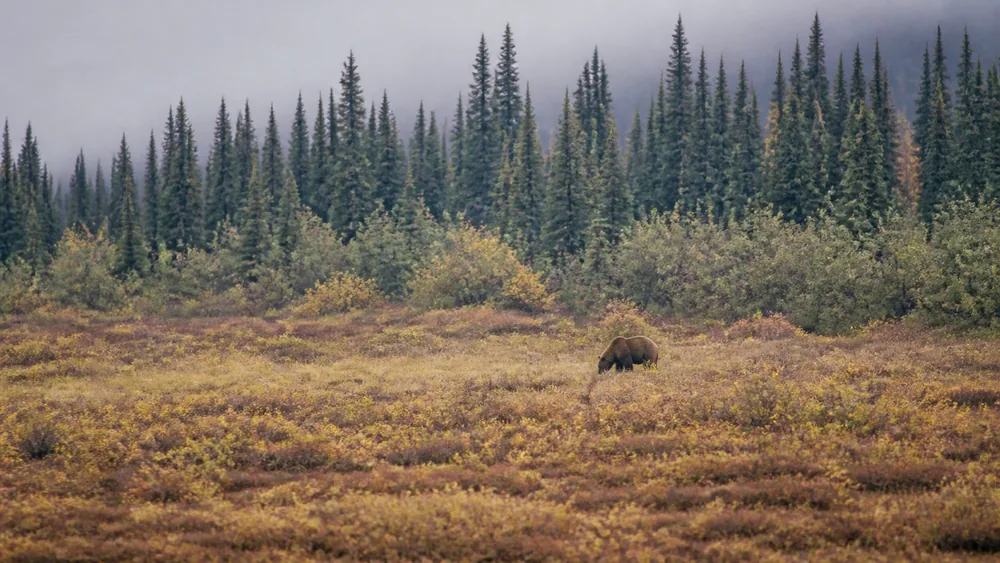
A bear you see at distance, doing bear things, is not an emergency. It is a bear eating berries with somewhere else to be.
The tell is what the animal does with its attention.
A bear that keeps feeding, keeps walking, or drifts away has already decided about you. It may glance up, register a human shape, and go straight back to what it was doing, which is the ordinary outcome and the one worth expecting.
What changes the picture is a bear that stops and looks at you, or one that starts closing the distance.
Those two behaviours move you into the next section. Everything else is a wildlife sighting, and the correct response is to enjoy it briefly and leave.
Size matters far less than people assume.
What matters is how much ground sits between you, whether you have a way to open more of it, and whether the bear has an escape route of its own. A cornered bear on a narrow trail is a harder problem than a much larger one across a meadow.
What do you do while the bear is deciding?
Do not run. That instruction sits above everything else on this page, because a bear can run as fast as a racehorse both uphill and downhill.
Running also does something worse than failing. It converts you from an unclear shape into something that flees, which is what prey does.
So the first job is to be obviously human.
Talk. A calm voice is the specific signal that identifies you as a person rather than an animal, and it works when your silhouette under a large pack does not.
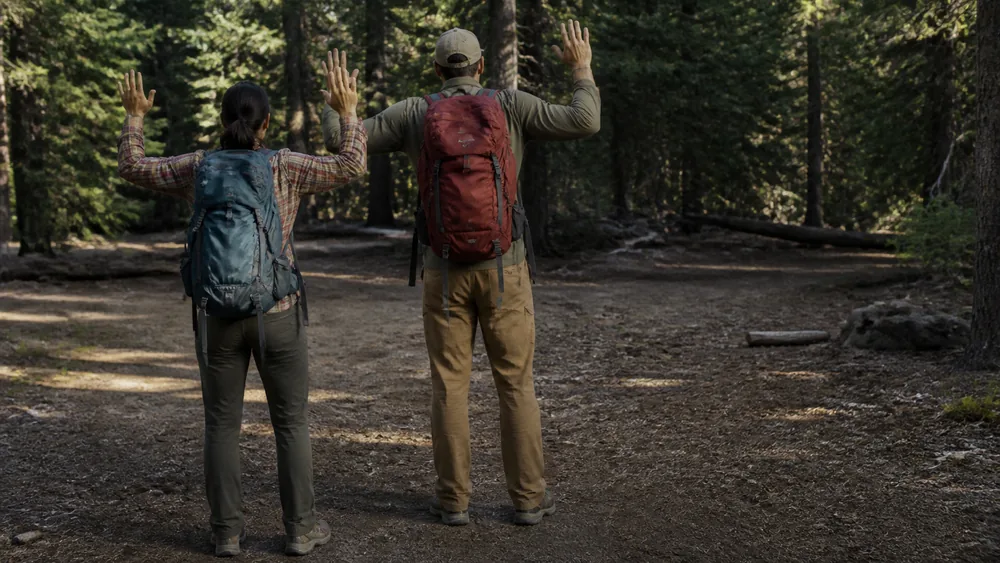
Then make yourself readable. Stand your ground, wave your arms slowly, and let the bear resolve what it is looking at.
Slow is the operative word in that sentence.
Sudden movement reads as either flight or challenge, and neither helps. A group should close up rather than spread out, because several people standing together present as one large animal instead of several small ones.
- Stop movingHold your position rather than backing off in a hurry. Sudden retreat looks like prey behaviour.
- Speak, and keep speakingA steady human voice does the identification work. Volume matters less than continuity.
- Raise your arms slowlyLarge and unhurried. This is not the moment for a sudden gesture.
- Close the group upStand together. Scattered people read as several targets rather than one problem.
- Back away at an angleLeave without turning your back, watching the bear as you open the distance.
- Never step between a female and cubsIf there are cubs, the widest possible detour is the whole plan.
A female with cubs deserves its own line because it is the situation most likely to produce a defensive attack. Never place yourself between her and a cub, and never approach either.
A charging bear is usually not committed
Bears bluff. A charge that stops short, veers off, or ends in the bear standing there huffing is common, and it may be repeated more than once.
That is genuinely useful to know and almost impossible to use in the moment.
You will not reliably tell a bluff from a committed charge while it is happening, and you do not need to, because the response is the same either way. Hold your ground.
There is a related posture that people misread constantly.
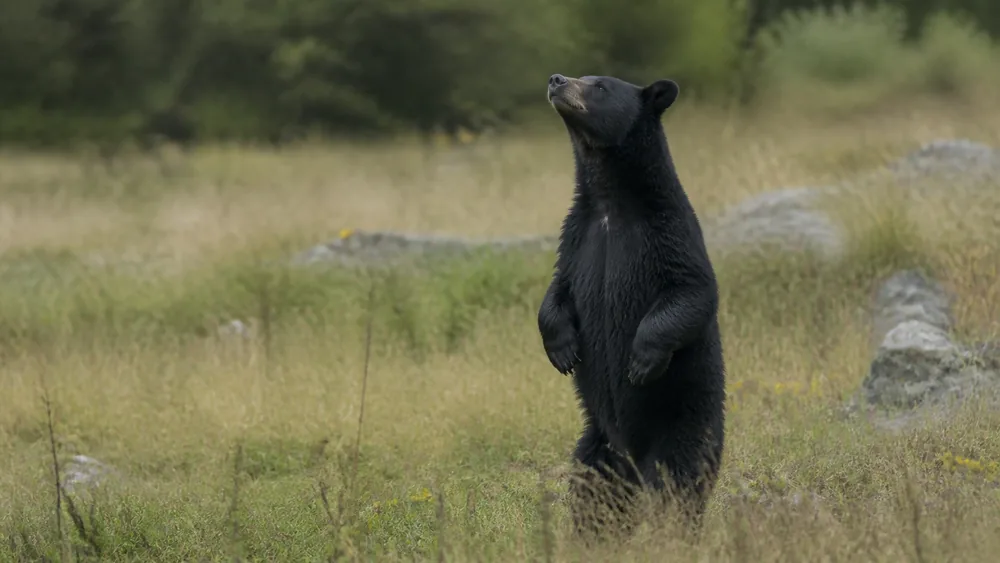
A bear standing on its hind legs looks like aggression and usually is not. It is how a bear gets its nose and eyes higher to work out what you are, and a standing bear is often a curious bear rather than a committed one.
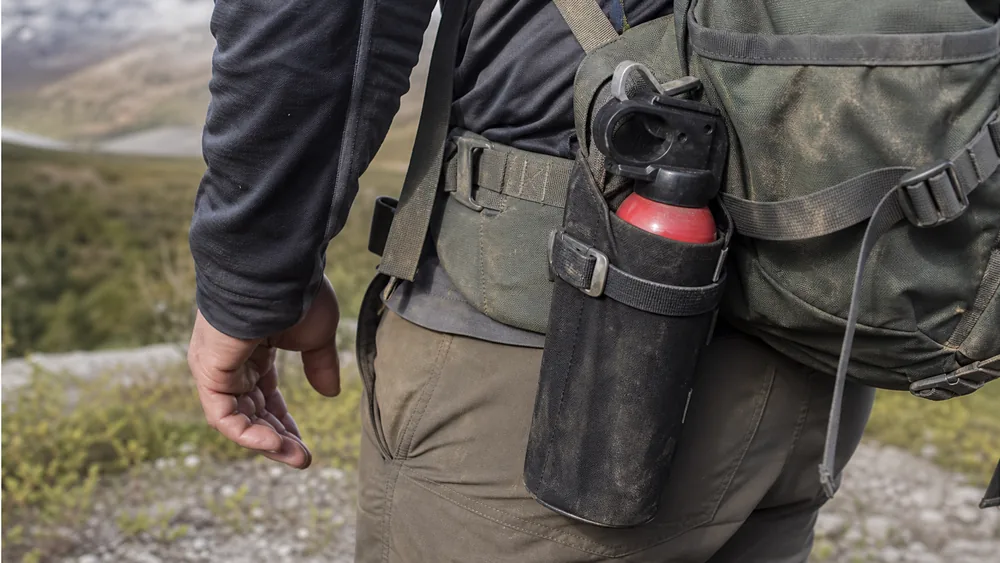
Spray, if you carry it, comes out as the bear closes rather than at first sight.
That timing is the whole reason it has to be somewhere you can reach in about a second. Spray buried in a pack lid is a purchase, not a defence.
Do you play dead or fight back?
Both, and the reversal is the single most important thing on this page. The correct action flips on two variables, which are the species and whether the attack is defensive or predatory.
Take the defensive brown bear first, because it is the case that generated the famous advice.
A grizzly that is startled, or protecting cubs or a carcass, is trying to end a threat rather than eat you. The guidance is to leave your pack on and play dead, lying flat on your stomach with your hands clasped behind your neck.
The pack stays on for a reason. It armours your back and neck through exactly the part of the attack the bear is trying to finish.
Black bears invert that instruction completely.
You do not play dead for a black bear. Get to a car or a building if one is close, and if escape is not possible, fight back with whatever is in reach and aim for the face and nose.
Then there is the case that overrides species entirely.
A bear that stalks you and then attacks, or that comes into your tent, is not defending anything. It is treating you as food, and playing dead in that situation is the worst available option.
| The bear and the attack | What it wants | What you do |
|---|---|---|
| Brown or grizzly, startled or protecting | To end a threat | Pack on, flat on your stomach, hands behind your neck, stay still |
| Black bear, any attack | Varies, and playing dead never helps | Escape if you can, otherwise fight back hard at the face |
| Any bear that stalks then attacks | To eat | Fight back with everything, immediately |
| Any bear entering your tent | Treated as predatory by default | Fight back, and do not wait to work out its intent |
Predatory attacks are rare, which is exactly why they catch people out. The remembered advice is the grizzly advice, and it is the wrong one here.
That last row is a rule rather than a judgement.
You will not be assessing motive at two in the morning through nylon, so the guidance removes the judgement and tells you to treat it as predatory. Fight back.
The evidence on bear spray is unusually clear
This is one of the few outdoor equipment arguments settled by data rather than opinion. Two Alaskan datasets cover it, and they point the same way.
Spray first.
Across 83 incidents between 1985 and 2006, bear spray stopped the undesirable behaviour in 92 percent of brown bear cases and 90 percent of black bear cases. More usefully for you, 98 percent of the people carrying spray came out of close-range encounters uninjured.
Now the comparison most people assume goes the other way.
A second dataset covered 269 firearm incidents. Long guns succeeded in 76 percent of cases and handguns in 84 percent, which sounds respectable until you look at what happened to the people.
Twenty-four percent of firearm carriers were injured.
The finding that should settle the argument is quieter than that. Firearm carriers were injured at the same rate whether or not they actually fired the weapon, which means carrying one did not change the outcome.
- Spray, brown bears
- Stopped the behaviour in 92 percent of cases
- Spray, black bears
- Stopped the behaviour in 90 percent of cases
- People carrying spray
- 98 percent uninjured in close-range encounters
- People carrying firearms
- 24 percent injured
- Firearm carriers who fired
- Injured at the same rate as those who did not
Where spray actually fails is carriage. A canister in the bottom of a pack, or clipped somewhere you would need both hands and ten seconds to reach, is not carried in any sense that matters.
It lives on a hip belt or a chest strap, in an open holster, on the same side every time.
Practise pulling the safety clip once at home. The first time you do it should not be while something large is closing the distance.
Camp is where a sighting becomes a problem
Almost every genuinely bad bear story starts with food. A bear that finds a meal at a campsite learns that campsites contain meals, and from then on it looks for people rather than avoiding them.
That is how encounters get manufactured.
The mechanism matters because it changes what counts as an attractant. Anything with a smell qualifies, so toothpaste, sunscreen, lip balm, and the wrapper you forgot in a jacket pocket all belong with the food.
Layout does the rest of the work.
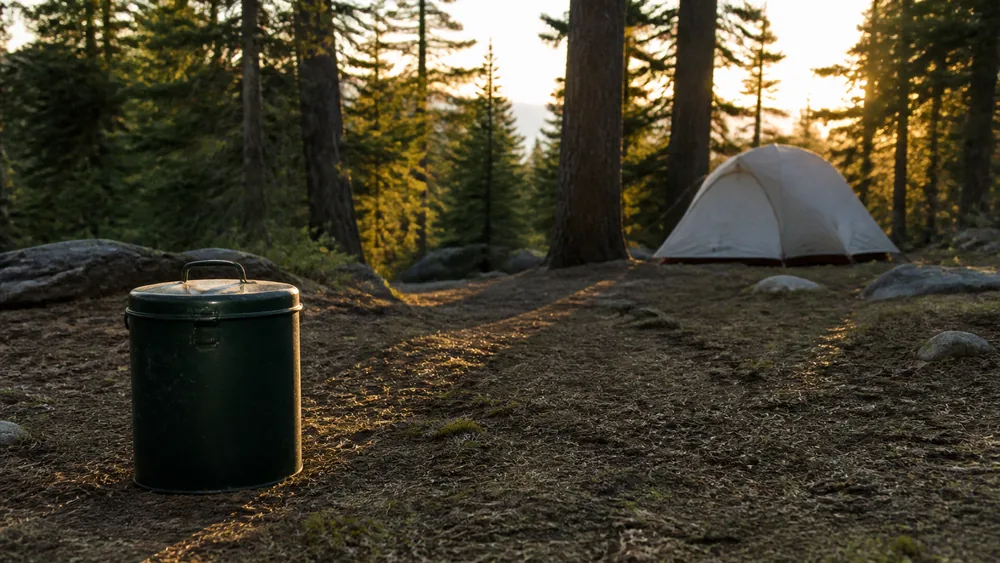
Cook and eat away from where you sleep, and store everything scented together and secured, well away from the tent. The point is to keep the smell and the sleeping bag in different places.
- Everything scented goes in the same secured place, including toiletries.
- Cook and eat well away from the tents rather than beside them.
- Use the storage the land manager requires, because a hang is not accepted everywhere.
- Finish clearing up before dark, since night is when camp visits happen.
- Sleep in clothes you did not cook in.
Check the rules for where you are going rather than assuming. Approved hard-sided canisters or fixed lockers are mandatory in a growing number of places, and a rope over a branch will not satisfy them.
The last argument for all of this is not about you.
A bear that learns to raid camps usually ends up destroyed, and the party that taught it rarely finds out. The habituated bear pays, along with whoever camps there next month.
Sources
The encounter behaviour and the species-specific attack responses used here, including standing your ground, identifying yourself by voice, the position for a defensive brown bear attack, the opposite instruction for black bears, and the rule that a bear attacking in a tent is treated as predatory, come from: National Park Service bear safety guidance.
The deterrent figures for spray, covering 83 Alaskan incidents between 1985 and 2006 and the 98 percent uninjured rate among people carrying it, come from: Efficacy of Bear Deterrent Spray in Alaska.
The firearm comparison, covering 269 incidents and the finding that carriers were injured at the same rate whether or not they fired, comes from: Efficacy of Firearms for Bear Deterrence in Alaska.
AnswersQuestions readers ask
Should you play dead or fight back during a bear attack?
It reverses. For a startled or defensive brown bear, play dead flat on your stomach with your pack on and hands behind your neck. For a black bear, or for any bear that stalks you or comes into your tent, fight back.
What do you do if a bear charges you?
Hold your ground. Many charges are bluffs that stop short or veer away, you cannot reliably tell the difference at speed, and running is the wrong answer to both.
Does bear spray actually work?
Across 83 Alaskan incidents it stopped the behaviour in 92 percent of brown bear cases and 90 percent of black bear cases, and 98 percent of people carrying it were uninjured in close-range encounters.
Is a firearm better than bear spray?
The Alaskan data says no. Firearm carriers were injured at the same rate whether or not they fired, with 24 percent injured, against 2 percent for people carrying spray.
What does it mean when a bear stands on its hind legs?
Usually curiosity rather than aggression. Standing lifts the nose and eyes so the bear can work out what you are, and it is one of the most commonly misread postures.
How do you keep bears away from a campsite?
Store everything scented, including toiletries, in whatever the land manager requires, and cook and eat well away from where you sleep. A bear that finds food at a camp starts seeking out camps.