
Is This Trail Safe for Hiking With Your Dog Today?
Check access first, then plan for leash control, paws, heat, water, and wildlife.
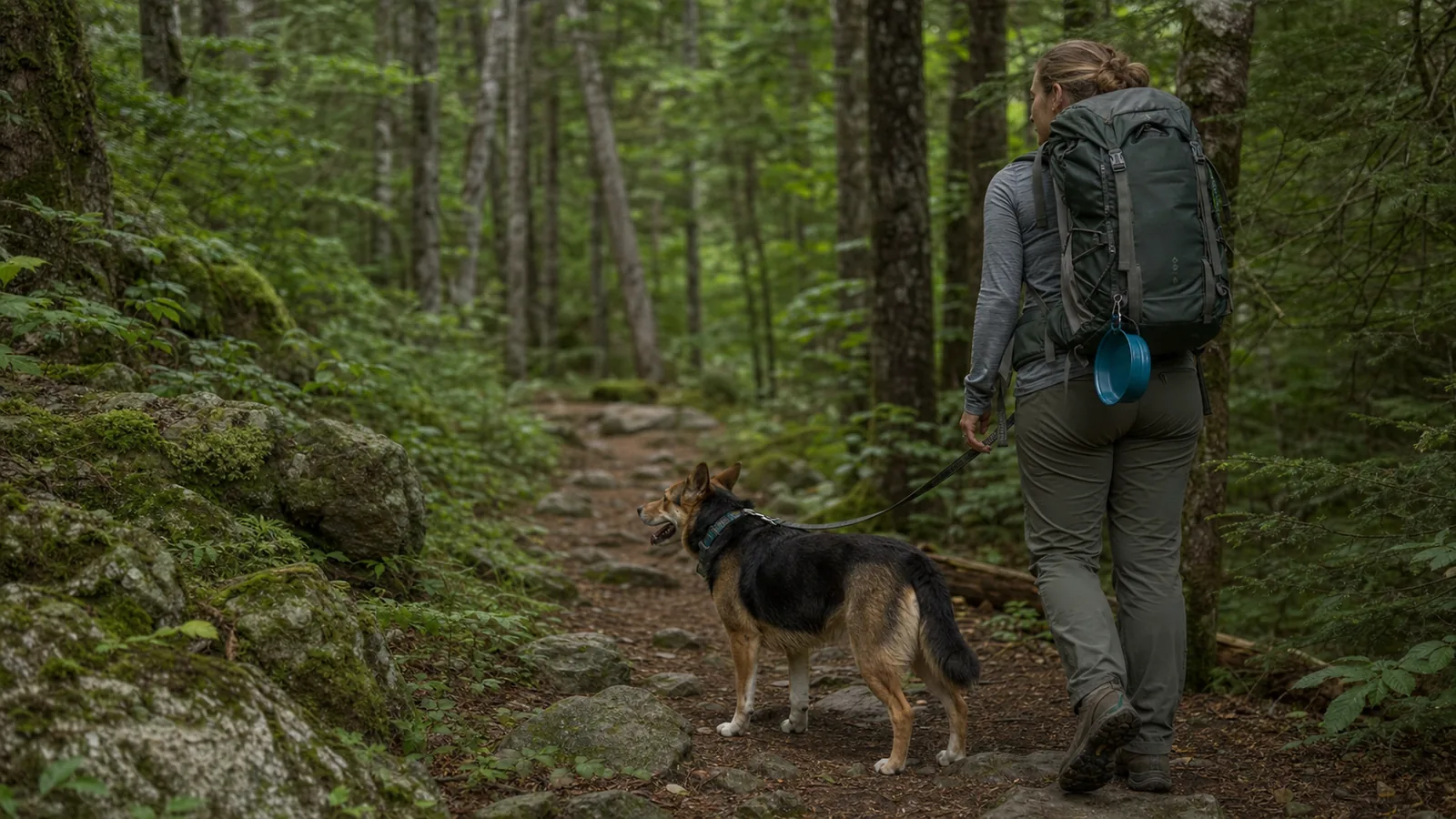
A trail can allow dogs and still be wrong for your dog today. Confirm the exact rule, prove leash control close to home, choose for paws and shade, carry clean water, keep wildlife separate, and leave when movement, behavior, or recovery changes.
Does this trail fit your dog today?
A dog hike needs three yes answers. Dogs must be allowed on the exact trail.
The route must fit the dog's body and behavior. The conditions must leave a calm, short exit.
One yes cannot replace another.
A park may welcome pets on roads, campgrounds, or paved paths while closing backcountry trails and boardwalks.
A legal trail can still be too hot, sharp, narrow, icy, crowded, or exposed. A fit dog can still be unready to pass horses or other dogs on a leash.
Permission is the first gate rather than proof that the hike fits.
- Permission
- The current official page allows dogs on this exact trail and date
- Control
- The handler can shorten the leash, turn around, wait, and pass without a lunge
- Body
- The dog has recent easy walks that match the planned time and surface
- Route
- Shade, width, exits, paw surface, and obstacles fit the dog and handler
- Conditions
- Heat, cold, rain, wildlife, and crowds stay below the dog's tested limit
- Exit
- The handler can reverse early and has a realistic way to help an injured dog
If permission or control fails, leave the dog home.
If surface, heat, crowd stress, or exit is uncertain, choose a shorter and easier trail. Do not drive to the trailhead hoping the dog will settle after the first mile.
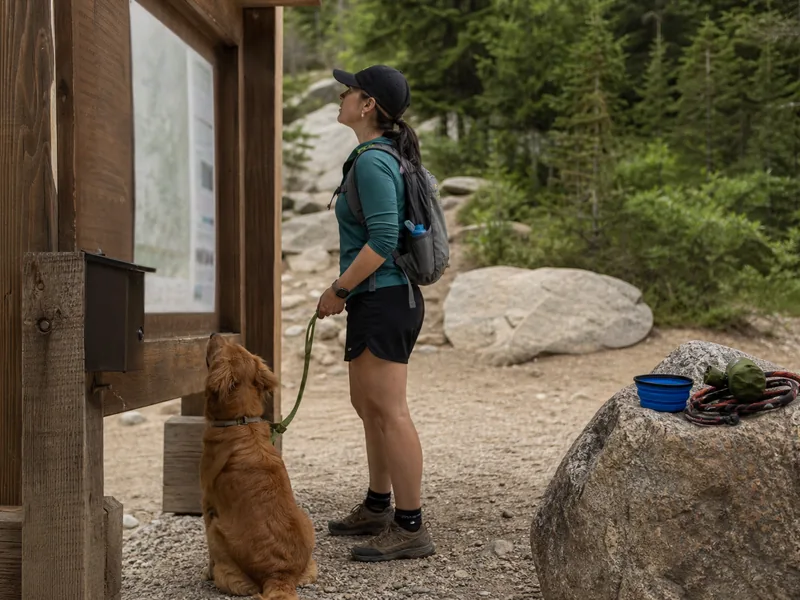
You should check the official land-manager page for the trail, not a crowd-sourced dog icon. Look for dog access, leash length, seasonal wildlife closures, waste disposal, shuttle restrictions, campground limits, and any segment where the route enters a different jurisdiction.
A saved copy of the rule page keeps the details available after you leave cell service.
National Park Service guidance says to check each park because many parks do not allow pets on hiking trails or boardwalks.
It also recommends a leash no longer than six feet for park hikes. The local rule remains controlling.
A forest, city trail, refuge, and national park may use different limits.
The human route still needs the normal trail choice process and day-hike checks done first. Add dog needs after water, weather, navigation, light, and the human exit are covered.
Can you control your dog before reaching the trail?
A leash rule and leash skill are different. The handler needs to control length, direction, stops, and passes while also using a map, opening a gate, picking up waste, or moving around an obstacle.
Run a 30-minute rehearsal on a familiar path. Use the same collar or harness and physical leash planned for the hike.
Include a narrow pass, a stop, a U-turn, a water break, a dropped item, and a calm wait while another dog or person remains at a safe distance.
Control must work under distraction before the trail adds wildlife or exposure.
- Fit the equipmentConfirm that two fingers fit under the collar or harness and that hardware is not damaged.
- Walk with slackThe dog can move without constant pulling while the handler keeps the leash out of feet and poles.
- Call closeBring the dog beside the handler before a narrow pass rather than after contact begins.
- Make a U-turnReverse direction without dragging the dog or wrapping the leash around legs.
- Wait under distractionHold a calm position while a person or dog passes at a workable distance.
- Handle one taskPick up waste or open the map while the other hand keeps secure control.
- End on a calm cueReturn home if repeated lunging, panic, or pulling does not settle in the easy setting.
A friendly dog can still rush a child, crowd a fearful hiker, trigger another dog, or move behind a horse. A reliable recall does not replace a physical leash where the rule requires one.
It also does not protect against a sudden scent, falling rock, or an off-leash dog around a blind corner.
Your grip should stay secure without tightening across your fingers during a sudden pull.
Do not clip the leash to a weak pack loop. Hands-free systems can free a hand, but a pull can unbalance the handler on rock, stairs, or a narrow side slope.
The exact setup needs a test on easy ground before it reaches a trail.
Your dog should stay home when new spaces, dogs, people, bikes, or leash restriction reliably produce fear or aggression. The NPS makes the same recommendation for reactive pets.
A busy trail is a poor training classroom because other visitors cannot consent to take part.
How do you build a dog up to a longer hike?
Your dog's longest recent easy walk is the baseline. The dog should finish with normal gait, attention, drinking, and leash behavior, then move normally later that day and the next morning.
Change one demand on the next rehearsal. Add a little time, a short climb, a new surface, warmer conditions, or a busier setting, but do not combine them on the same first test.
For example, a dog comfortable for 45 minutes on cool packed dirt might try 55 minutes on the same route. That result says more than moving straight to a 90-minute rocky trail because the cause of any paw, heat, or behavior change remains visible.
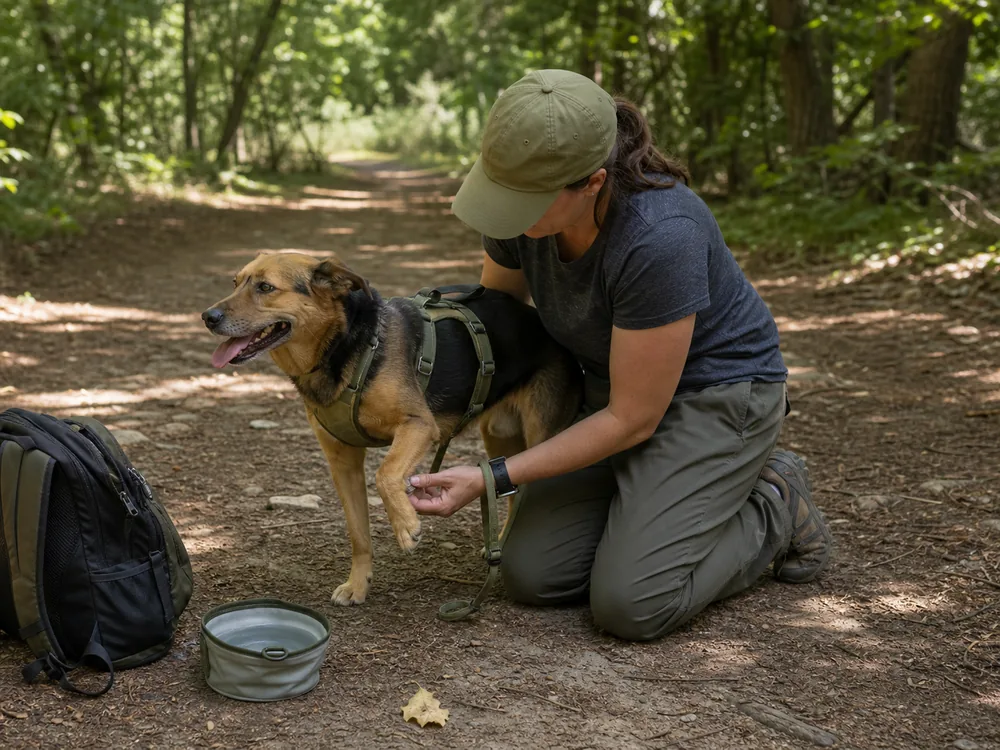
Repeat a successful step before adding another. Dogs can stay eager while pads, joints, or temperature control are already losing margin, so enthusiasm is not the recovery measure.
For the next 24 hours, you should check paws, strap contact areas, appetite, drinking, stairs, rising from rest, and ordinary walking. Reduce the next outing when limping, repeated paw licking, unusual stiffness, poor appetite, or subdued behavior appears.
A veterinarian can explain how age, growth, body shape, health, medication, past injury, and local disease risks affect progression. Puppies and dogs with medical conditions need individual advice rather than a distance formula.
These short walks are where you can practice trail skills. Calm passes, a U-turn, water from the carried bowl, paw handling, and a short rest in shade should work before distance grows.
The final rehearsal should match the planned surface, equipment, and likely weather while staying close to an easy exit. If the dog cannot recover normally from that smaller version, choose a shorter trail.
Recovery earns the next increase. Add distance only after the dog handles today's time, surface, equipment, and conditions without a lasting change.
Which surfaces, shade, and exits fit your dog?
The route should reflect your dog's lowest margin. A dog may have strong aerobic fitness but tender pads, good paws but poor heat tolerance, or calm behavior until a narrow trail forces close passes.
Your first route should be shorter than the dog's longest recent walk. Match time and surface before adding climb.
A dog that handles 90 minutes on cool dirt has not proved 90 minutes on sharp rock in sun.
The weakest margin decides rather than the dog's excitement at the car.
| Route feature | What it asks from the dog | Better early choice | Reject when |
|---|---|---|---|
| Packed dirt | Steady walking and normal paw wear | Short shaded out-and-back | Deep mud hides holes or forces edge travel |
| Sharp rock | Tough pads and careful placement | Brief known segment | Pads are soft, cracked, or recently abraded |
| Open slab or sand | Heat tolerance and paw protection | Cool morning with nearby shade | Surface is hot or the return stays exposed |
| Ice or crusted snow | Paw comfort, balance, and cold tolerance | Flat short route with proven equipment | Repeated slipping, ice balls, or lifted paws |
| Narrow ledge | Close leash control for dog and handler | Wide trail with durable passing spots | A pull could cause a fall |
| Ladder or scramble | Safe body handling and a carry option | Walkable trail without lifting | Dog must jump blind or be hauled by the collar |
| Crowded multi-use trail | Neutral passes around bikes, dogs, and children | Quiet time on a wider path | Dog cannot remain close without lunging |
| Long loop | Reliable conditioning and few exit needs | Out-and-back with early turns | One injury or heat problem creates a long carry |
Consider two four-mile routes. A shaded out-and-back on packed dirt gives you a turn every few minutes and wide passes.
A rocky loop crosses exposed slab in mile three. The numbers match, but the loop commits paws and heat tolerance after the easiest exit has gone.
The shaded out-and-back is the safer choice.
Estimate the time added by sniffing, waste, water, paw checks, and passes.
The dog's pace may be quick, but the handler jobs make elapsed time longer. Use that slower return pace in the daylight and heat plan.
Distance, gain, surface, access, and exits get screened the same way as any first-time route choice for people. Rain and winter change dog footing and body temperature too, so rain hiking decisions and the winter hiking plan both apply when those conditions show up.
Pack for water, control, waste, and a carry-out
Dog gear has four main jobs.
It supplies clean water, preserves physical control, contains waste, and handles a small paw or mobility problem. Keep the human navigation, light, layers, first aid, food, and water intact.
Do not make an unconditioned dog carry a pack to reduce the human load. A pack changes heat, rubbing, balance, and effort.
An experienced dog may carry a light, well-fitted load after veterinary and product guidance, but the handler still needs a plan if the dog can no longer carry it.
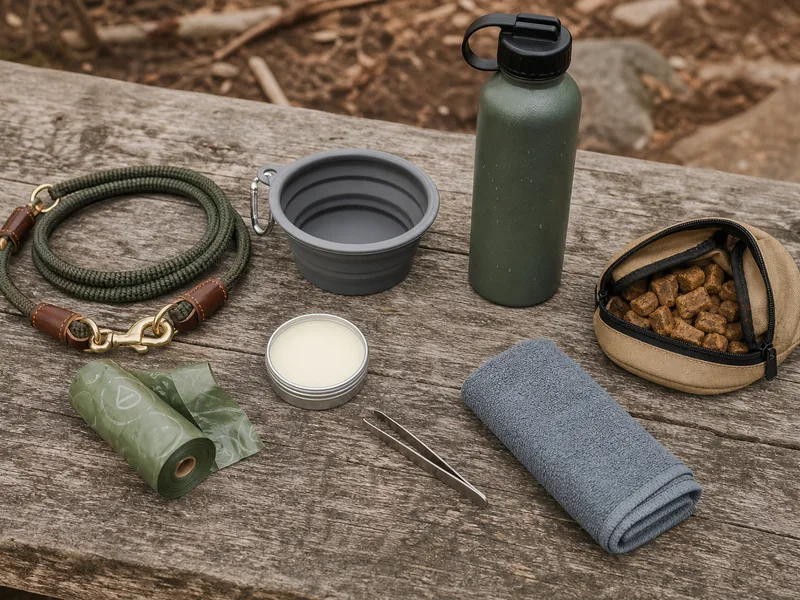
Your kit should solve a problem and support an exit you can complete.
- Physical leash that meets the exact rule plus a secure backup connector.
- Fitted collar or harness with readable identification.
- Dog water measured separately from the human supply.
- Collapsible bowl that can be reached without unpacking the safety kit.
- More waste bags than the expected number of stops plus a sealed carry container.
- Paw-cleaning cloth, bandage supplies, and any booties already tested at home.
- Tweezers or a comb for burrs as appropriate to the route.
- Small towel or dry insulation for a wet or cold stop.
- Normal small trail food or reward that agrees with the dog's stomach.
- Emergency veterinarian and local clinic details saved before the drive.
- A realistic carry aid or enough help to move the dog from the farthest point.
The carry plan is the item many handlers skip. A medium or large dog may be impossible for one person to carry over rough ground.
Your route should stay close enough to a road or help unless another capable adult or a tested evacuation sling makes the carry plan realistic.
The bowl, bags, paw supplies, and leash backup should remain reachable in under a minute.
Food and dog waste need separate containers. Pet food can attract wildlife, so follow local food-storage rules at the car, campsite, and trail.
The normal hiking packing list comes first, and the dog items get added on top. A human water carry estimate covers the handler only, but the dog's supply remains a separate amount chosen with veterinary guidance, weather, time, effort, and reliable refills.
Which water sources are unsafe for dogs?
Your carried supply should cover the dog without relying on every blue line on the map.
Offer small drinks at planned checks and after effort changes. Ask a veterinarian for advice specific to the dog's size, health, diet, and conditions instead of applying one universal volume.
Panting does not give a precise water prescription. It can rise with heat, exercise, stress, or pain.
You should read drinking together with pace, attention, drooling, shade-seeking, gait, and recovery.
Clear water is not proof that a source is safe for a dog.
Known carried water
This is the baseline because source quality and access are controlled.
Stagnant or slow water
Germs and animal urine may contaminate it, so the dog should stay out.
Discolored or bad-smelling water
The dog should not drink, swim, or play there.
Foam, scum, algal mats, or paint-like streaks
These signs can warn of harmful algae, so leave the water edge.
Dead fish or animals
Dogs and people should stay away, and posted health warnings apply.
Fast cold stream
Water access is not worth a fall, leash entanglement, or swept dog.
Unknown clear source
The planned carried supply avoids a guess while you follow veterinary and land-manager advice.
CDC pet travel guidance tells owners to avoid stagnant water and water that is discolored, smells bad, has foam, scum, algal mats, paint-like streaks, or dead animals nearby. Keep the dog from swimming or playing there as well as drinking.
Leptospirosis bacteria can spread through urine from infected animals and contaminate water or soil.
Slow or stagnant water can be an exposure. Talk with the dog's veterinarian about vaccination and prevention for the places and activities planned.
A website cannot decide that medical question for one dog.
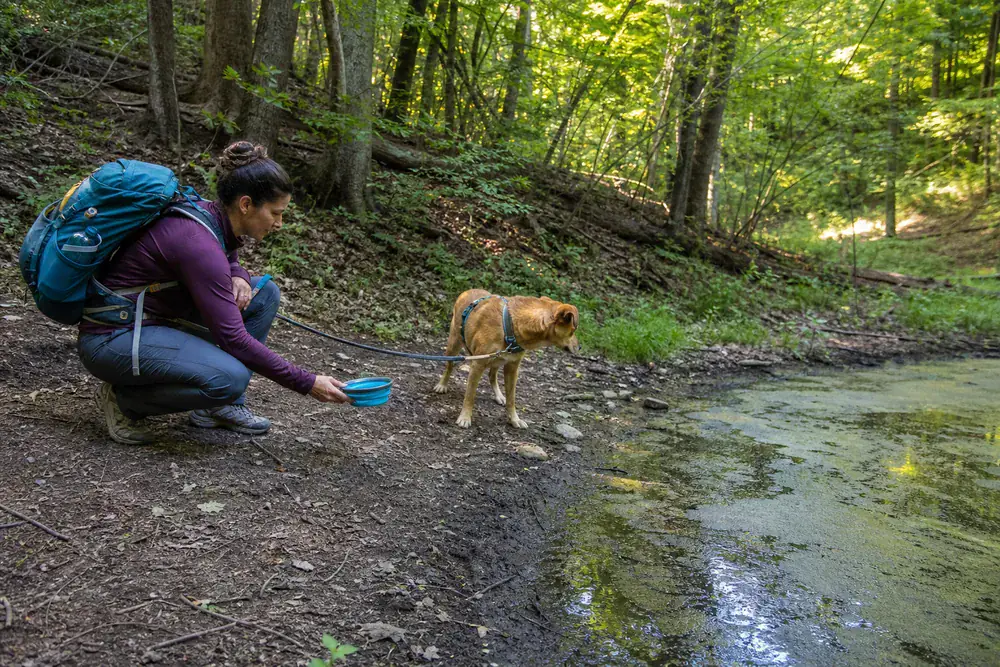
Do not let the dog enter fast water to reach a drink. A leash can snag, and the current can pull the dog and handler off balance.
Step back from the edge, use the bowl, and keep the route on stable ground.
How do heat and paw condition change the hike?
Your dog's normal easy-walk behavior is the comparison point.
The useful check covers panting, saliva, attention, pace, body position, paw placement, and how quickly the dog settles in shade. One sign may be ambiguous.
A persistent cluster means the route no longer fits.
The NPS lists excessive panting, drooling, and vomiting as overheating warnings.
You need to move the dog to a cooler area and offer water. Severe signs, collapse, confusion, repeated vomiting, or failure to improve require prompt veterinary help.
Call ahead and follow professional instructions.
Paws and heat interact.
Hot slab can injure pads while the same exposed segment raises body heat. Sharp rock can make the dog shorten steps, which the handler may mistake for tiredness.
Wet grit can soften and abrade skin between the toes.
A changed gait is an exit signal even when the dog still wants to follow.
| Observed change | Possible field problem | Immediate action | Next decision |
|---|---|---|---|
| Panting stays high in shade | Heat, effort, stress, or pain | Stop in a cooler place and offer carried water | End the route if recovery is not prompt and normal |
| Heavy drooling or vomiting | Possible heat illness or another urgent problem | Cool, exit, and contact a veterinarian | Seek prompt professional care |
| Lagging or lying down | Fatigue, heat, pain, fear, or illness | Stop and assess the whole dog | Take the shortest calm exit |
| Lifting one paw | Hot surface, thorn, cut, ice, or irritation | Move off the surface and inspect safely | Protect the paw or carry out |
| Licking paws repeatedly | Abrasion, burr, grit, or pain | Check pads and between toes | Do not continue onto rougher ground |
| Limping | Pain or injury | Stop the hike and reduce weight on the limb | Arrange a supported exit and veterinary advice |
| Frantic pulling or shutdown | Fear, wildlife, crowd stress, or overload | Increase distance and leave the trigger | Choose a quieter route next time |
| Normal movement after shade | Short-term effort may be settling | Recheck water, paws, and route | Continue only on an easier return |
Do not rely on a fixed hand-on-ground count to prove a surface is safe.
Shade, material, color, wind, and pad condition differ. Check the dog's foot placement and choose shaded natural tread when heat is building.
An early or cool start cannot guarantee a safe return after the sun reaches exposed rock.
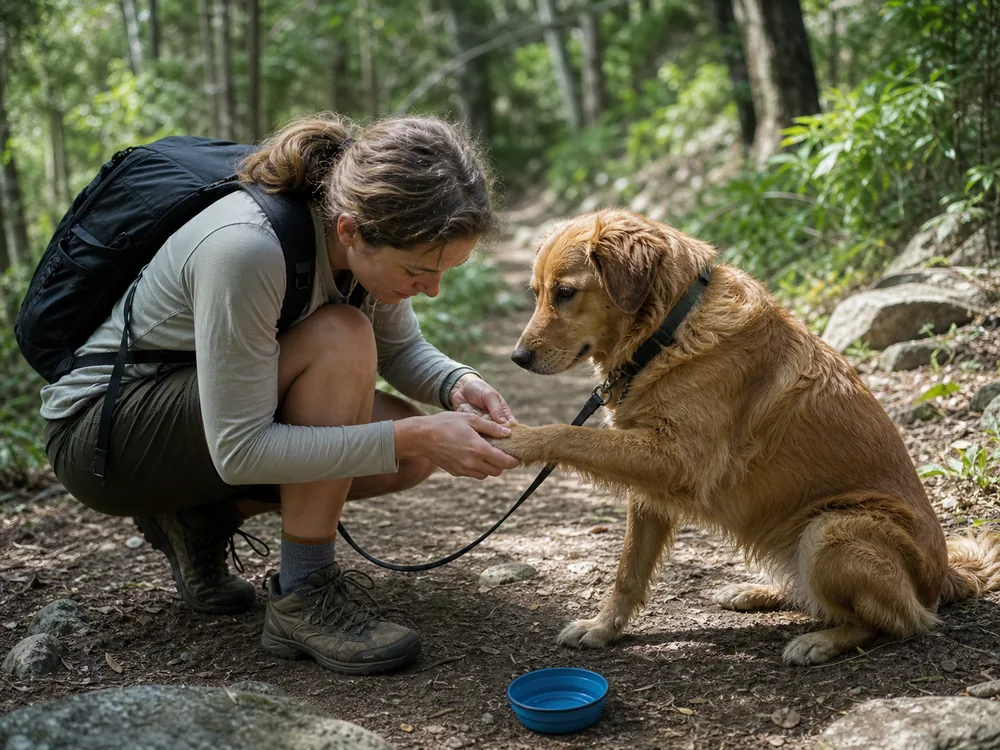
Booties help only when they fit, stay secure, and the dog has learned to move in them before the hike. They can rub, trap grit, or hide a problem.
Booties need testing on short walks and removal during paw checks. They do not justify sharp or hot terrain beyond the dog's conditioning.
Age, health, coat, body shape, medication, and past heat tolerance can change risk.
Puppies, older dogs, short-nosed dogs, and dogs with medical conditions need individualized veterinary guidance. Early starts and shaded routes come from the same hot-weather timing choices people use, but the dog may reach its limit first.
How should you pass hikers, bikes, horses, and dogs?
Begin the pass before the other party reaches the dog. Call the dog close, shorten the leash without creating constant neck pressure, move to a durable wide spot, and keep the dog's body on the side away from the pass.
Do not ask for a greeting by allowing the dog to approach.
You can ask about contact only when it is appropriate, and you should accept no immediately. Children, fearful hikers, working service animals, and dogs recovering from illness should not have to avoid an extended leash.
Neutral passing is the standard rather than friendliness.
- See the pass earlyChoose a wide durable spot before the leash space disappears.
- Call the dog closePlace the dog beside or slightly behind the handler.
- Shorten the leashRemove the crossing line without winding it tightly around the hand.
- Ask what the other party needsFollow a rider's or bike user's instruction when safe.
- Keep bodies separatedDo not allow nose-to-nose contact or a swing behind a horse.
- Wait until fully clearPrevent the dog from turning into the passing party.
- Resume only when calmIf barking or lunging continues, reverse the route or create more distance.
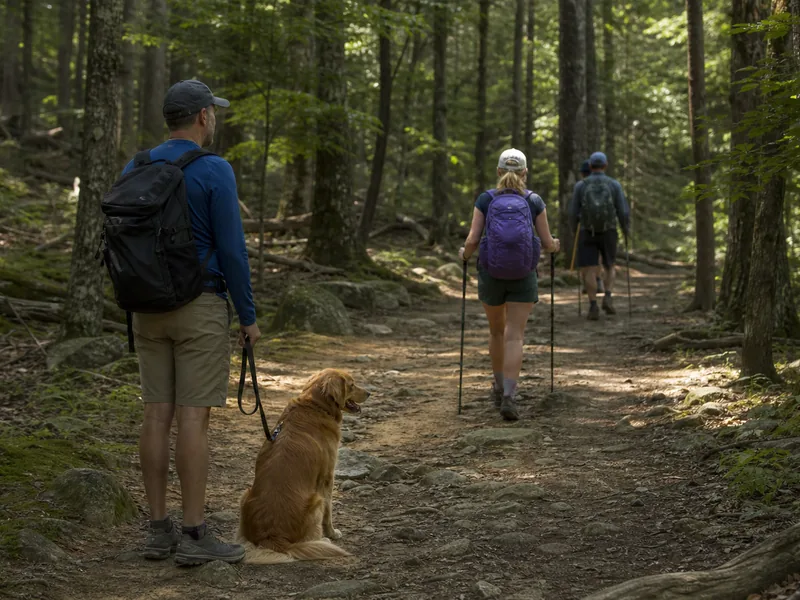
Give horses much more space.
The dog should stay visible to the rider, quiet, and close. Neither you nor the dog should move suddenly behind the horse.
The rider can tell you where to stand because terrain and horse behavior may change the safest arrangement.
Bikes can appear quickly. Use a short physical leash, listen for warnings, and avoid standing across the trail.
A retractable line or long leash can become a trip line before the handler reacts.
Your dog should stay away from wildlife, nests, burrows, carcasses, feces, and food remains.
Domestic animals and wildlife can injure each other or exchange disease. A leash also prevents the dog from flushing hidden animals out of habitat.
Bag waste immediately and carry it out unless the land manager gives another disposal method. A tied bag beside the trail is still litter and may be forgotten or torn open.
Pet waste can contaminate water and spread disease.
A dedicated hard-sided or odor-resistant container keeps a full bag outside the food area. If the handler cannot carry the dog's waste for the full distance, choose a shorter dog route.
Yielding, sound, durable surfaces, and other shared-trail habits apply well beyond dog handling.
When should you turn around with your dog?
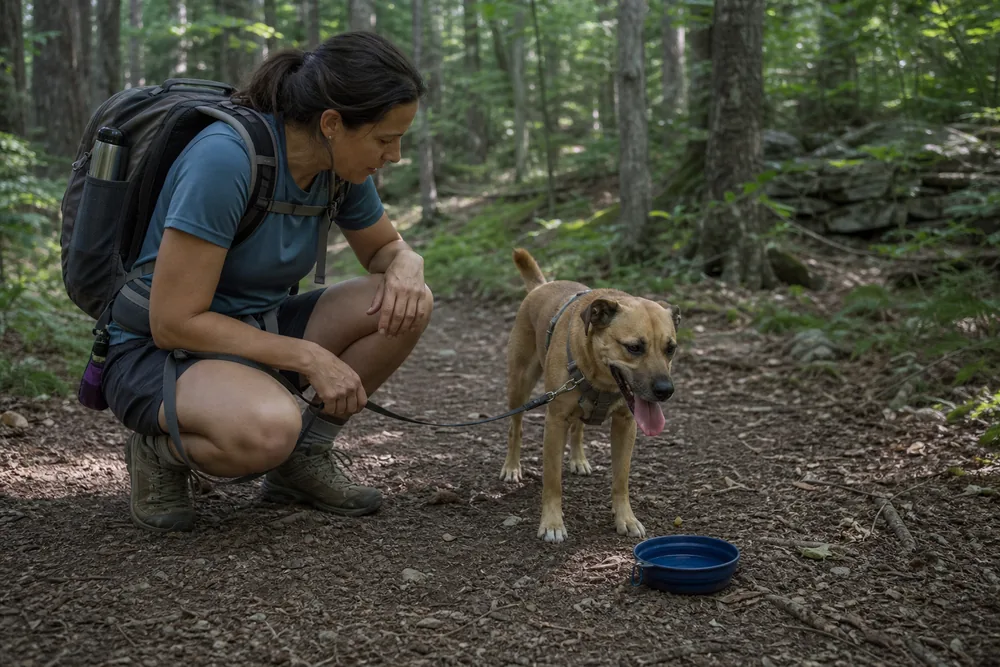
You should establish the dog's normal state at the trailhead by noting gait, interest, panting, leash behavior, paw placement, drinking, and response to simple cues.
Recheck after the first climb, before exposed or rough ground, at the turnaround, and after any stressful pass.
A dog that is excited may keep moving through discomfort. The handler decides from observable changes rather than waiting for refusal.
The first persistent change sets the exit when a short rest does not restore normal behavior.
| State change | What to check | Field decision |
|---|---|---|
| Lagging after normal pace | Heat, paws, fear, pain, and water response | Stop, assess, and take the shortest exit if it persists |
| Repeated lying down | Shade recovery, attention, breathing, and gait | End the route rather than coaxing forward |
| Refusing water with changed behavior | Vomiting, distress, weakness, or confusion | Exit and contact a veterinarian |
| New limp or lifted paw | Pads, toes, nails, burrs, cuts, and heat | Protect or carry the dog and stop hiking |
| Repeated lunging or panic | Trigger distance and handler control | Create distance, reverse, and choose a quieter route later |
| Normal trail behavior but poor next-day gait | Stairs, rising, appetite, and paw licking | Reduce the next route and seek veterinary advice when needed |
| Tick found after the hike | Full-body check and later behavior or appetite | Remove promptly and follow veterinary guidance |
At the car, check all four paws, between toes, nails, gait, gums and breathing as appropriate, water response, and behavior. Clean mud and grit.
Note any rubbing under the collar, harness, or pack.
A post-hike tick check should follow every outdoor trip.
CDC guidance highlights the ears, eyelids, under the collar, front legs, between toes, between back legs, and around the tail. Long or dark coats need a slow hands-on check.
A tick needs prompt removal followed by veterinary advice.
Behavior or appetite changes from a tick-related illness may appear later. The CDC notes that signs can take 7 to 21 days or longer after a bite.
You should keep the date and location of the hike, then contact a veterinarian if concerning changes appear.
Recovery decides the next route.
Normal enthusiasm at the trailhead does not erase limping on stairs, paw licking, unusual stiffness, poor appetite, or an unusually subdued day after the hike. Repeat the easier route only after normal movement returns and veterinary advice supports it.
Your route, weather, communication, and turnaround decisions still need the ordinary hiking safety plan. The dog adds another body and another set of decisions, so the final route should become simpler rather than more ambitious.
Step by stepPractical steps
- Confirm dogs are allowed on the exact trail and date, including leash and waste rules.
- Prove close control, U-turns, waits, and calm passes on an easy local walk.
- Choose a route for shade, paw surface, width, wildlife, and an early exit.
- Carry separate dog water, a bowl, identification, waste storage, paw care, and a carry plan.
- Screen every natural water source and keep the dog away from stagnant, discolored, foamy, or bad-smelling water.
- Compare panting, gait, paws, attention, drinking, and leash behavior with the dog's normal state.
- Take the shortest calm exit on the first persistent change and use recovery to size the next hike.
AnswersQuestions readers ask
Can dogs go on all hiking trails?
No.
A park may allow pets in developed areas while closing specific trails, boardwalks, shuttles, or wildlife zones. Check the current official page for the exact trail, date, leash length, and waste rule.
How much water should I bring for my dog?
Plan the dog's supply separately from yours and ask a veterinarian for guidance based on the dog's size, health, food, weather, time, and effort. Carry known water and offer small drinks during planned checks instead of waiting for severe panting.
Should my dog wear booties?
Booties may help on sharp, cold, or abrasive surfaces only when they fit and the dog has practiced in them. They can rub, trap grit, or hide a problem, so remove them for paw checks and do not use them to justify unsafe terrain.
What are signs my dog should turn around?
Persistent lagging, lying down, heavy panting that does not settle in shade, drooling, vomiting, lifted paws, licking, limping, poor attention, panic, or loss of leash control means the route no longer fits. Use the shortest calm exit.
Do I have to pack out dog waste?
Follow the land manager's rule.
In most trail settings, bag the waste immediately and carry it out in a sealed container. Leaving a bag beside the trail for the return is still litter and risks forgetting it or having wildlife tear it open.
Can my dog drink from a stream or pond?
Carried water is the safer baseline. Keep dogs away from stagnant, discolored, bad-smelling, foamy, scummy, or algae-covered water and places with dead animals.
Even clear water can contain germs, so discuss local risks and prevention with a veterinarian.
Where should I check my dog for ticks after hiking?
Check the ears, eyelids, under the collar, front legs, between toes, between the back legs, and around the tail, then work through the whole coat. Remove ticks promptly and contact a veterinarian about later behavior, appetite, or health changes.