
Is It an Ankle Sprain or a Break, and Can You Walk Out?
Most advice about sprains was written for someone who gets to sit down afterwards.
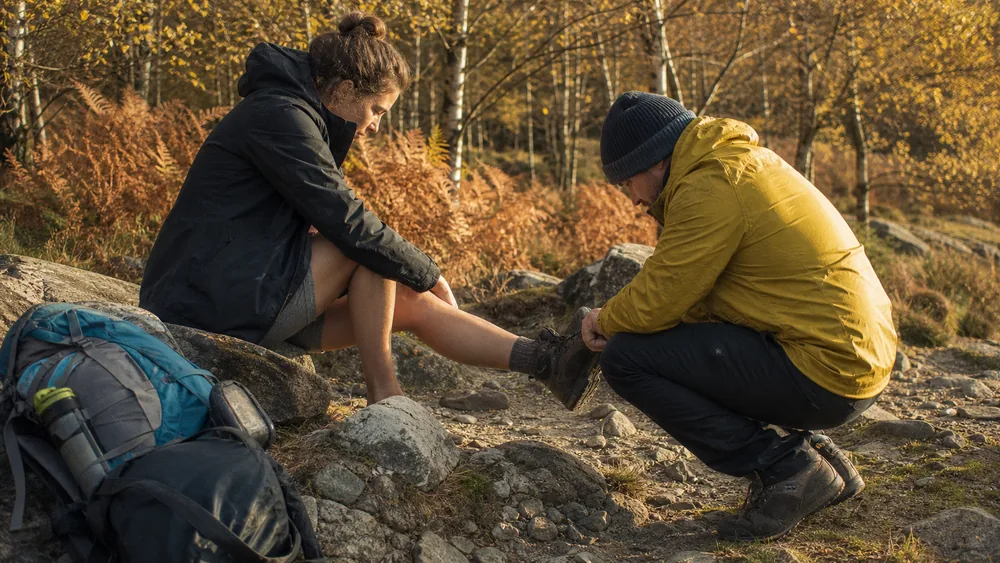
A rolled ankle out on a trail is a weight-bearing decision made against a swelling clock. The useful questions are whether this could be a break, and whether the person can still walk to the car before the joint decides for them.
A rolled ankle is the injury most likely to turn a good day into a long one. It is also the injury where nearly every piece of advice you have absorbed was written for somebody who gets to sit still afterwards.
Out here you usually cannot.
The joint is going to swell over the next hour whether the party likes it or not, and the distance back to the car does not shrink while everyone stands around deciding.
- Sit down, stay lacedGet the weight off, and leave the boot done up while you work out what has happened.
- Ask what the foot didAn outward roll, a twist with the foot planted, and a hard flat landing point at different injuries.
- Try four stepsWeight-bearing is the most useful single test available, and it often settles the question without anyone touching a lace.
- Press the bone pointsIf four steps are not possible, check the back edges and tips of both ankle bones and two specific points on the foot.
- Decide inside the first half hourWalking out is easiest before the swelling arrives, so make the call rather than sitting on it.
That order is deliberate. The cheapest test comes first, and it is the one most likely to make the rest unnecessary.
Can you tell a sprain from a broken ankle out here?
Pain and swelling are almost useless for telling the two apart. A bad ligament tear can swell into a grapefruit within the hour, while a small break at the end of the fibula can look like very little for the first twenty minutes.
So the party needs something better than an opinion about how bad it looks.
Emergency departments use a short screen for exactly this, built to decide who needs an X-ray without imaging everybody. It rests on two things a group can check on a rock, which is bone tenderness and four steps.
Start with the steps, because they cost nothing.
Get the person upright with a hand on a shoulder and ask for four steps, limping allowed. Somebody who can do that has already told you a great deal, and somebody who genuinely cannot is now a different problem for the rest of the day.
Then press the bone. Ligament injuries hurt over soft tissue, and the screen deliberately targets four bony points where tenderness suggests something harder than a sprain.
- The back edge and the tip of the outer ankle bone, along the lower few inches of the fibula.
- The back edge and the tip of the inner ankle bone, which people routinely forget to check.
- The bump you can feel on the outer edge of the midfoot, roughly level with the arch.
- The bony point on the top of the inner arch, forward of the ankle.
- Four steps taken unaided, however slowly and however much they limp.
A person with no tenderness at any of those points who can take four steps has a very low chance of a fracture. In the populations where this screen was studied, that figure sits under one in a hundred.
That is a screen and not a diagnosis.
It is designed to be over-cautious in the direction that matters, so tenderness at any of those points means treating the injury as a possible break, getting help rather than improvising, and having it looked at properly. What it buys the party is a defensible decision made in five minutes instead of an argument made over an hour.
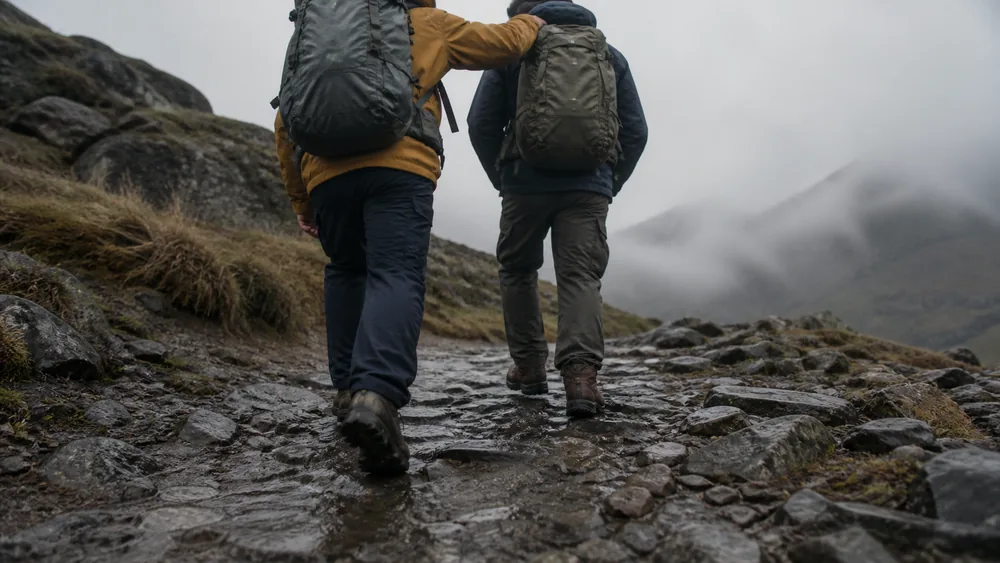
Leave the boot on
The reflex after a bad roll is to get the boot off and look at it. On a trail that reflex is usually wrong, because a laced boot is simultaneously a compression wrap and a partial splint, and it is the reason the person can still walk.
Swelling builds over the hours that follow.
There are real exceptions, and they are narrow. The boot comes off if the foot is going numb or losing colour, if there is a wound underneath, or if the party has already decided this person is not walking out.
Loosening one or two laces sits between the two positions. It buys a little room without surrendering the boot, and it is almost always the better middle option.
Not every rolled ankle is the same injury
The overwhelming majority of rolled ankles are the same movement. The foot turns inward under the leg, the ligaments on the outside take the strain, and the pain sits below and slightly in front of the outer ankle bone.
That is the injury most likely to be walkable, and it is what most people picture.
Two other patterns behave differently enough to matter. Pain sitting above the joint, in the gap between the two shin bones, points at the higher injury caused by rotation rather than a simple roll.
That one takes far longer to settle and deserves lower expectations from everybody.
| Where it hurts | What probably happened | What it changes today |
|---|---|---|
| Below and in front of the outer ankle bone | The common inward roll straining the outside ligaments | Most likely walkable with load off and poles in hand |
| Above the joint, between the shin bones, worse on twisting | A rotational injury to the join between the two shin bones | Expect much less distance and a far longer recovery |
| On the inner side of the ankle | A less common and often harder injury | Lower the plan, and treat a poor four-step result seriously |
| Along the outer edge of the foot | Possibly a break at the base of the fifth metatarsal | Back to the screening check, and treat it as a bone injury |
Pain on the inner side after a roll is uncommon. When it does turn up it tends to mean a more substantial injury, which is a reason to be less generous with the walk-out plan.
The point of separating these is not diagnosis. Where it hurts sets expectations, and a party that expects four slow miles behaves differently from one that expects two brisk ones.
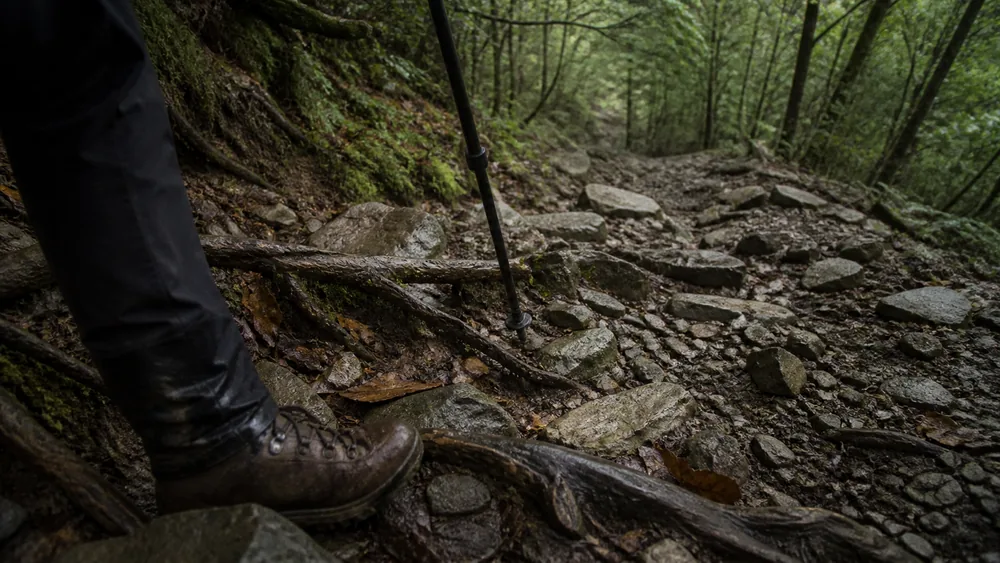
How do you get someone with a bad ankle back to the trailhead?
The mistake here is treating the walk out as the injured person's problem. It belongs to the whole party, and the useful changes are things everybody else does.
Start with the load, because nothing else comes close.
Every kilogram on that walker's back goes through the damaged joint on every step, so moving the pack onto other people is the single biggest reduction available. Splitting one pack across two people is easier than it sounds and beats heroics from the person who is already limping.
Move the weight
Take the pack off the injured walker entirely and split it between the others. This removes more force from the joint than anything else the party can do.
Two poles, not one
A pair lets the walker unload the ankle both as the foot lands and as it pushes off. A single pole only helps on one side of the stride.
Shorter steps, flatter line
Long strides and side slopes are what re-roll a fresh sprain. Aim the feet at flat placements even where it means a slower, uglier line.
Take the longer way
Extra distance on an easy track costs far less than a short steep descent on loose ground when the joint is already unstable.
Agree a turn-back point
Name a bridge, a junction, or a time where the party stops and reconsiders, so that decision is not made through gritted teeth in the dark.
Descent is the hard part, which is unfortunate because the way home is usually downhill. Going down loads the ankle harder than going up, and it demands more of exactly the control the injury has taken away.
A fresh sprain is also much more likely to roll again in the first hour.
That second roll is what converts a walkable injury into a carry, so the slow careful start is not fussiness. It is the part that protects the whole plan.
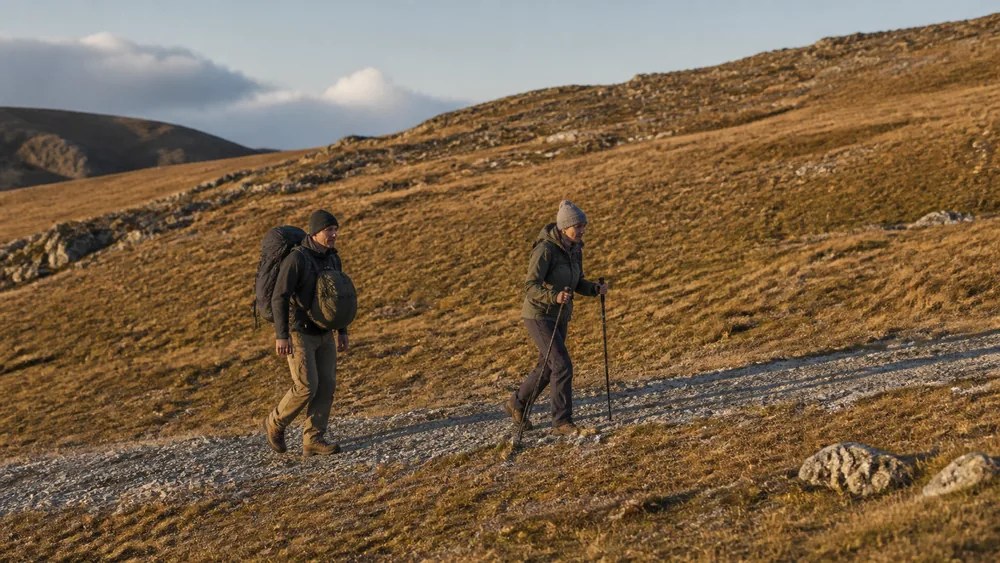
Ice and elevation are clinic advice, and you are not in a clinic
Most people can recite the old acronym about rest, ice, compression, and elevation. It was written for somebody who can get home, sit on a sofa, and put a bag of peas on a joint.
The field version has to survive a four-mile walk.
The guidance itself has moved on, and helpfully in your direction. Current soft-tissue thinking replaced rest with controlled loading, on the evidence that long periods off the joint make tissue worse and that sensible early weight-bearing restores function faster.
So the walk out is not a compromise you should feel bad about.
Within the limits set by the screen and by pain, moving on the ankle is closer to current best practice than sitting on it for two days would be. That is a genuinely useful thing to know while you are limping.
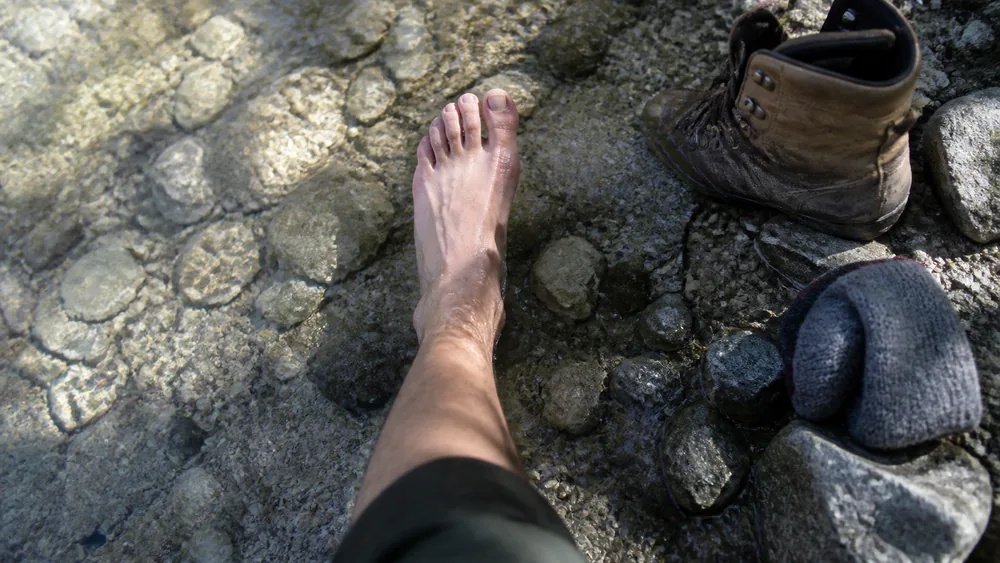
Cold water is the field version of ice and it is worth taking when the route hands it to you. A stream stop with the boot off for ten minutes at the end of the day is easy, though it is not worth engineering a detour for.
Elevation is the same kind of opportunistic measure.
It costs nothing in camp or in the car and it is simply not available while walking, so treat it as an evening job rather than a treatment plan. Loading beats resting, and the rest is comfort.
Do braces and taping actually work?
They do, for a specific group, and the honest version of that sentence matters more than the headline. The evidence on support is about preventing the next sprain in somebody who has already had one, not about protecting an ankle that has never been hurt.
For that group the effect is real and reasonably large.
Bracing cuts recurrence by roughly half. When researchers compared bracing against balance and neuromuscular training, both approaches produced a similar reduction and the evidence did not clearly favour either one.
Pros
- Cuts repeat sprains by around half in people who have sprained that ankle before
- Works from the moment it goes on, unlike training that takes weeks to show an effect
- Useful on a trip that starts before there is time to train anything
Cons
- No clear benefit for anyone who has never sprained an ankle
- Tape applied over a joint that is still swelling loses tension quickly and needs redoing
- A brace that will not fit inside your boot will not get worn, whatever the evidence says
Taping in the field is less impressive than it looks in a video. Tape wants a dry, clean, stable surface, and a swelling ankle inside a damp sock on a trail offers none of those.
The brace, if it fits the boot, is the more practical answer for a walker.
What actually stops the next one
The strongest predictor of an ankle sprain is having already had one. That is uncomfortable, because it means the useful question after a first sprain is what you do over the following weeks rather than what you do on the trail.
Balance training is the measure with the clearest numbers behind it.
In people who had already sprained an ankle, proprioceptive training reduced repeat sprains with a relative risk of about 0.64, which works out at roughly one sprain prevented for every thirteen people who complete a programme. It costs nothing beyond standing on one leg while the kettle boils.
The same reviews found no clear benefit for people who have never sprained an ankle, which is worth saying plainly.
- Balance training after a sprain
- Relative risk about 0.64, roughly one sprain prevented per thirteen people trained
- Bracing after a sprain
- Similar effect to training, and available immediately
- Never sprained before
- No clear benefit shown for either measure
- Fatigue and descent
- The two conditions under which most rolls actually happen
The trail-side half of prevention is less scientific and just as real. Most rolls happen late in the day and on the way down, when the legs are tired, the light is going, and foot placement quietly stops being deliberate.
Nobody rolls an ankle while concentrating.
Which makes the practical version of all this fairly small. The last hour deserves attention, and an ankle that has gone once has earned a few weeks of standing on one leg.
Sources
The bone-tenderness points and the four-step weight-bearing test come from the standard emergency screen used to decide who needs ankle imaging, along with the very low fracture rate when every element is negative: Ottawa Ankle Rules.
The shift from rest to optimal loading in soft-tissue injury management, and the reasoning that prolonged unloading harms recovery, are set out in the editorial that proposed replacing the older acronym: PRICE needs updating, should we call the POLICE?.
The recurrence figures for balance and proprioceptive training, including the relative risk of 0.64 and the number needed to treat of about thirteen, and the absence of clear benefit in people with no previous sprain, come from an evidence-based review: Proprioceptive Training for the Prevention of Ankle Sprains.
The comparison showing bracing and neuromuscular training each reduce recurrence by around half, with no clear advantage to either, comes from a systematic review and meta-analysis: Proprioceptive and neuromuscular training compared to bracing.
AnswersQuestions readers ask
How do you know if an ankle is sprained or broken?
Press the back edge and tip of both ankle bones, the bump on the outer edge of the midfoot, and the bony point on the inner arch, then ask for four steps. No bone tenderness and four steps taken means a fracture is unlikely.
Should you take your boot off after rolling an ankle?
Usually not, because a laced boot works as compression and a partial splint, and a swollen foot may not go back into it. Take it off for numbness, colour change, a wound, or if the person is not walking out.
Can you walk on a sprained ankle?
Often yes, and current guidance favours controlled loading over rest. Take the pack off the injured walker, put two poles in their hands, and shorten the stride.
How long does a sprained ankle take to heal?
An ordinary sprain on the outside of the joint settles far faster than a higher injury between the two shin bones, which can take months. Pain above the joint line that is worse on twisting is the sign to lower expectations.
Does an ankle brace prevent sprains?
It roughly halves recurrence in people who have already sprained that ankle, and shows no clear benefit for people who never have. Balance training produces a similar reduction but takes weeks to work.
When does a rolled ankle need outside help?
When the person cannot take four steps, when any of the four bone points is tender, or when the joint cannot carry weight far enough to reach the trailhead safely.