
Can You Go Backpacking With Kids Without Pushing the Day Too Far?
Size the first family overnight around repeatable child capacity, adult load reserve, a familiar camp routine, and a morning exit decision.
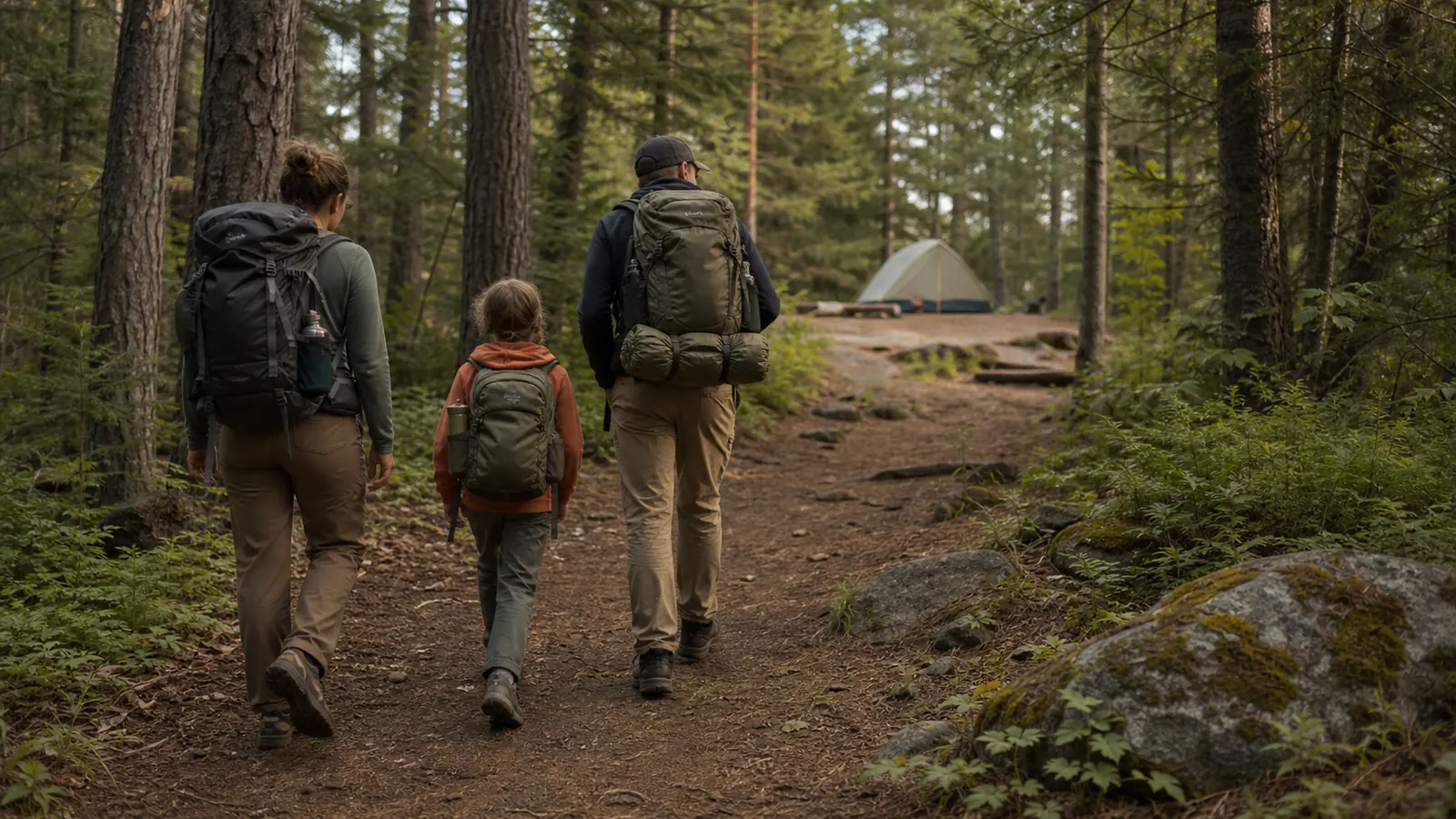
Backpacking with kids works when the route is small enough for the child to eat, get warm, sleep, and walk out the next morning. Adults should plan from the child's proven pace, carry the critical shared systems, keep room to absorb the child's load, and choose an exit that still works after a cold evening or poor night.
How much backpacking can a child repeat on day two?
A first family overnight should fit the child's repeatable capacity, not the farthest distance an adult can persuade the child to finish. The walk into camp is only the first part of the test.
Backpacking adds jobs that a day hike never asks the child to absorb. The family must make camp, change layers, eat, handle the bathroom, settle after dark, sleep in an unfamiliar place, and pack again before walking out.
A child may arrive excited and then lose appetite, warmth, patience, or coordination while the adults still feel capable. That difference matters because adults can carry discomfort farther.
A child often shows the limit through quieter behavior, repeated stops, stumbling, tears, or an inability to complete a familiar task.
Let the slowest hiker set the moving pace, as the National Park Service recommends. Then add time for looking at things, eating, using the bathroom, changing layers, and solving small worries.
These pauses are part of the family pace rather than delays to recover later.
The route also has to leave the adults with unused capacity. One adult may need to carry a child's pack while another manages navigation, water, shelter, or a distressed child.
A plan that already consumes every adult's strength has no practical family reserve.
Success is simple. The child reaches camp with enough attention to eat and get warm, sleeps well enough to function, and can walk toward the exit without being pushed.
Plan for the walk out, because first-day enthusiasm cannot finish the second day for them.
The broader backpacking foundation explains shelter, sleep, food, water, and camp work. This family plan assumes the adults already own those jobs and now need to size them around a child.
What should a child prove before a first overnight?
Wanting to sleep outside is useful motivation, but it does not show that a child can manage loaded walking and camp on the same day. Readiness comes from observable practice, not a birthday or a universal mileage formula.
Start with day hikes that end before the child is depleted. The child should finish with a normal gait, explain hunger or rubbing, drink without a contest, and still handle a simple task at the trailhead.
A family day-hike baseline helps reveal the real pace and the kind of support the child needs.
- Finish a familiar day hike with normal walking and energy left.
- Carry a small fitted pack without leaning, rubbing, or repeated adjustment.
- Reach a snack, water bottle, warm layer, and rain layer without adult unpacking.
- Sleep in the planned shelter and sleep system close to home.
- Use the bathroom plan and headlamp without confusion.
- Wake, eat, dress, pack one personal item, and take a short walk the next morning.
- Tell an adult about cold, pain, fear, hunger, or a bathroom need early.
Run the sleep rehearsal in a backyard, local campground, or another legal place with an easy exit. Use the actual sleeping pad, sleeping bag, night clothing, headlamp, food, and bedtime cues.
A practice with different gear can hide the problem that the real trip will expose.
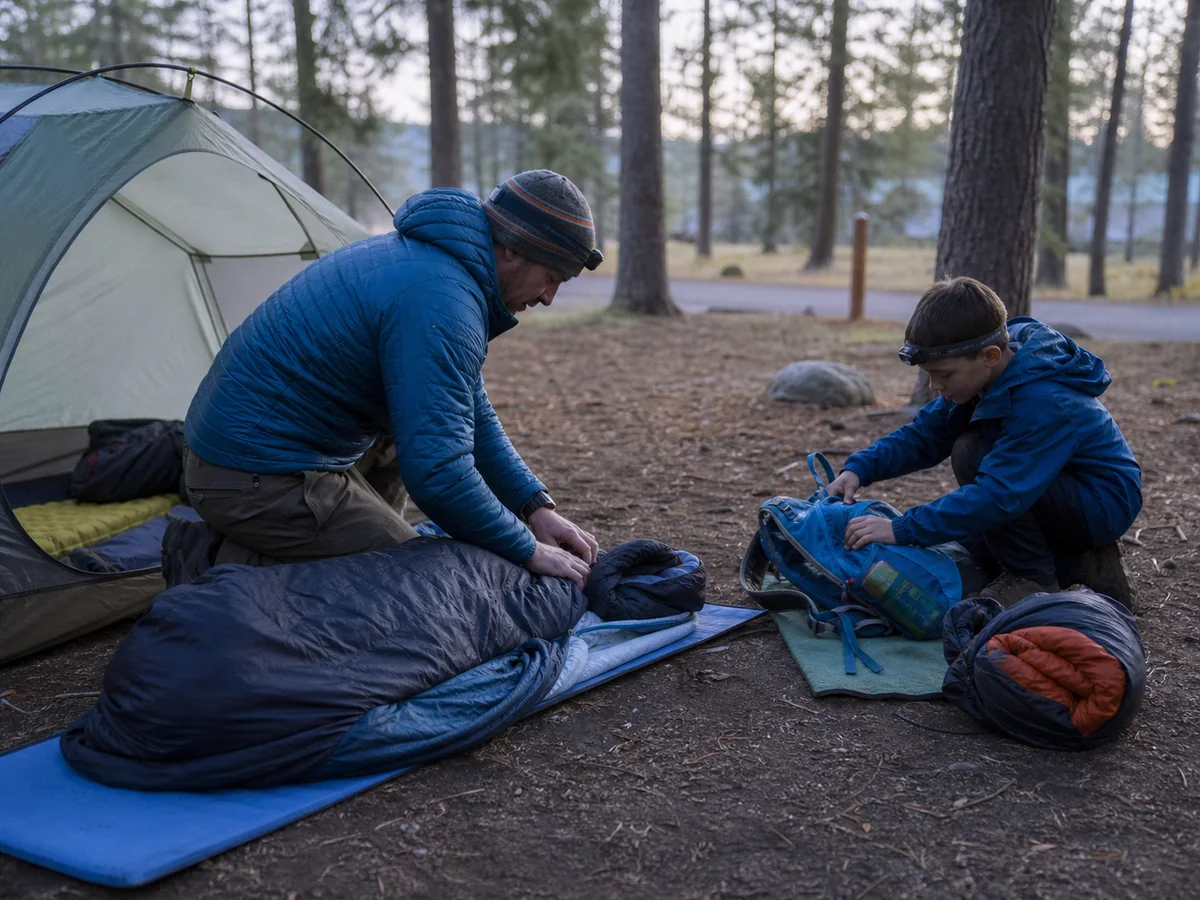
Observe the morning before selling the next adventure. Appetite, warmth, mood, feet, and willingness to walk tell you more than a quick yes when the child wants to please an adult.
When the rehearsal exposes poor sleep, fear after dark, cold feet, pack pain, or a hard morning, fix one cause and repeat the controlled night.
Proof beats age. Waiting for clearer evidence costs less than discovering the same limit beyond the trailhead.
Basic day hiking checks can support the practice walk, but the overnight must also prove sleep, darkness, food storage, and a second start.
The adults have to finish the route carrying more
Imagine that the child hands over the whole pack halfway to camp. If the adults cannot absorb it and still reach shelter or turn around safely, the route and load plan are already too tight.
Choose a short, established route with simple navigation, modest terrain, a verified legal camp, and a direct walk out. The same trail choice factors still matter, but the adults also need enough reserve to support the child.
REI suggests a first family campsite only a mile or two from the trailhead. Treat that as a conservative example, not a promise that every child or trail fits the same distance.
| Route feature | Forgiving first choice | Fragile first choice |
|---|---|---|
| Trail shape | Clear out-and-back with known junctions | Loop or traverse that removes easy retreat |
| Terrain | Stable tread and modest climbing | Long descent, rough crossings, or exposed scrambling |
| Camp | Legal established site confirmed in advance | Informal spot the family hopes will be usable |
| Water | Current source information plus carried reserve | One small source that may be dry |
| Exit | Same route back to a road or staffed area | Exit beyond the hardest terrain |
| Timing | Several spare daylight hours at camp | Arrival depends on the child's fastest pace |
| Adult load | Space and strength to take child gear | Every adult pack already feels full |
Water can veto an attractive campsite. Verify the current source with the land manager and carry enough capacity for the dry section, camp, breakfast, and the walk to the next reliable source.
The trip water calculation should include the child and a delay margin rather than using the adult total twice.
Check current permits, fire rules, food storage, wildlife guidance, closures, and campsite restrictions for the exact area. A family plan needs fewer unknowns because one adult may be occupied with the child while the other solves the field problem.
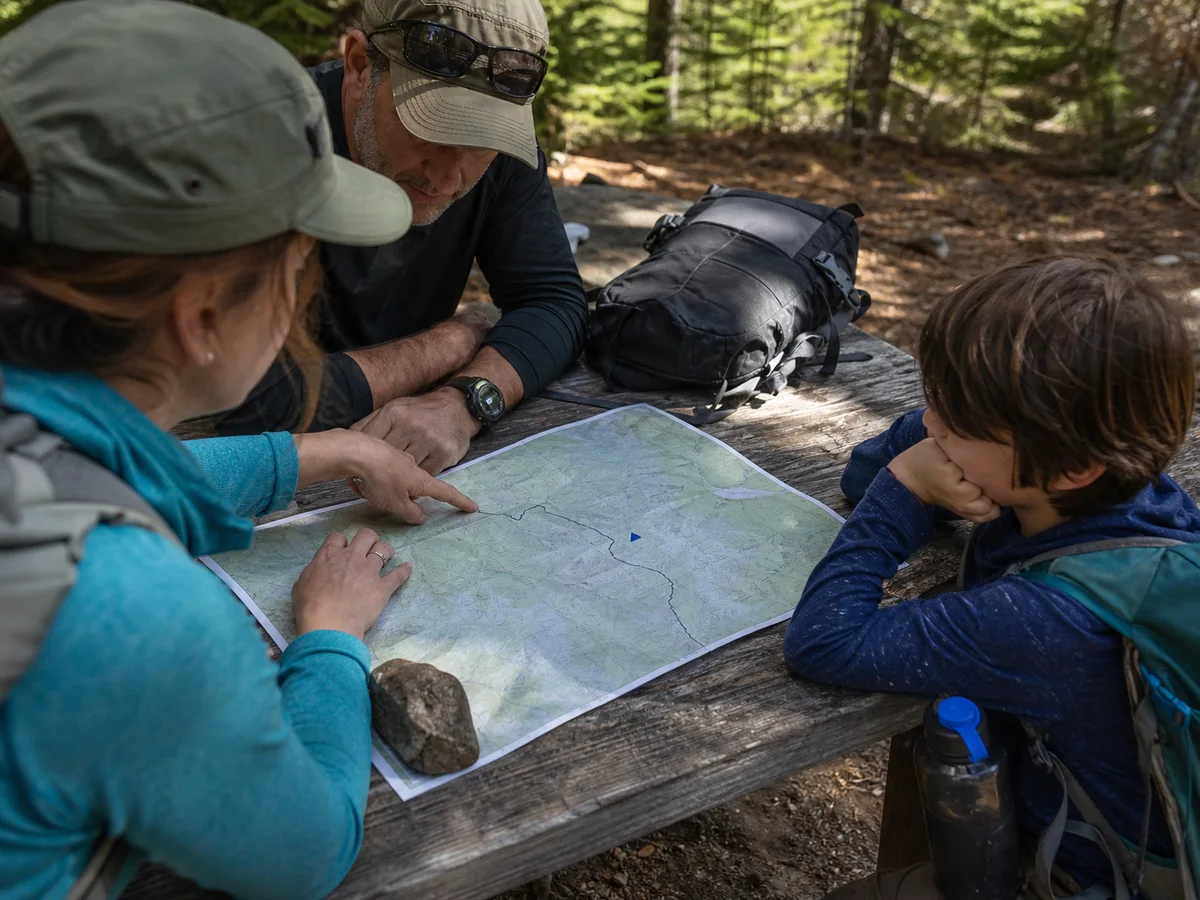
Place the turnaround before the family enters the most committed terrain. If the child is already slow, quiet, cold, or unwilling to eat at that point, use the easy line home.
Do not borrow time from camp setup and bedtime.
The first backpacking trip plan covers verified camps, daylight, water, transport, and a trusted contact.
Add one family question to every choice. Could the adults complete this move while carrying more and supporting a child who has stopped cooperating?
Adult reserve is a route feature. It matters as much as distance, elevation, water, and daylight.
Loads shift the moment a child starts to fade
Decide the load-transfer order at home. Trailside fatigue is a poor time to discover that the child's sleeping bag will not fit anywhere else or that an adult pack has no safe attachment point.
The child can carry a few light personal items in a pack sized to the child's body. Use two broad shoulder straps, keep the load close, and adjust it so the child stands and walks normally.
Forward lean, shoulder pain, numbness, rubbing, or a changed stride means the load or fit needs correction.
- Child keeps reachable
- Water, familiar snack, warm layer, rain layer, whistle, and headlamp
- Adults control
- Shelter, stove, treatment, navigation backup, first aid, food storage, and emergency insulation
- Transfer first
- Extra clothing, sleeping item, or other nonessential child-carried bulk
- Fit warning
- Leaning, rubbing, numbness, shortened steps, or repeated strap pulling
- Adult reserve
- Empty volume and tested strength for the child's entire carried load
Do not build the trip around a fixed pack percentage. Body size alone cannot capture pack fit, terrain, weather, experience, sleep, or how the child moves late in the day.
The useful test is the child's gait and communication under the real load.
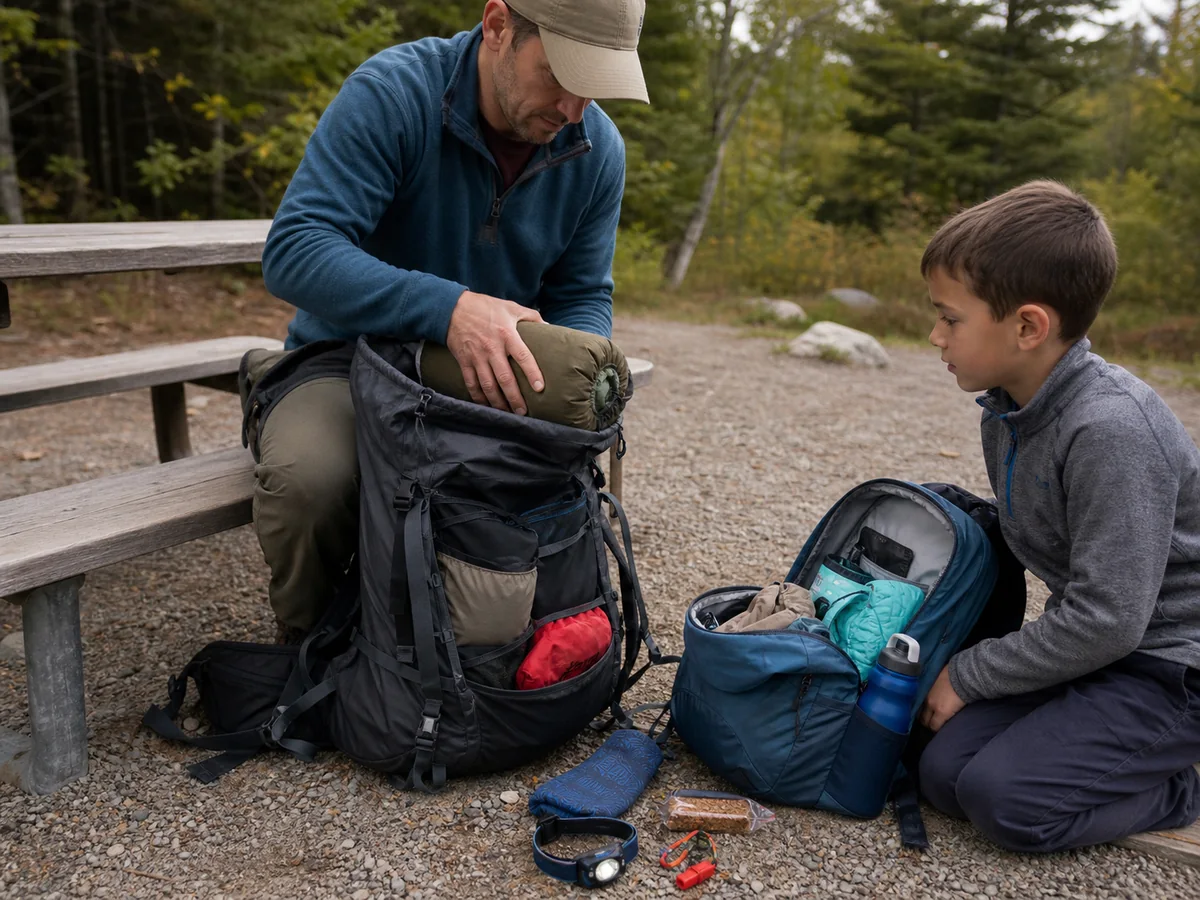
Adults should keep the critical shared systems because those systems cannot become inaccessible when a child drops a pack, wanders from it, or refuses to carry it. A child may still own useful jobs, such as tracking a water bottle or packing night clothing, without controlling shelter or the group's only navigation backup.
Test the transfer on a loaded walk. Move everything from the child's pack into the adult packs, adjust the load, and cover a hill or rough section.
The backpack fit sequence becomes more important after the weight changes because a hurried external bundle can pull an adult backward.
Set a transfer trigger before leaving. A changed gait, persistent rubbing, unusual quietness, repeated stumbling, or failure to keep the pack balanced should reduce the child's load early.
The child's pack is optional. The adults' ability to take it is part of the plan.
How do food and water affect a child's trail attention?
A child who becomes argumentative, clumsy, silent, or unable to choose may need food, water, warmth, rest, or a shorter route. Treat the change as information before treating it as bad behavior.
Keep familiar food where an adult can hand it over without unpacking camp gear. Small portions offered during safe stops are often easier than waiting for a child to request a large meal after hunger is sharp.
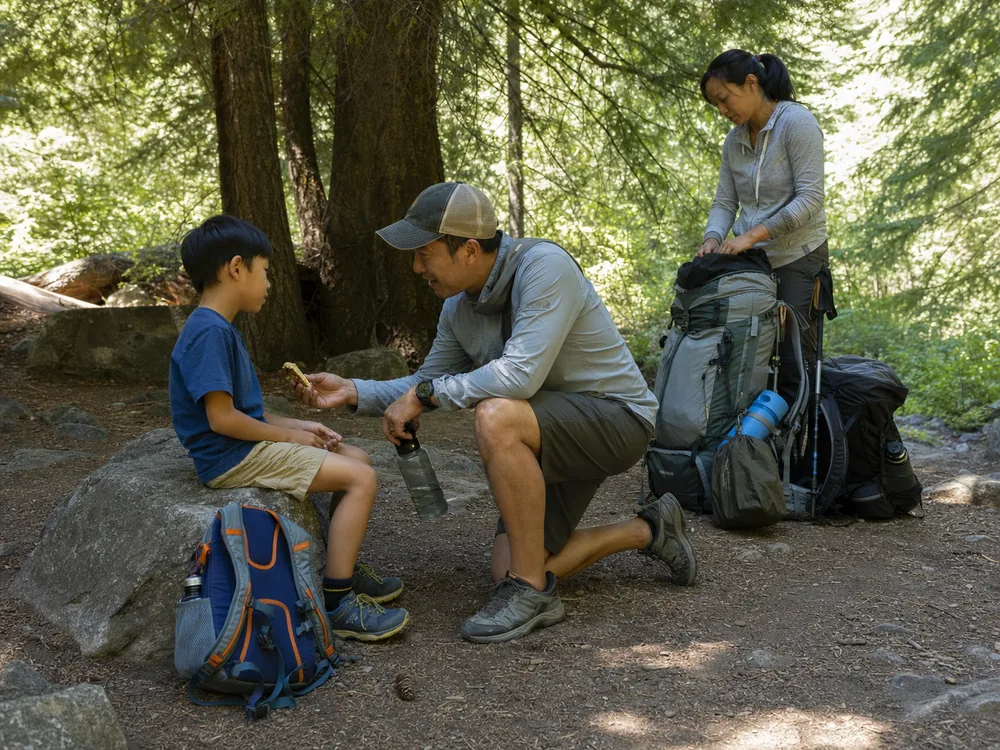
Give the child a reachable bottle and teach the child to report when it is getting low. Adults still track the total.
A child carrying water does not own the calculation, source verification, treatment, or reserve.
Pace breaks down
Stop on safe ground, offer food and water, check feet and pack fit, then shorten the next goal.
Mood changes quickly
Lower demands, correct hunger or cold, and ask one concrete question at a time.
Hands lose simple tasks
Add warmth and rest while an adult checks whether the route should end.
The child refuses food or water
Stop increasing distance and assess whether the family can safely walk out.
Repeated stumbling appears
Remove load, check footwear and fatigue, then use the conservative exit.
Plan breaks around safe places rather than exact clock intervals. A broad trail edge, sheltered junction, or camp approach may be useful.
An exposed slope or creek crossing is not the place to discover that the child needs ten minutes and an open food bag.
Offer water and food before the child reaches the hard part of the route. The NPS advises hikers to snack, drink, and let the slowest person set the pace.
With children, those actions also preserve attention for footing, adult instructions, and changes in weather.
The adult should make the route decision before every correction becomes a negotiation. If food, water, rest, dry socks, or a lighter pack restores normal movement, continue only to the next conservative checkpoint.
If function does not return, walk toward the exit.
Behavior can be an early field signal. It does not prove one cause, but it tells the adult to stop adding distance until the child's basic needs and movement are clear.
The common backpacking failure chains show how small pace, water, pack, and camp errors combine. A child gives the adults less time to ignore the first one.
How do you keep a child warm during slow walking and stops?
An adult moving behind a child may feel warm while the child cools during a snack stop. The family cannot use the adult's comfort as the clothing test.
Add the child's layer before shivering or complaints become the first clear sign. Keep rain protection and a warm layer reachable in the child's pack or an adult's top pocket.
Hands and head also need protection when wind or a long stop removes heat.
Protect one complete dry camp set inside waterproof storage. Walking clothes may become damp from rain, sweat, mud, or a bathroom accident.
The rain backpacking dry core keeps night clothing and sleep insulation separate from that wet system.
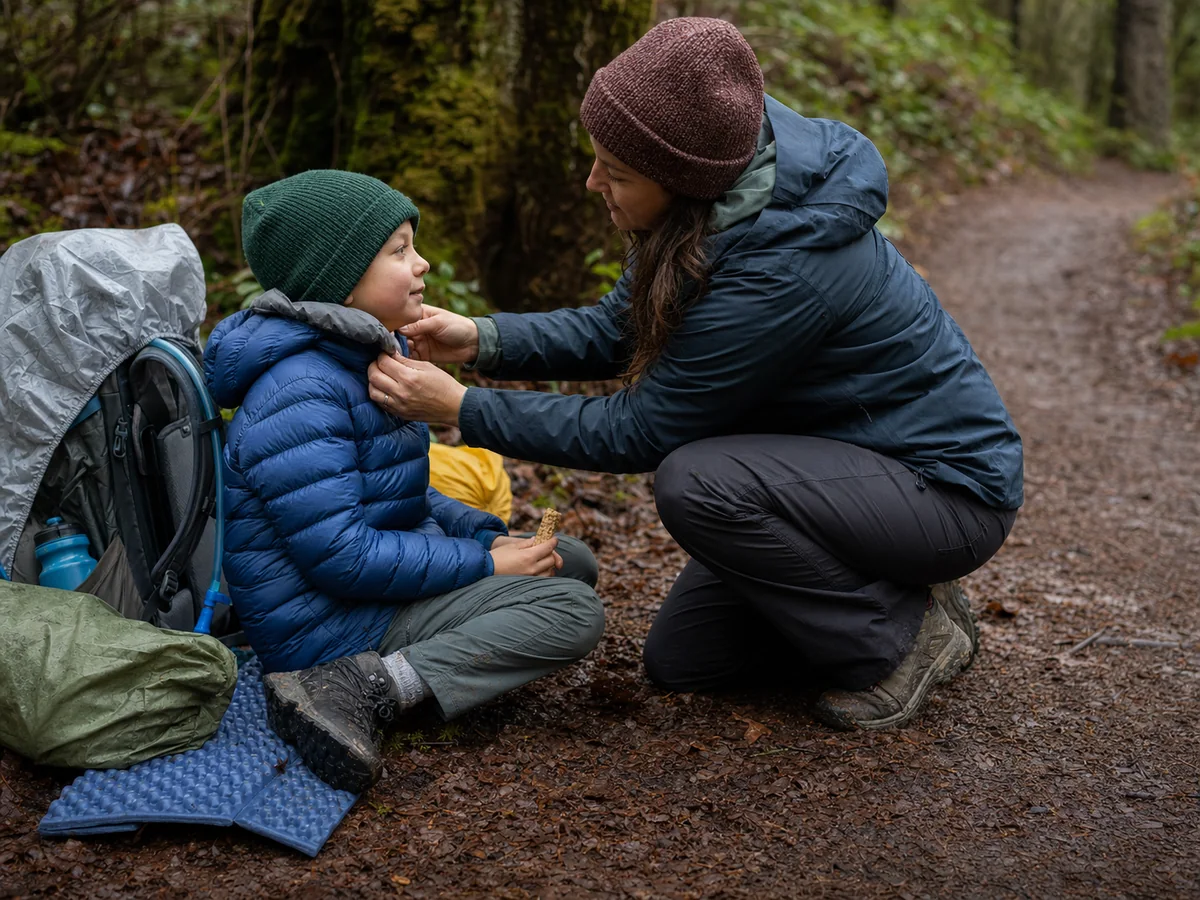
Reach camp early enough to build shelter while the child can still eat and follow instructions. Cold rain, strong wind, wet sleep gear, or a child who cannot warm should trigger a shorter plan or exit.
The cold and wet signs explain when this has moved beyond ordinary discomfort and needs urgent action.
Dress for the slow moments. A clothing plan that works only while the child is climbing does not cover breaks, camp, or the morning start.
How can you make backpacking camp familiar before bedtime?
The child's bedtime clock keeps moving while adults look for a site, collect water, and pitch shelter. Arriving early protects more than daylight.
It keeps unfamiliar work from stacking on top of hunger and fatigue.
Pause before unloading. Confirm that the site is legal, durable, away from obvious runoff and falling hazards, and compatible with the current food-storage rule.
Then give the child one safe job with a visible finish.
- Secure the child and the siteName the camp boundary, put packs in one place, and keep the child beside an adult.
- Build shelterAdults control the pitch while the child handles one low-risk task already practiced.
- Change the child into dry layersProtect the sleep clothing from cooking, water work, mud, and rain.
- Offer water and familiar foodRestore energy before asking for more patience or decisions.
- Handle the bathroomUse the planned legal method before darkness or urgency removes choices.
- Set the sleep spacePlace pad, bag, night clothing, light, and comfort item in the practiced order.
- Store attractantsSecure food, wrappers, toiletries, and scented items under the current local rule.
- Repeat the morning planTell the child what happens after waking and where the exit begins.
A useful child job might be placing tent stakes beside an adult, unrolling the sleeping pad, counting water bottles, or putting night clothing in the tent. Avoid tasks involving a stove, sharp tool, unstable water edge, wildlife attractants, or wandering beyond sight.
Food should be familiar, simple to prepare, and likely to be eaten after a strange day. Keep a no-cook backup when weather, fire restrictions, a stove problem, or a tired child makes the planned dinner unrealistic.
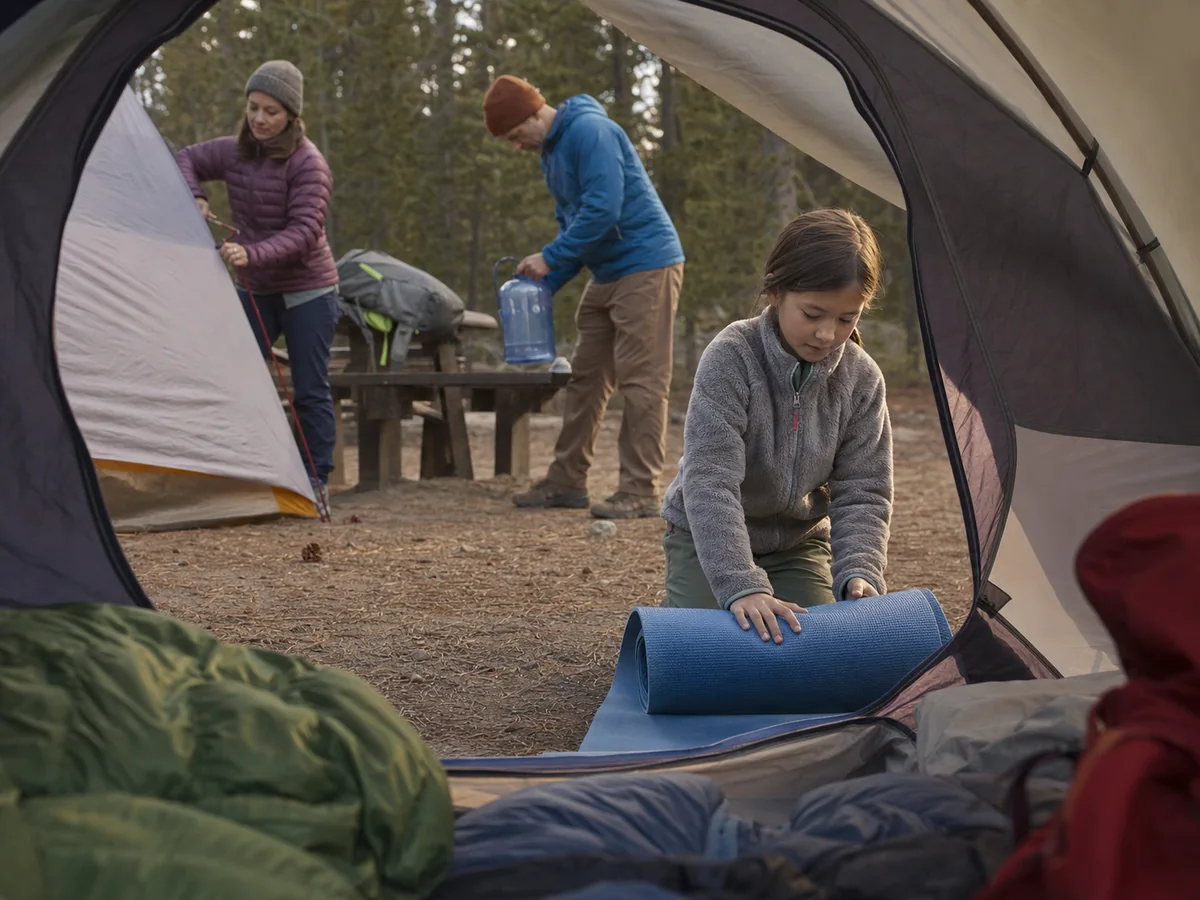
Handle the bathroom before the child is desperate. The correct method depends on land-manager rules, terrain, water, privacy, and the child's needs.
Pack every hygiene item and any required waste container as part of the route plan.
Keep one or two familiar bedtime cues. Clean sleep clothes, a short story, a small comfort item, or the usual order of teeth and toilet can reduce the amount of novelty the child must process.
If the family reaches camp late, cold, hungry, or already arguing, simplify. Build shelter, restore warmth, provide safe food and water, and decide whether the morning should be a direct exit.
Do not protect an ambitious camp experience at the cost of sleep.
Familiarity saves attention. The goal is not to reproduce home.
It is to leave the child enough known steps to settle while the adults finish the backcountry jobs.
The backpacking packing systems should keep shelter, dry sleep gear, food, water, and child layers accessible in the order the family uses them.
A child needs a short list of rules they can repeat
A tired or frightened child cannot execute a long safety speech. Each field rule needs one child action and one matching adult responsibility.
For separation, teach the child to stop, stay put, and blow the whistle in a repeated pattern. Practice the sound before the trip.
Adults should keep children between a lead and rear adult when possible, count the group at junctions, and stop the moment visual contact breaks. Those basic hiking safety habits should already feel routine before the family adds darkness and camp.
Separated
Child stops and whistles. Adults return to the last confirmed point and begin the planned response.
After dark
Child uses the headlamp and moves only with an adult.
Wildlife appears
Child stays beside the adult, does not approach, and follows the local response.
Food is open
Child keeps it in the eating area and gives every wrapper to the responsible adult.
Bathroom needed
Child tells an adult early and goes only with the planned supervision.
Water edge
Child stays inside the named boundary and never collects water alone.
Wildlife rules depend on the place and species. Check current land-manager guidance before the trip, teach the exact response in plain language, and keep food and scented items under adult control.
Do not ask a child to remember different improvised rules after an animal appears.
Night movement needs a light that the child can find and operate. Attach or place it consistently, but do not let a lanyard or loose cord create an entanglement hazard.
The child should wake an adult before leaving the sleep area.
Bathroom privacy matters, yet remote terrain, darkness, water, and wildlife can make independent movement unsafe. Decide the supervision and waste method before departure.
The child needs to know that asking early creates more privacy and better choices.
Short rules survive fatigue. Ask the child to repeat each action during rehearsal, then make the adult side of the rule equally specific.
Simple compass basics can become a supervised learning activity, but a child-held compass never replaces adult navigation or the separation plan.
What should you check before a child starts day two?
Watch the first quiet minutes before promising the day's destination. A child may say yes because the adult sounds excited, while movement, appetite, warmth, or attention says the night took too much.
Start with warmth and food. The child should be able to get dressed, drink, and eat something familiar without unusual withdrawal, shaking, confusion, or a long struggle.
Protect the child from standing cold while adults pack.
Check feet and movement in full light. Look for rubbing, blisters, swelling, wet skin, and pain.
Then watch the child stand, squat, step over a small obstacle, and walk around camp without a pack.
Ask concrete questions. “Where does it hurt?” and “Show me which shoe rubs” produce more useful information than “Are you okay?” Notice whether the child can follow one instruction, remember the morning sequence, and show normal interest in the surroundings.
| Morning evidence | Continue the exit plan | Shorten now | Walk out directly |
|---|---|---|---|
| Warmth | Warm in dry layers | Slow to warm but returns to normal | Cannot warm or behavior remains abnormal |
| Food and water | Eats and drinks normally | Small appetite after a poor night | Repeated refusal with falling function |
| Feet and gait | Normal steps without pain | Mild rubbing corrected at camp | Limping, swelling, or pain changes walking |
| Attention | Follows simple instructions | Tired and needs a slower routine | Confused, unusually withdrawn, or repeatedly unsafe |
| Weather and gear | Dry sleep system and suitable forecast | Damp item or reduced weather window | Failed shelter, wet insulation, or unsafe conditions |
| Adult reserve | Adults can take child gear and still move safely | Adults need the shortest route | Adults cannot support the child and complete the route |
Continue only toward the known exit or a plan with equal or greater control. A first family overnight does not need an extra loop, viewpoint, or second camp to prove its value.
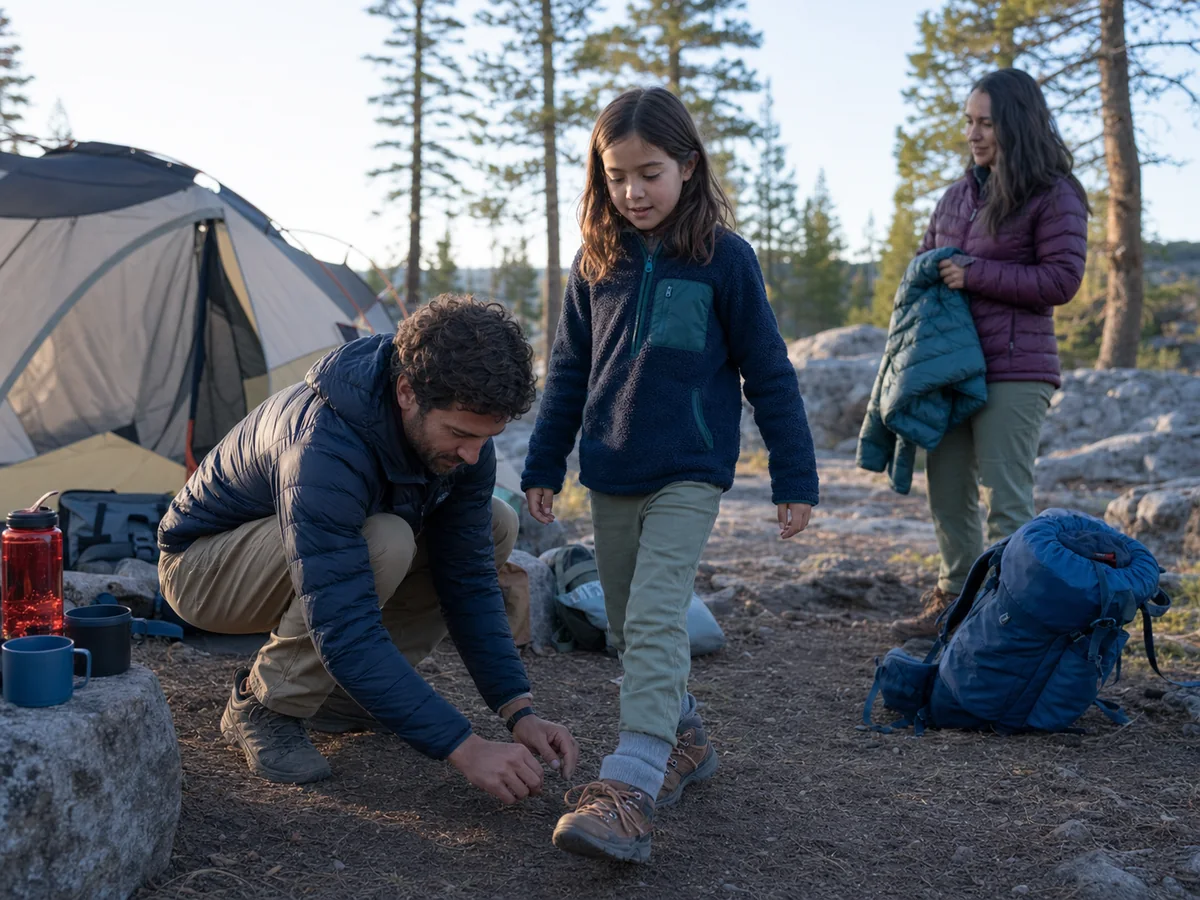
Shorten the plan when poor sleep, damp gear, tender feet, slower attention, or a weather change has reduced the reserve but normal function returns. Walk out directly when pain changes gait, the child cannot warm, essential gear fails, behavior stays abnormal, or the adults cannot safely absorb the needed support.
Close the trip with the trusted contact after the family reaches the exit. Then record what the child ate, carried, feared, enjoyed, and struggled to do.
Change one or two causes before the next overnight.
Recovery earns the next trip. A controlled walk out after an imperfect night is a successful first result because it gives the family evidence without demanding a crisis.
The backpacking training process can help adults prepare for loaded hills and consecutive days. Family training should also include the heavier contingency load that the adults may carry on the exit.
Sources
The National Park Service recommends a trip plan, suitable route, backup options, water, food, and a pace set by the slowest hiker: NPS Hike Smart. Its family guidance keeps the adult responsible for essentials while involving children in planning: NPS Hiking with Kids.
REI recommends rehearsal, a short first campsite, child-sized loads, adult lead and rear positions, and practiced whistle and headlamp use: Backpacking with Kids. HealthyChildren.org explains proportional pack sizing, two-strap use, close fit, and forward lean as a sign that a child's load is too heavy: Backpack Safety.
Current local rules come first for permits, camps, water, fire, food storage, wildlife, waste, closures, and emergency contacts on the chosen route.
Step by stepPractical steps
- Prove a loaded day hike, the real sleep system, and a normal morning restart close to an exit.
- Choose a short legal route that adults can finish while carrying the child's full load.
- Keep shared shelter, navigation, food storage, water treatment, first aid, and emergency warmth under adult control.
- Reach camp early and protect food, warmth, bathroom needs, and a familiar sleep routine before attention falls.
- Use appetite, warmth, feet, gait, attention, weather, gear, and adult reserve to choose the direct morning exit.
AnswersQuestions readers ask
What age can a child start backpacking?
There is no single age. Use evidence from comfortable day hikes, clear communication, a successful sleep-system rehearsal, normal morning function, and adults who can carry every shared system plus the child's load.
How far should kids backpack on a first trip?
Choose less than the child has already completed comfortably on a day hike, then reduce the plan for pack weight, camp work, weather, stops, poor sleep, and the walk out. A short established camp close to the trailhead is a conservative first choice.
How much weight should a child carry backpacking?
Avoid a universal percentage.
Use a child-sized pack, keep the load close, and watch gait, leaning, rubbing, numbness, and communication. Adults must have room and strength to take the entire load.
What should a child carry while backpacking?
A child can keep water, a familiar snack, a warm layer, rain protection, whistle, and headlamp reachable. Adults should control the only shelter, navigation backup, treatment, first aid, food storage, and emergency insulation.
When should a family end a backpacking trip early?
Use the direct exit for limping, inability to warm, abnormal behavior, repeated refusal of food or water with falling function, failed essential gear, unsafe weather, or when adults can no longer support the child and move safely.