
Is Backpacking Good Exercise for Endurance and Strength?
Backpacking trains sustained aerobic work, loaded movement, balance, and muscular endurance, but the route and recovery decide whether the dose is useful.
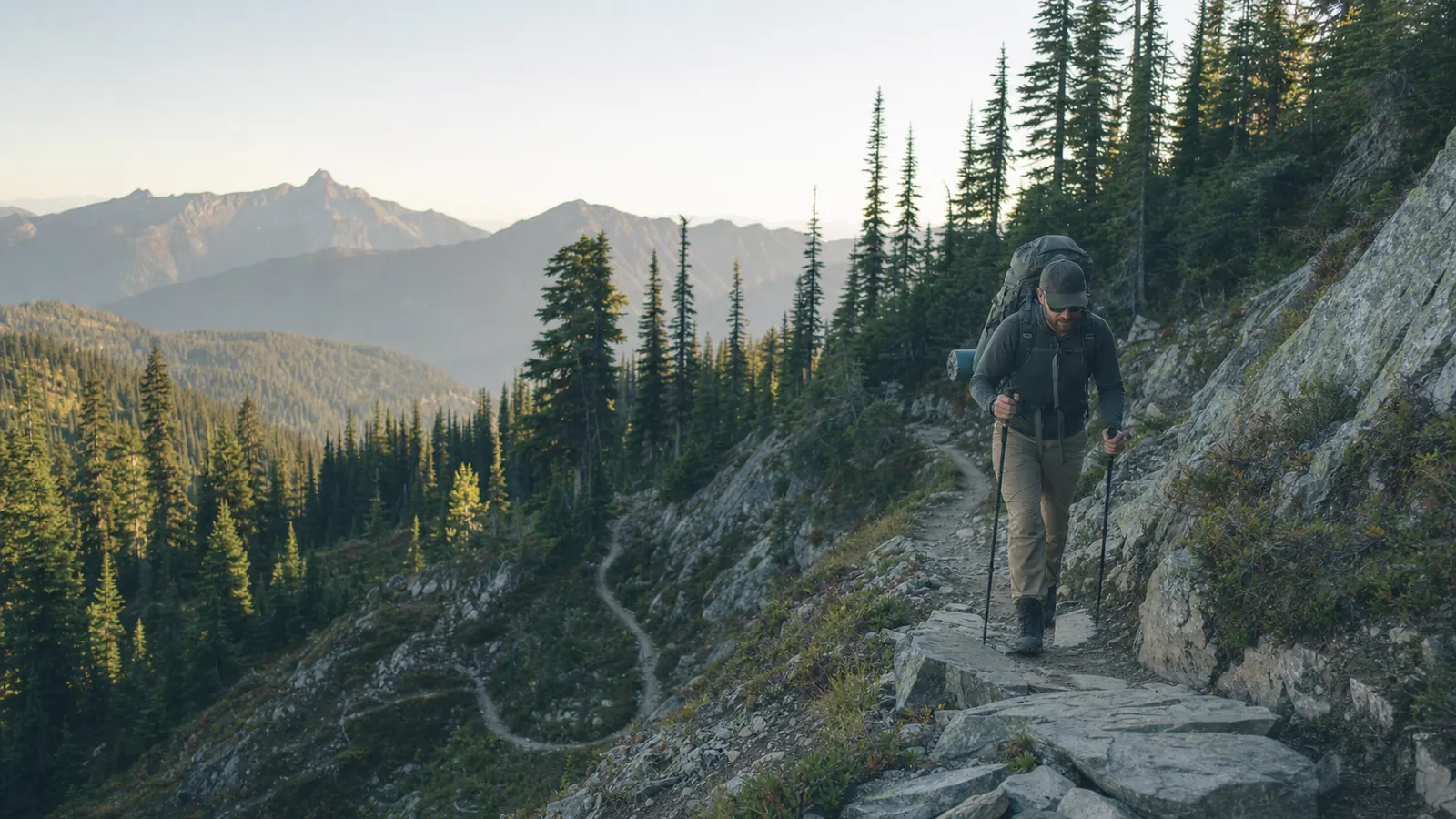
Yes, backpacking is good exercise. Hours of walking raise aerobic demand, while the pack, climbs, descents, and uneven ground add muscular work that helps most when you can keep a steady pace, control each step, recover overnight, and repeat the effort without pain changing how you move.
Which parts of fitness does backpacking train?
Backpacking combines sustained walking with a load that must be lifted, balanced, and controlled across changing ground. That makes it useful aerobic and muscular-endurance exercise, especially when the route lasts for hours and continues the next day.
The useful training dose ends when the pack or pace changes how you walk, think, or place your feet.
Loaded-walking rule
The heart and lungs support the moving work.
The calves, thighs, hips, and trunk repeat lower-force contractions for thousands of steps. Ankles and feet adjust to uneven surfaces while the upper body keeps the load from pulling backward or sideways.
That mix does not make backpacking a complete strength program. A long climb can exhaust the legs without providing the controlled progression needed to build maximal strength.
Pulling, pushing, and full-range resistance work also receive little direct training from ordinary trail walking.
| Fitness quality | Backpacking contribution | What still needs separate work |
|---|---|---|
| Aerobic endurance | Sustained walking raises breathing and heart rate | Shorter controlled hard efforts when appropriate |
| Muscular endurance | Legs and trunk repeat work under load | Progressive resistance for higher force |
| Balance and coordination | Uneven ground changes every foot placement | Focused practice for known movement limits |
| Bone loading | Weight-bearing movement provides repeated loading | Individual medical guidance when bone health is a concern |
| Mobility | Trail steps use varied joint positions | Deliberate mobility where range is restricted |
The best comparison is not backpacking versus no exercise.
It is backpacking versus the training job you need. A person building endurance for an overnight route benefits from loaded walking.
Someone trying to improve upper-body strength needs another tool.
New backpackers need overnight trip basics such as camp setup and route planning before treating the trip as exercise.
Several fitness qualities improve, but no single activity covers every one.
How do pack weight and grade change the effort?
Every kilogram in the pack must be moved forward, lifted on climbs, and controlled on descents. Laboratory research on loaded walking has found that mechanical work and metabolic cost rise as carried mass rises.
Real trails add uneven footing, variable speed, wind, heat, and repeated hours that a treadmill cannot reproduce exactly.
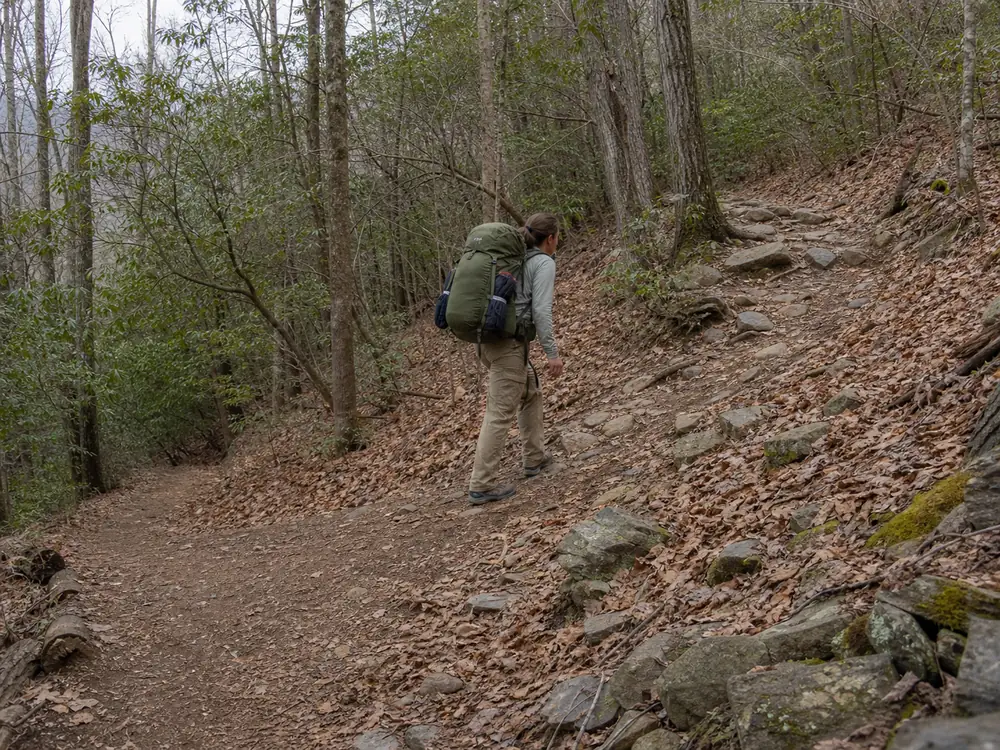
Uphill travel raises the body and pack against gravity. A pace that feels conversational on level ground can become vigorous on a sustained grade even when speed drops.
Downhill travel lowers breathing for some people but increases braking work. The thighs control knee flexion, the hips stabilize the trunk, and the feet must keep the load from continuing downhill after each landing.
More carried mass
Raises the work of moving and controlling the combined body and pack.
Steeper climb
Increases breathing demand and the force needed at each step.
Long descent
Adds repeated braking that can expose weak control before breathing feels hard.
Loose or uneven ground
Requires shorter steps, balance corrections, and more attention.
Longer duration
Turns a manageable hourly effort into a recovery problem when food, water, or feet fall behind.
Pack weight is not the only variable. A lighter pack on deep sand, mud, snow, or broken rock can demand more attention than a heavier pack on firm level tread.
Change one variable at a time through a loaded-pack training progression that preserves stable movement. Shorten the route before adding overnight equipment, or keep the route familiar when increasing food and water.
Keep your first backpacking itinerary below the point where loaded exercise makes camp work or the return uncertain.
Load changes the route. It should alter pace, distance, and the amount of reserve you keep.
What intensity are you actually doing?
You do not need a calorie display to classify the effort.
The CDC talk test offers a simple field signal. During moderate activity, you can talk but not sing.
During vigorous activity, you cannot say more than a few words without pausing for breath.
That test is relative to the person. A fit backpacker may stay conversational on a climb that pushes a beginner into short phrases.
Heat, altitude, poor sleep, illness, and a heavier water carry can also move the same person into a harder zone.
| Field signal | Likely effort | Backpacking decision |
|---|---|---|
| Full easy conversation | Light to moderate | Maintain pace and check that the group shares the same effort |
| Talk but not sing | Moderate | Sustainable for many trained people when food water and cooling stay on time |
| Only a few words | Vigorous | Use intentionally and briefly when the route still has ample margin |
| Speech or coordination becomes confused | Unsafe change | Stop assess the person and reduce exposure or seek help |
| Stride shortens and pack sways | Load or pace too high | Slow down reduce the objective or exit |
A route can contain several zones.
A flat forest approach may be light, the pass may be vigorous, and a careful descent may feel muscular rather than breathless. Judge the day by the hardest sustained section and by what remains afterward.
Do not use breathlessness as proof that the trip is productive. On a remote route, very hard effort can consume attention, water, food, and time needed for navigation or camp.
Conditions that reduce the exit margin should override the exercise goal in your backpacking safety plan before pace or distance rises.
Breathing is a decision signal, not a score to maximize.
How should backpacking count toward weekly exercise?
Count the time spent moving at a moderate or vigorous effort, not every hour between the trailhead and camp. Rest stops, map checks, water treatment, meals, and sitting at camp may support the trip, but they are not automatically aerobic minutes.
U.S. guidance recommends 150 to 300 minutes of moderate aerobic activity each week for adults, or 75 to 150 minutes of vigorous activity, plus muscle-strengthening work on at least two days. People who are inactive can start with smaller amounts and build over time.
Use the talk test to sort the moving time. Minutes when you can talk but not sing usually fit moderate intensity. Minutes when you can say only a few words before pausing for breath usually fit vigorous intensity.
The guideline uses a simple two-to-one comparison. One minute of vigorous aerobic activity counts about like two minutes of moderate activity. A trip with 150 moderate minutes and 20 vigorous minutes would therefore equal about 190 moderate-equivalent minutes for the weekly aerobic total.
That calculation describes intensity, not whether the route was a good decision. Vigorous minutes gained from overheating, altitude illness, panic, or carrying a load that destroys stable movement are warning signs rather than a training bonus.
Moving time also needs context. Four hours recorded by a watch may include a long lunch, photography, navigation stops, and camp chores. Use the actual periods of continuous trail movement and the effort during those periods if you want a useful weekly estimate.
Do not count the same work twice. A loaded climb can contribute aerobic minutes and muscular endurance, but it still does not prove that every major muscle group received progressive strength work. Keep the separate two-day strength recommendation in view.
A multi-day trip can put a large share of the weekly aerobic volume into one or two days. That does not mean a new backpacker should chase the full guideline on the first loaded hike. Feet, tendons, joints, balance, fueling, and sleep may need slower progression than the heart and lungs.
Use the next morning as a correction. If normal walking is intact, food and sleep worked, and the planned pack still feels controllable, the dose may be repeatable. If you limp, cannot manage stairs normally, or remain unusually exhausted, reduce the next route even when the aerobic total looked impressive.
For a simple log, record moving minutes, the longest sustained climb, talk-test range, pack weight at the start, and next-morning movement. Those five facts make two trips easier to compare without pretending a watch can measure every trail demand.
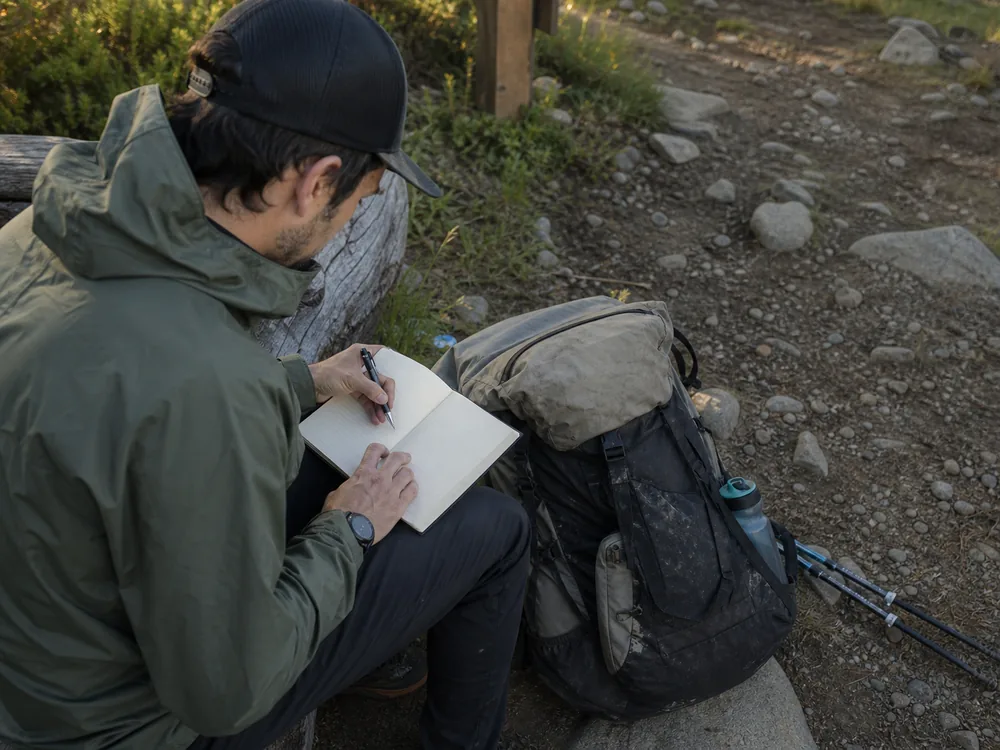
Compare similar sessions before changing the plan. A higher heart rate on a hotter day or at higher elevation does not prove that fitness declined, while a lighter recorded effort can hide a shorter route or longer stops.
On a two-day trip, record each day separately. A strong first day does not cancel a second day with poor movement, and combining both into one average can hide the recovery problem that should reduce the next trip.
Count movement after the trip, but choose the trip from skill, conditions, and a safe exit.
The climb and descent train different jobs
The descent often reveals the training gap first. Breathing may settle while the thighs absorb repeated landings and the feet slide forward inside the shoes.
Soreness after a route can come as much from braking as from climbing.
Climbing shifts the job toward propulsion.
The calves, quadriceps, glutes, and hips help raise the body and pack, while the trunk limits unwanted rotation. Shorter steps usually keep the center of mass closer to the working leg.
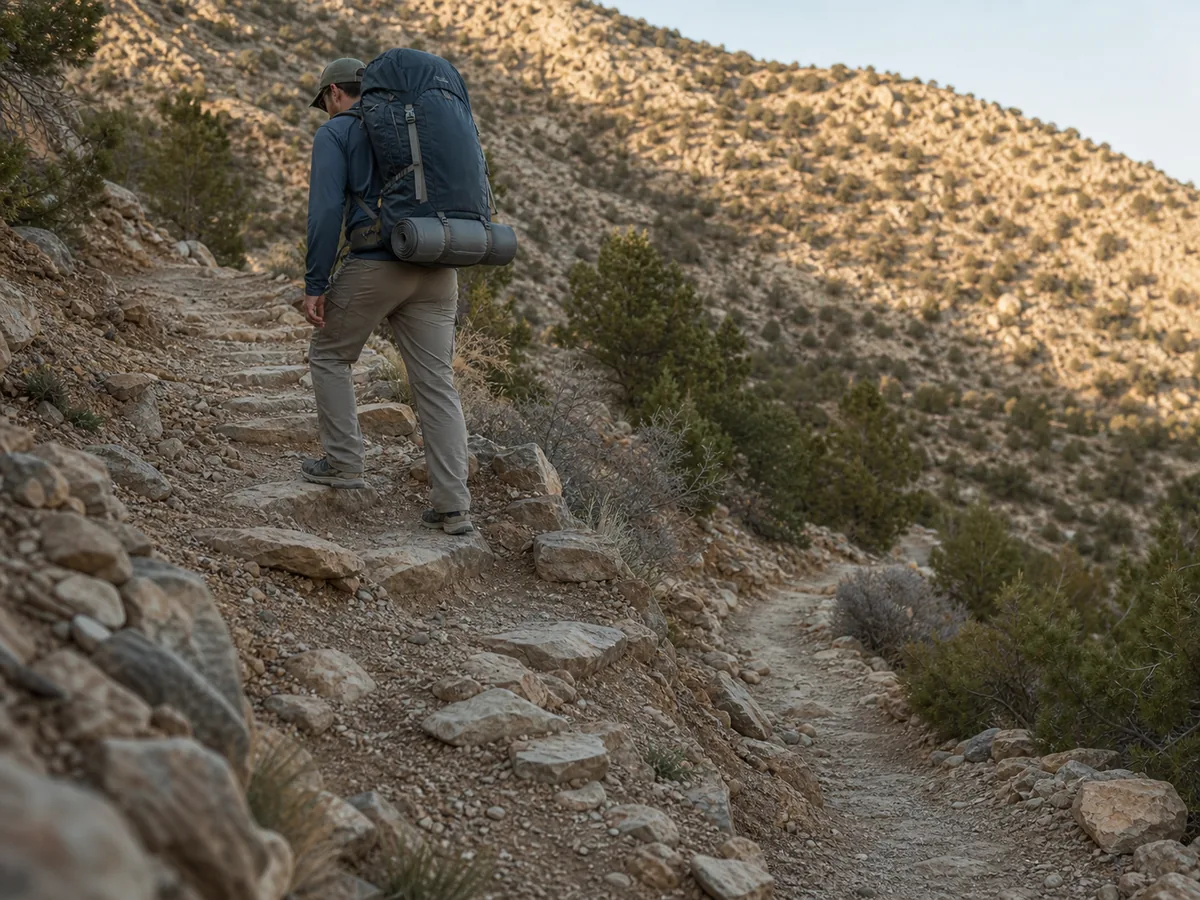
Uneven ground adds a separate task. Ankles and feet respond to rocks, roots, soft soil, and off-camber tread.
A pack that moves independently of the torso increases the correction needed after each poor landing.
Climb
Drive through a controlled step while keeping breathing below the route limit.
Descent
Shorten the stride and control speed before each landing.
Side slope
Keep the pack centered and avoid a load that pulls downhill.
Step-over
Lift the foot high enough to clear the obstacle without swinging the pack.
Camp carry
Move water and food with the same lifting control used on the trail.
This is why a flat unloaded walk does not fully prepare the body. Training must eventually include the real shoes, a stable pack, sustained climbs, careful descents, and enough time to expose pressure points.
Dense weight kept near the spine makes balanced backpack loading more predictable than a rear-heavy or side-heavy load.
Direction changes the job. Train the descent and the loaded balance, not only the climb.
Backpacking does not replace two strength days
U.S. physical activity guidance recommends both weekly aerobic activity and muscle-strengthening work on at least two days.
Backpacking can supply substantial aerobic time, but repeated trail steps do not automatically cover every major muscle group with progressive resistance.
Use strength sessions to build the gaps the trail exposes.
Squat or step patterns can raise leg force. Hinges, calf work, pulling, pushing, and loaded carries cover movements that ordinary walking may undertrain.
The exact program should match your experience, equipment, health, and trip.
People with health conditions, recent injury, balance concerns, pregnancy, or a long period without activity should discuss a demanding loaded route with a qualified clinician. Start with smaller amounts of activity when that is the safer entry point.
Separate the training tools. Let backpacking build route-specific endurance while controlled resistance work builds force.
Build the exercise dose without turning the route into a test
Start with a load and distance you can repeat with stable form.
A useful first session is not the farthest walk you can finish. It is the walk you can finish, recover from, and repeat without pain or exhaustion changing the next few days.
Increase only one main stressor at a time. More distance, more climb, more pack weight, rougher footing, and consecutive days all count as separate increases.
- Set an unloaded baselineWalk the planned time on easy ground and note breathing feet and next-day recovery.
- Add the real packBegin with the equipment needed for a short controlled rehearsal rather than an arbitrary heavy load.
- Introduce climbingKeep distance stable while adding a modest familiar grade.
- Practice descent controlUse short steps and stop before knee pain or unstable landings appear.
- Repeat on consecutive daysTest whether feet appetite sleep and movement remain usable the next morning.
- Move to an overnightChoose a simple route with an early camp and direct exit.
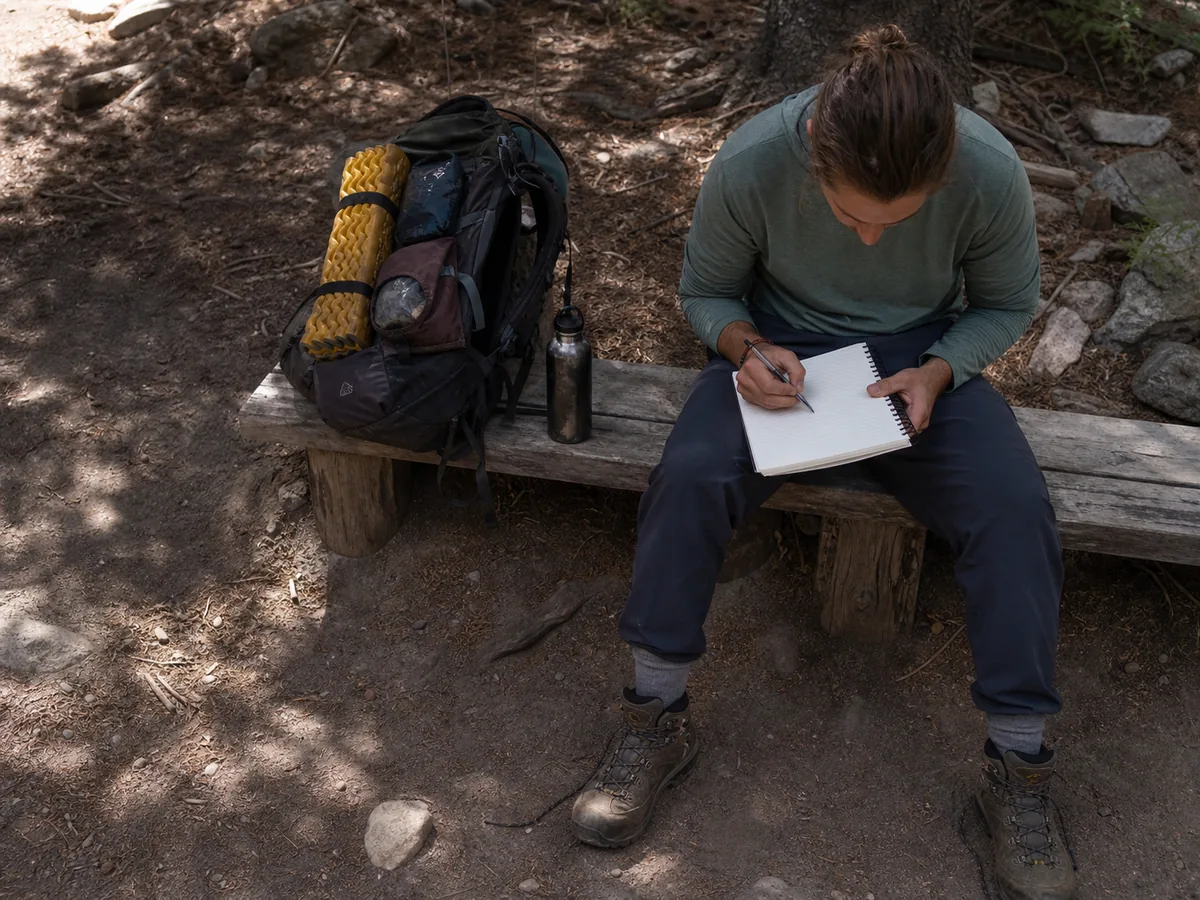
Keep the pack representative rather than deliberately overloaded.
Write a backpacking gear inventory to show which route systems the load is actually carrying, rather than what you assume is there.
After the inventory is accurate, ultralight weight reduction can remove proven excess without deleting a safety function.
After each session, note time, climbing, carried water, total pack weight, foot condition, pain, appetite, sleep, and how normal walking feels the next morning. These observations are more useful than a single calorie estimate.
Repeat before adding. A dose that cannot be repeated is a test, not a training base.
When does useful fatigue become too much load?
Ordinary tiredness can make the legs feel heavy while movement stays coordinated. The boundary changes when pain alters the stride, the pack repeatedly pulls the torso off line, or attention drops enough that simple decisions are missed.
Stop and reduce the load or objective when a problem becomes progressive. Walking farther from an exit to see whether it improves removes the cheapest correction.
- Pain changes stride length or causes limping.
- One shoulder hip or foot receives increasing pressure.
- The pack sways after normal turns or step-downs.
- Feet begin scuffing rocks or catching roots repeatedly.
- The person cannot eat drink navigate or adjust layers on schedule.
- Speech attention or coordination changes beyond expected exertion.
- Symptoms worsen after a short rest and simple correction.
- Normal walking is still altered the next morning.
A hot spot, loose hipbelt, missed snack, or dry bottle can be corrected before it joins a backpacking failure chain that becomes harder after camp and another morning.
Pain with swelling, a clear injury, chest pain, fainting, severe shortness of breath, confusion, or other alarming symptoms needs an appropriate medical or emergency response.
This is not a diagnosis list. Use local emergency services when the situation may be life-threatening.
Fitness does not overrule route judgment. If a person is moving poorly, shorten the day even when the planned training target remains unfinished.
Reduce the margin further during solo backpacking because no partner can notice a changing stride, missed food, or confused decision before you do.
Movement quality sets the limit. Distance completed after form fails is not useful credit.
Recovery determines whether the benefit lasts into day two
Backpacking differs from a long day hike because camp is part of the exercise dose. The body still has to collect and treat water, pitch shelter, prepare food, manage feet, stay warm, sleep, and begin again.
The next morning provides better evidence than the finish line. Check appetite, thirst, urine pattern, foot condition, sleep, soreness, balance, and willingness to load the pack.
One signal rarely decides the day, but several degraded systems should lower the route ceiling.
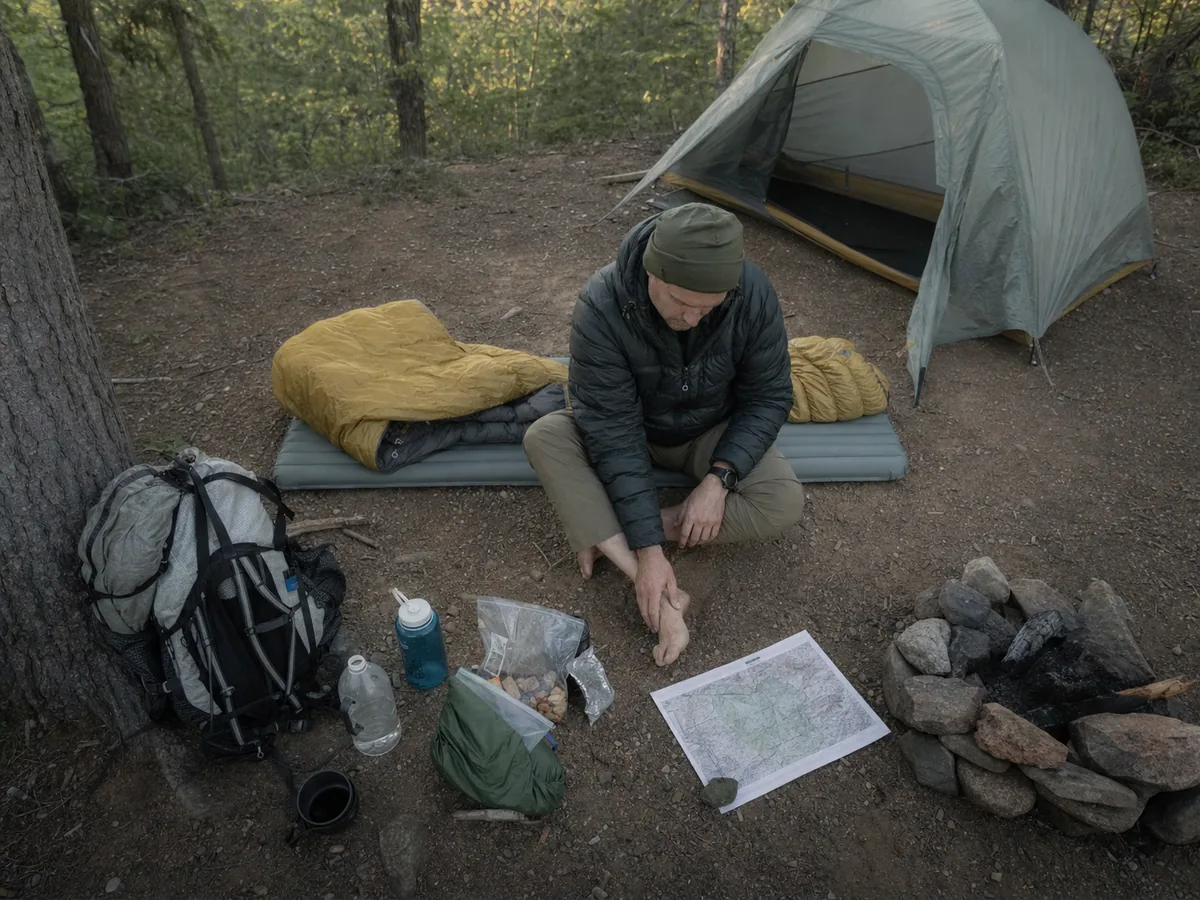
Eat and drink during the route rather than trying to repair the whole deficit at camp. Keep packed food and water reachable without a full stop, so the effort of walking never competes with basic care.
If dry insulation, sleep, foot comfort, or normal gait did not survive, use the shortest safe exit. Cold rain spends extra energy on warmth and camp work, so a wet-weather backpacking routine needs a lower ceiling.
Snow, ice, and short daylight add traction and timing costs, so winter backpacking plans need the same conservative limit.
A successful progression preserves tomorrow. That may mean an easier second day, a rest day after the trip, or a smaller load on the next rehearsal.
Recovery completes the workout. Backpacking is good exercise when the body can absorb the work and keep moving well.
Sources
The CDC explains relative moderate and vigorous activity, including the talk test: How to Measure Physical Activity Intensity.
The U.S. Department of Health and Human Services recommends 150 to 300 minutes of moderate aerobic activity each week plus muscle-strengthening activity on at least two days: Physical Activity Guidelines for Americans.
A controlled study of loaded walking found that mechanical work and metabolic energy expenditure rose approximately with added backpack load. Its small laboratory sample and treadmill setup should not be treated as a personal trail prediction: Mechanics and energetics of load carriage.
Use the pattern, not a calorie promise. Load, grade, duration, footing, fitness, and recovery determine the real exercise dose.
Step by stepPractical steps
- Establish a repeatable unloaded walking baseline.
- Add the actual pack while keeping terrain and duration stable.
- Add climbing and descent practice on familiar ground.
- Test consecutive days before a remote multi-day route.
- Reduce load or distance when pain, gait, attention, or recovery worsens.
AnswersQuestions readers ask
Is backpacking considered cardio?
It can be.
Sustained loaded walking often raises breathing and heart rate into moderate or vigorous aerobic intensity. Use the talk test because the same route can be easy for one person and hard for another.
Does backpacking build leg strength?
It builds route-specific muscular endurance and can expose strength gaps, especially on climbs and descents. It does not replace controlled progressive resistance for the legs, upper body, and other major muscle groups.
How many calories does backpacking burn?
There is no useful universal number.
Body size, pack weight, speed, grade, surface, weather, altitude, and duration all change energy use. Plan food from tested intake and route demands rather than one calorie estimate.
Is a heavier pack a better workout?
Not automatically. More mass raises the work and can reduce balance, pace, and recovery.
Carry what the route requires, build strength separately, and increase training load only while movement stays controlled.
How do I know whether a backpacking workout was too hard?
Reduce the next dose when pain changes your stride, the pack repeatedly destabilizes you, attention falls, or normal walking and daily function have not recovered by the next morning.