
Down Sleeping Bags vs Synthetic
Both of the arguments you have heard are true, and both are quoted well outside the conditions where they decide anything. The choice turns on whether you can keep the bag dry and how many years you intend to own it.
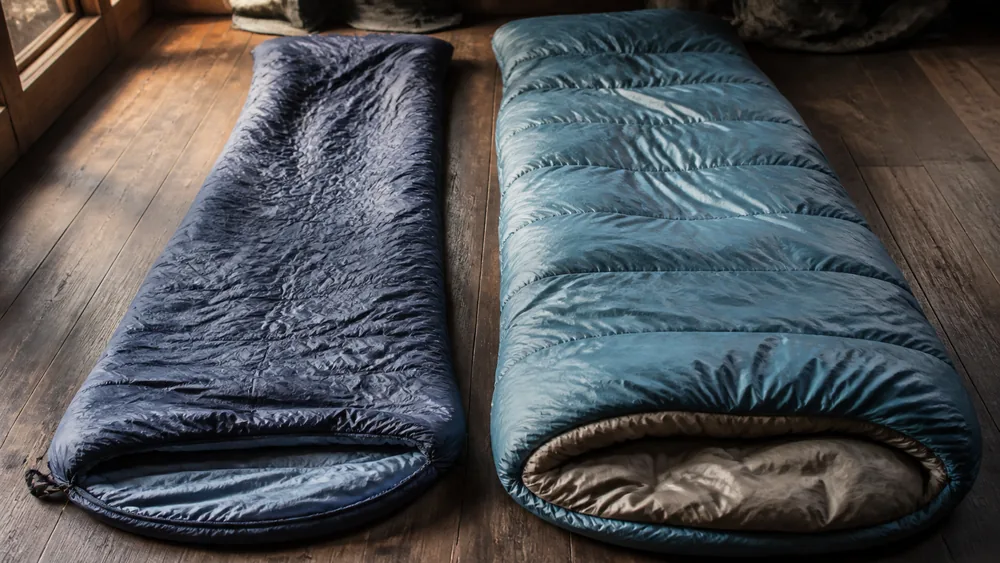
You have heard both arguments. One says down gives more warmth for less weight and less space, the other says synthetic keeps insulating after a soaking, and both are true.
They are also quoted far outside the conditions where they decide anything.
This page takes both arguments seriously enough to check where they hold. Temperature rating, bag shape, and fit are a separate question and they belong elsewhere.
What actually differs between the two fills
Down is the fine under-plumage of geese and ducks. It works by trapping air in a three-dimensional cluster, and it is extremely good at holding a lot of air for very little weight.
Synthetic fill is polyester fibre arranged to do the same job. It traps air between filaments rather than inside clusters, which takes more material and more weight to reach the same warmth.
That single structural difference produces most of what follows.
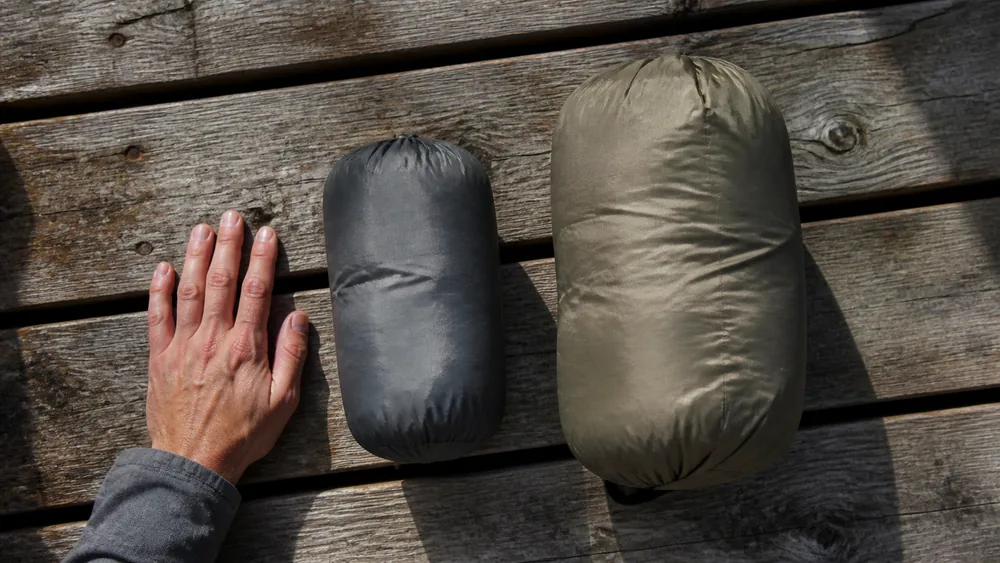
The gap in warmth for a given weight is large rather than marginal, and the gap in packed size is larger still.
Pack volume is often the real constraint rather than weight. A down bag that compresses to half the volume of an equally warm synthetic one changes which rucksack you need.
Then water arrives and the picture inverts. Wet down clumps together, the clusters collapse, and the air they were holding disappears.
Synthetic fibres keep more of their structure when wet, so they go on trapping some air and they dry far faster afterwards.
| Property | Down | Synthetic |
|---|---|---|
| Warmth for its weight | Considerably higher | Lower, so more weight for the same rating |
| Packed size | Compresses much smaller | Bulkier for equivalent warmth |
| When it gets wet | Loft collapses and insulation largely goes | Keeps some loft and some insulation |
| Drying in the field | Slow, sometimes days | Fast, often overnight |
| Working life | Ten to fifteen years, longer with care | Roughly three to seven years of regular use |
That last row is the one most comparisons leave out, and it does more to the decision than anything above it.
Is the wet argument as strong as people say?
The argument is sound and the way it is used is not.
Synthetic really does insulate when wet, and the question nobody asks is how a sleeping bag actually gets wet. It is almost never immersion.
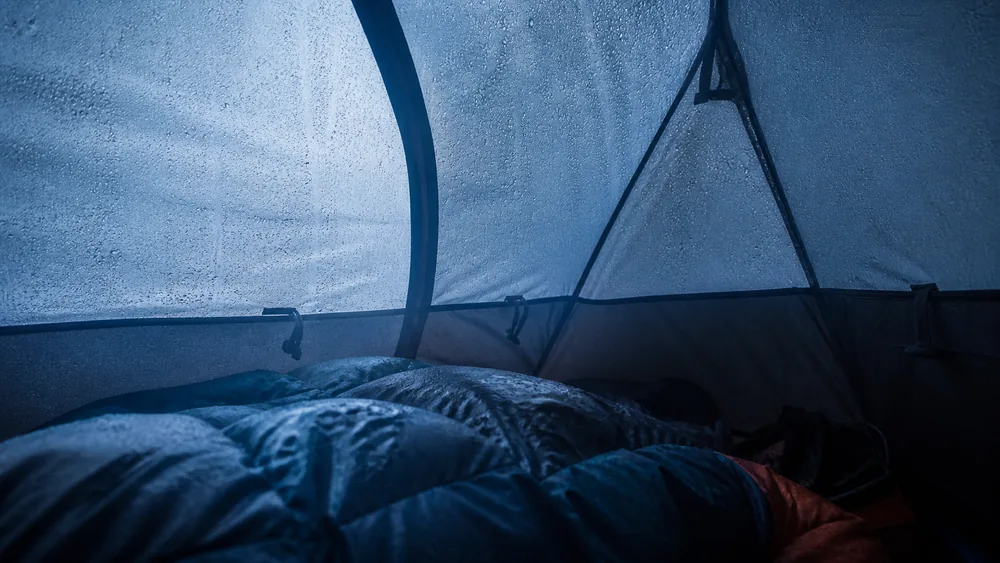
Picture the ways moisture reaches your fill on a real trip. Rain during the walk, condensation running down the inside of a tent, and your own body moisture accumulating over consecutive nights.
Only the first of those is dramatic, and it is also the easiest to solve completely.
A dry bag or a lined pack removes the rain route almost entirely, and it costs very little. That is why the wet argument collapses for a lot of people the moment they examine their own trips.
- Rain during the walk
- Solved by a dry bag, and it favours neither fill
- Tent condensation
- The commonest real wetting, gradual rather than sudden
- Sweat and body moisture
- Builds across consecutive nights, which is where long trips differ
- Full immersion
- The scenario people picture, and the rarest for a walker
- Hydrophobic treatment
- Buys time rather than immunity, and it is not waterproofing
Treated down deserves its own line because it has genuinely narrowed the gap. Down treated with a durable water repellent keeps its loft far longer when damp, with one treatment claiming up to 13.5 times longer than untreated down.
It is still a delay rather than a fix. Sustained wet conditions defeat treated down too, so the treatment moves the threshold rather than removing it.
Someone facing a week of rain has not been rescued by a coating.
So here is where synthetic genuinely wins. Several consecutive wet days with no chance to dry anything, a bag handled by people who will not look after it, or any trip where the bag is going to get soaked and you still have to sleep in it tomorrow.
Cheaper to buy, more expensive to own
Synthetic costs less in the shop. That is real, it is usually the deciding factor, and it compares two products with very different working lives.
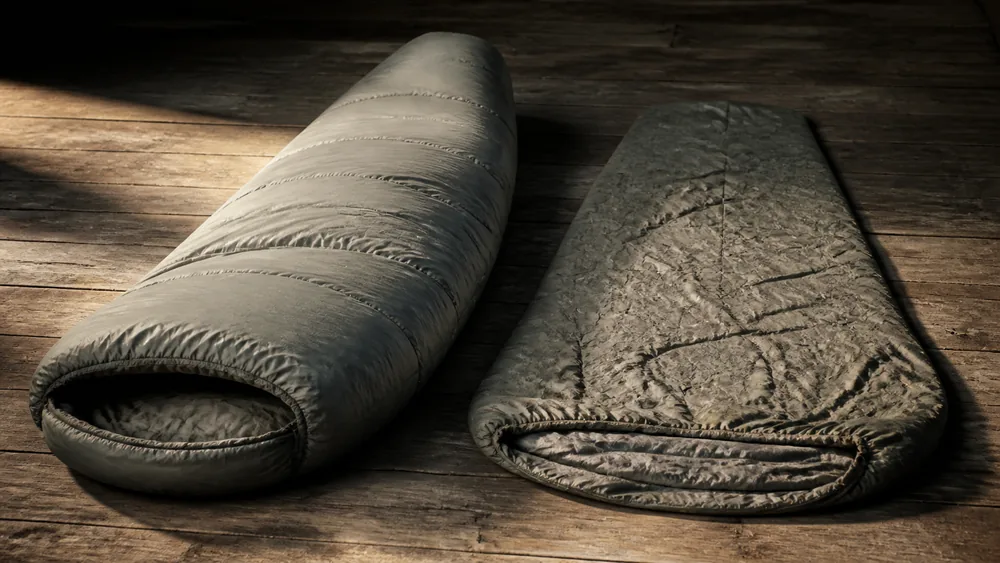
Synthetic fills lose meaningful loft after roughly three to seven years of regular use. The fibres break down, the bag packs smaller than it used to, and it stops reaching its rating.
Down bags in the same use commonly last ten to fifteen years, and a well-kept one goes on considerably longer than that.
Put those numbers into the price comparison and it changes direction.
A down bag at twice the price that lasts three times as long is cheaper per year of use, and it was lighter and smaller for every one of those years. The purchase price told you the opposite.
How synthetic ages matters as much as how long it lasts. It fades rather than fails, so the bag gets colder by degrees while still looking perfectly fine in the cupboard.
People find out on a cold night instead, which is a worse way to learn it.
A flat down bag is often recoverable. Washing it properly clears out the body oils and dirt holding the clusters shut, and most of the loft comes back.
A flat synthetic bag is not.
Mountain Equipment states it without hedging, that most synthetic fillings lose loft and warmth over time no matter how well they have been cared for. Care buys years on a down bag and almost nothing on a synthetic one.
The price argument does still favour synthetic in one clear case. If you are buying a first bag, or you camp a handful of nights a year, you will not be around long enough to collect down's lifespan advantage.
Paying for years you will not use is not thrift.
Down is not one thing, and neither is synthetic
There is a problem with the question as it is usually asked. Down covers a range wide enough that a cheap down bag and an expensive one behave almost nothing alike.
The variable is fill power, which counts how many cubic inches one ounce of down expands to fill. It appears on the label of any sleeping bag worth buying, and the spread between the numbers is far wider than most people assume.
Outdoor Life puts real volumes on it. One ounce of 550 fill expands to about 9 litres, while one ounce of 900 fill reaches almost 15.
Set a synthetic beside them on the same scale and the picture stops being a two-way argument.
Litres of loft per ounce of fill. The gap between good down and cheap down is larger than the gap between cheap down and synthetic.
That is the whole problem with the question. A 550-fill bag can lose to a well-made synthetic on exactly the weight and packed-size axes down is supposed to win.
So a budget down bag is often the worst of both.
It carries down's wet weakness, down's care requirements, and down's price, without delivering enough of down's advantage to pay for them. If the budget only reaches low fill power, synthetic is usually the better bag.
Synthetic divides too, and the split is a straight trade rather than a quality ladder. Short staple fibres imitate down's cluster structure and compress well at the cost of longevity, while continuous filament holds loft and lasts at the cost of packing down.
Which one a bag uses is part of why the working life of synthetic spans several years rather than landing on a number.
One difference has nothing to do with performance. Down is an animal product, and the industry has a documented history of live-plucking and force-feeding.
Certification schemes such as the Responsible Down Standard exist to trace sourcing, and for some buyers that settles the question before any performance argument starts.
Does winter change the answer?
Warmth comes from loft, and a colder rating simply needs more of it.
So the gap between the two fills is a percentage rather than a fixed number of grams.
Whatever synthetic gives away in warmth for its weight, it gives away on a bigger base once the bag is built for freezing nights. A difference you would shrug at in a summer bag becomes a different pack in a winter one.
Cold also tends to be dry, which quietly removes synthetic's best argument. Air holds less moisture as it gets colder, so the damp that makes synthetic sensible in autumn is often simply absent on a clear February night.
Down collects its largest advantage exactly where its weakness is least likely to show up.
Then the trip gets long, and it turns around again. Nothing dries in sub-zero air, so the moisture your body puts into the fill each night stays there.
On a winter trek that compounds night after night, and it is the same mechanism as any run of consecutive nights with no relief valve. Winter sharpens both arguments at once.
It widens down's weight advantage and it removes down's escape route.
Is there a third option?
Yes, and the binary framing hides it.
Some bags decline to choose and put both fills in the same bag. The common approach blends a small amount of loose synthetic through the down.
Outdoor Vitals describes what that is for. The synthetic element stabilises the down and stops the clusters collapsing when moisture arrives, which targets down's one real weakness instead of trading away its strengths.
It works, within limits. The same maker rates its own synthetic at 525 fill power against 800 for its down, which is the honest shape of the compromise.
A blend sits between the two rather than beating both.
So a hybrid narrows the wet gap without closing it. It costs more than plain synthetic, it still wants the storage and washing care that down demands, and a long soaking will still beat it.
What the money buys is a wider margin, not a different category. That suits one reader in particular.
Somebody who counts grams, camps in genuinely damp country, and has already worked out that a full synthetic bag is too heavy for the distance they walk.
Which one suits how you actually treat your gear?
Those lifespan figures carry a condition, and it is worth putting plainly.
Down lasts that long when it is looked after, and it punishes neglect in a way synthetic does not. Storage does most of the damage.
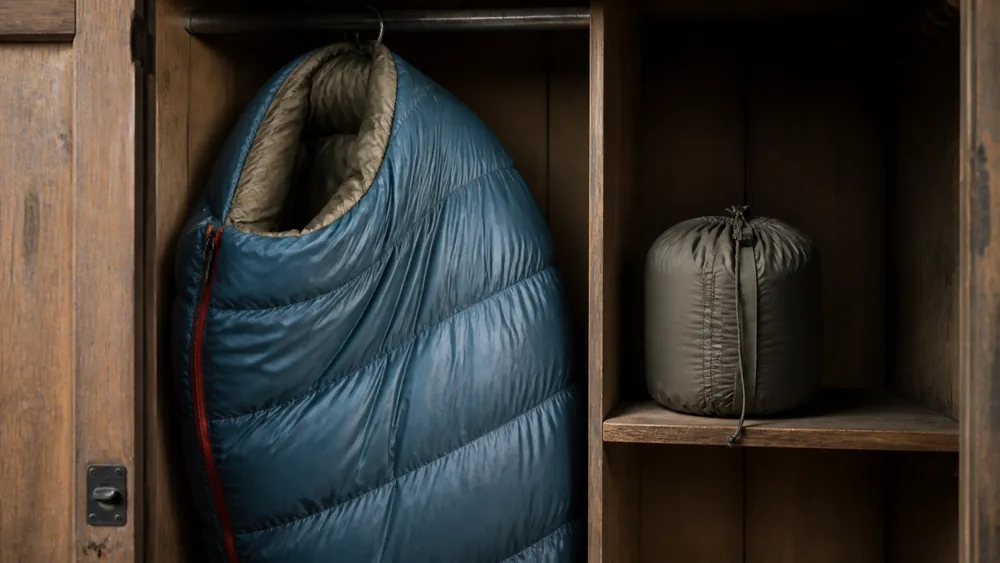
A down bag stored compressed in its stuff sack loses loft it never fully recovers, and a bag left like that for a couple of years can be permanently diminished. It wants to hang loose or sit in a large cotton sack between trips.
Washing is the other way people shorten a bag's life early. Down needs specific handling, and an ordinary machine cycle with ordinary detergent can ruin a bag in a single wash.
Synthetic tolerates far more, and it will die of age whatever you do.
- Stored uncompressed between trips rather than left in the stuff sack.
- Aired and fully dried after every trip, not just after wet ones.
- Washed rarely, and with the right products when it happens.
- Kept off grit and sharp ground, because shell damage ends a bag before the fill does.
- An honest answer about whether you will actually do the four things above.
That last line is the real test. The lifespan is conditional, and somebody who knows they will stuff the bag in a cupboard and forget it should discount down's advantage rather than paying for it.
So which should you buy?
For anyone carrying the bag on their back who can keep it dry, down is the default. It is lighter, it takes less room, it lasts longer, and the conditions that defeat it are avoidable with a dry bag and a little discipline.
Three situations flip that. Sustained wet trips where nothing dries, a first bag bought on a tight budget, and occasional camping where the lifespan advantage will never be collected.
In all three, synthetic is the better buy rather than the compromise.
Car camping quietly removes most of the argument. When weight and volume stop mattering, as they do on a car camping trip, down's two biggest advantages stop paying and a cheaper bulkier bag does the same job.
Spend the difference on a thicker sleeping pad instead.
Down
- Best for
- Anyone carrying the bag who can keep it dry
- Why it ranks
- Warmest for its weight, smallest packed, and two to four times the working life
- Keep in mind
- Loses most of its insulation once properly wet, and the lifespan depends on storage you may not actually do
Synthetic
- Best for
- Sustained wet trips, a first bag, or a handful of nights a year
- Why it ranks
- Keeps insulating after a soaking, dries overnight, and costs least in the shop
- Keep in mind
- Heavier and bulkier for the same rating, and the loft fades whatever you do
Blended down and synthetic
- Best for
- Damp country where you still count grams
- Why it ranks
- Loose synthetic through the down holds the clusters open when moisture arrives
- Keep in mind
- Costs more than synthetic, still wants down's care, and buys a delay rather than immunity
Down carries the most weight in that list, so it is worth seeing its case and its bill side by side.
Pros
- Considerably warmer for its weight, which is why light kit is built around it
- Compresses far smaller, and pack volume is often the binding constraint
- Lasts two to four times as long, which reverses the price comparison
- Treated down has narrowed the wet gap meaningfully
Cons
- Loses most of its insulation when it gets properly wet, and dries slowly
- Costs substantially more up front
- The lifespan depends on storage and care it may not receive
Once you have settled the fill, the rest of the decision is still ahead of you. Temperature rating, shape, length, and the features that actually keep heat in are a separate set of questions with their own answers.
Sources
The core comparison of warmth for weight, compressibility, and wet performance between the two fills is set out in: Down vs. Synthetic: Which Insulation Is Right for You?, REI.
The working lifespans used in the ownership argument, with synthetic losing meaningful loft after roughly three to seven years against ten to fifteen years or more for down, come from: Down vs Synthetic Sleeping Bags, Outdoor Life.
What hydrophobic treatment does, including the claim of keeping down dry far longer than untreated fill and the limit of that protection in sustained wet conditions, is covered by: Choosing a down sleeping bag, Alpkit.
The loft volumes behind the fill-power figures, with one ounce of 550 fill reaching about 9 litres against almost 15 for 900 fill, are given in the Outdoor Life comparison cited above.
That synthetic fills lose loft and warmth over time regardless of how carefully they are looked after is stated in: Caring for Synthetic Sleeping Bags, Mountain Equipment.
The trade between short staple and continuous filament synthetic, one compressing well at the cost of longevity and the other lasting at the cost of packing down, is set out in: Down vs. Synthetic: Understanding Sleeping Bag Insulation, GearJunkie.
The blended down and synthetic construction, and the 525 fill power rating placed against 800 for the same maker's down, come from: Sleeping Bag Insulation: What's the difference?, Outdoor Vitals.
AnswersQuestions readers ask
Is down or synthetic better for a sleeping bag?
Down for anyone carrying the bag who can keep it dry, because it is warmer for its weight, packs smaller, and lasts two to four times as long. Synthetic for sustained wet trips, a first bag, or occasional use.
Does synthetic really work when wet?
Yes, and the argument is quoted more broadly than it holds. Bags mostly get wet through condensation and body moisture rather than immersion, and a dry bag removes the rain route almost entirely.
What does hydrophobic down actually do?
It keeps loft far longer when damp, with one treatment claiming up to 13.5 times longer than untreated down. It is a delay rather than waterproofing, and sustained wet conditions still defeat it.
How long does a sleeping bag last?
Synthetic fills lose meaningful loft after roughly three to seven years of regular use. Down bags commonly last ten to fifteen years and longer with care, which reverses the price comparison.
Is a cheap down bag worth it?
Often not. Entry-level down around 550 fill can lose to good synthetic on weight and packed size, so a budget down bag carries down's wet weakness, care burden, and price without the performance.
Does down or synthetic matter for car camping?
Much less. When weight and packed size stop mattering, down's two biggest advantages stop paying, and the money is better spent on a warmer sleeping pad.