
Backpacking vs Hiking
One night out roughly doubles the load on your back and turns the car from somewhere you can reach into somewhere you left. Almost everything else about the choice follows from those two facts.
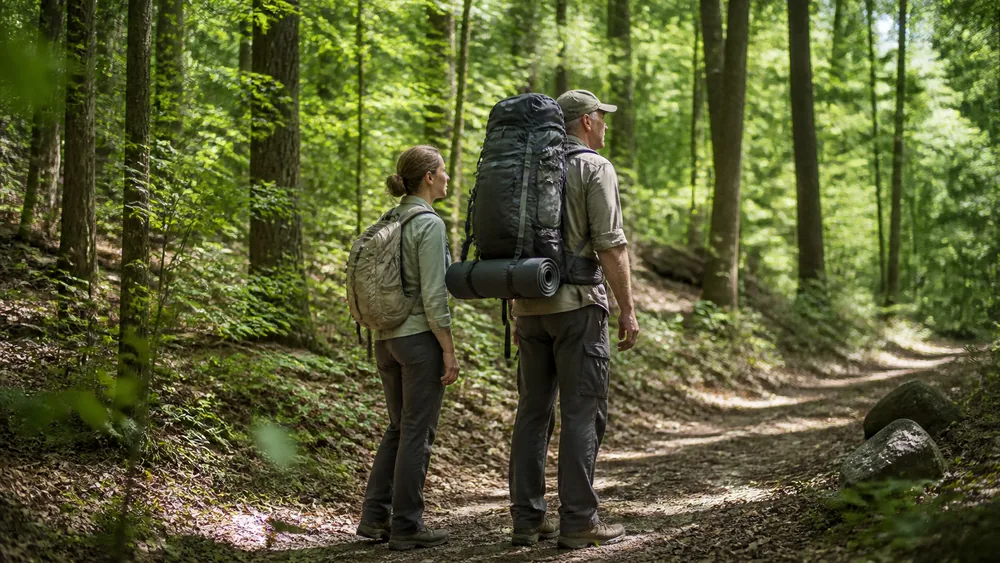
Hiking is walking a trail and coming home the same day. Backpacking is walking a trail carrying everything you need to sleep out, then doing it again tomorrow.
That definition takes ten seconds and settles almost nothing.
The part worth your attention is what happens once the night is on the itinerary, because the walking barely changes while nearly everything around it does.
- Count the nightsOne night is the line. Everything below follows from crossing it, and none of it matters if you are back before dark.
- Weigh what you would carryA day pack sits near a tenth of your body weight. An overnight pack sits near a fifth, which makes it a different object.
- Find your exitAsk how long the walk back to the car is from the far end of the route rather than from the trailhead.
- List what you do not ownShelter, sleep, a pack big enough to hold them, and a way to make water. Borrowed counts as owned.
- Check the second morningDay two is where feet, sleep, and appetite decide whether the plan was sensible.
Work through those and most people land on an answer before reading another word. The rest of this page explains why the answer is what it is.
The overnight changes more than the mileage
A day hiker carries supplies. A backpacker carries systems, and that distinction is doing more work than it looks.
Water makes the point cleanly.
On a day hike you carry all the water you will drink, which is a known weight that only goes down. On an overnight you carry a way to turn a stream into drinking water, because no realistic amount of bottled water covers two days of walking.
Shelter behaves the same way, except there is no reduced version of it.
You cannot carry a slightly smaller amount of tent. Either the shelter is with you or you are sleeping under whatever the weather provides, and the same is true of a sleeping bag and the mat underneath it.
Shelter
A day hiker carries none at all. This is a whole category arriving from nothing, and it has to work in wind and rain at the end of a tiring day.
Sleep system
The bulkiest thing in the pack. A bag rated for the wrong temperature turns a good trip into eight hours of waiting for sunrise.
Cooking and food for days
Food weight scales with nights rather than miles, so a longer route at the same distance still gets heavier.
Water treatment
You stop carrying water and start carrying the means to make it, which is lighter but adds a system that can fail.
Waste and hygiene
The category nobody thinks about until the first morning, and the one with no option to skip.
Every one of those has to work after dark, in weather, when you are tired and slightly clumsy.
A day hiker whose plan fails gets a long walk. A backpacker whose shelter fails is committed to the night anyway.
So the honest framing is not about duration. You are carrying life support, and the extra hours are a consequence of that rather than the cause.
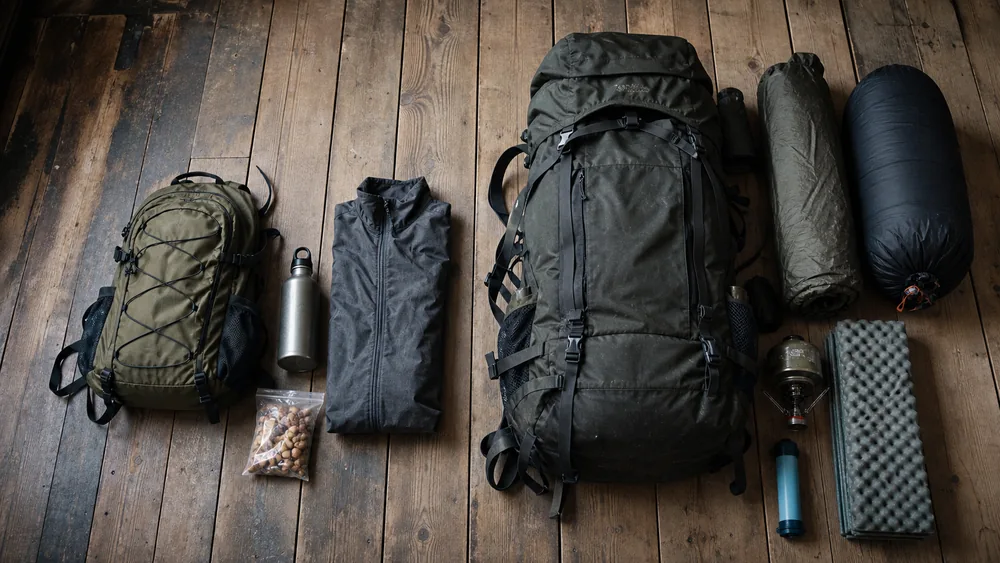
A loaded pack reshapes the whole day
The load difference is roughly a factor of two, and it is published rather than folklore. Standard guidance puts a loaded backpacking pack near or under 20 percent of body weight and a loaded day pack near or under 10 percent.
For somebody who weighs 150 pounds, that is about 30 pounds against about 15.
Pick your own body weight and do the arithmetic, because the abstraction hides how it feels. Fifteen pounds is a jacket, lunch, and two litres of water, and thirty pounds is that plus a small child's worth of equipment.
The cost of that weight does not show up as a single number.
One review of load-carriage research found that carrying around a quarter of body weight raised energy cost by roughly half when walkers held the same pace. The load takes payment either in extra effort at the old speed or in a slower speed at the old effort, and you get to choose which, but not whether.
| Planning quantity | Day hiking | Backpacking |
|---|---|---|
| Loaded pack, share of body weight | Near or under 10 percent | Near or under 20 percent |
| Loaded pack for a 150 pound walker | Around 15 pounds | Around 30 pounds |
| Realistic distance on a normal day | What your fitness allows | Noticeably less, and less again on day two |
| Terrain that stays comfortable | Most maintained trail | Narrower, especially steep descent and side slopes |
| What a mistake costs | A late finish | A night in the wrong place |
The planning error that follows is predictable. A capable day hiker takes their usual daily distance, adds a night, and books a route that would have been fine unloaded.
Descents are where the load bites hardest.
Going down with thirty pounds loads knees and ankles far more than the same ground unloaded, and it does it when you are tired and near the end of the day. Loaded pace estimates cannot be borrowed from your unloaded ones, and the second day usually runs slower than the first.
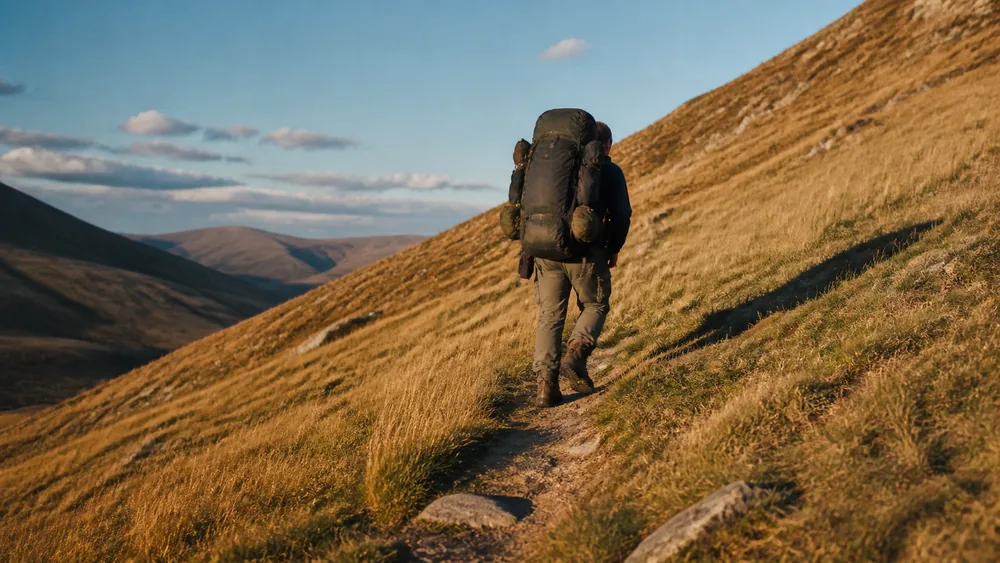
Can you still turn around?
A day hiker always has the same escape plan, and it is a good one. Walk back the way you came, and the worst case is the distance you have already covered, which never exceeds half a day.
That option quietly disappears on an overnight.
Every hour you walk away from the trailhead adds an hour to the walk back, and the trip is designed to keep doing that. By the middle of day two you can be further from a road than you have ever been on foot.
Ordinary problems change character across that gap.
A rolled ankle on a day hike is a slow limp back to the car and a wasted afternoon. The same ankle on the second night is a serious problem, because the walk out is long, loaded, and possibly over ground that took real effort in both directions.
Weather works the same way. A forecast that ends a day hike early can pin a backpacking party in place, and staying put costs food and warmth that were budgeted for walking.
There is a planning move that buys some of the option back.
Choose routes with intermediate exits, meaning trailheads, road crossings, or valley paths that let you leave partway. Exits are a route feature, and looking for them is the closest a backpacker gets to the day hiker's built-in escape.
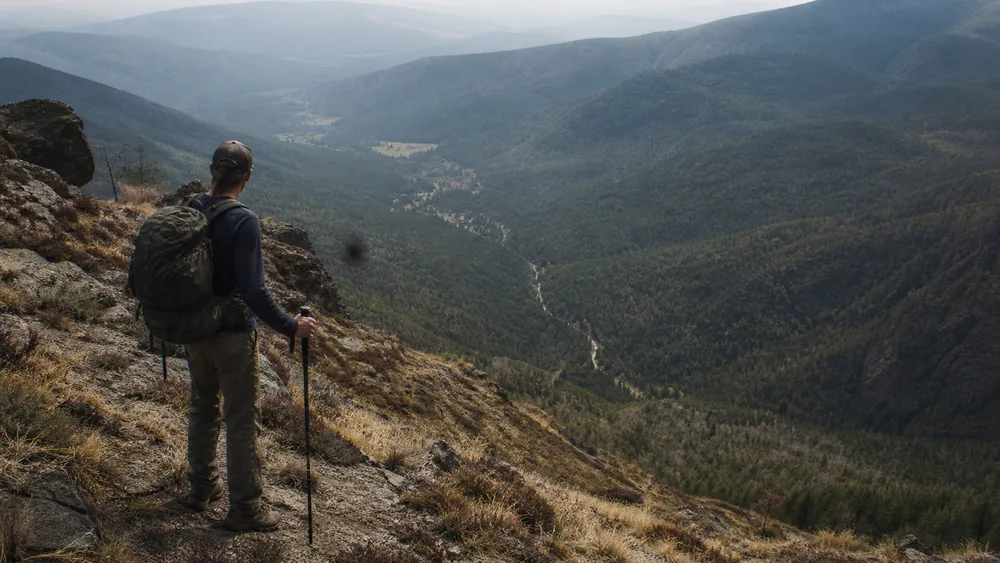
The four things a day hiker does not already own
Most people who day hike regularly are four items away from an overnight, and the list is shorter than the shops suggest.
Day hiking has almost no entry cost by comparison. Footwear that fits, layers for the forecast, water, and food cover it, and anyone who walks already owns most of that.
- Already covered by day hiking
- Footwear, layers, water, food, navigation
- Shelter
- Widely rentable, and the item people wrongly buy first
- Sleep system
- Bag plus mat, the biggest comfort decision and the hardest to borrow by size and rating
- A pack that holds it all
- The one genuine blocker, because a day pack physically cannot take the volume
- Water treatment
- Among the cheapest items and the most commonly forgotten
The pack is the item that actually gates a first trip. Shelter and sleep can be borrowed or rented from outdoor shops and clubs in most places, and a filter costs less than a decent pair of socks.
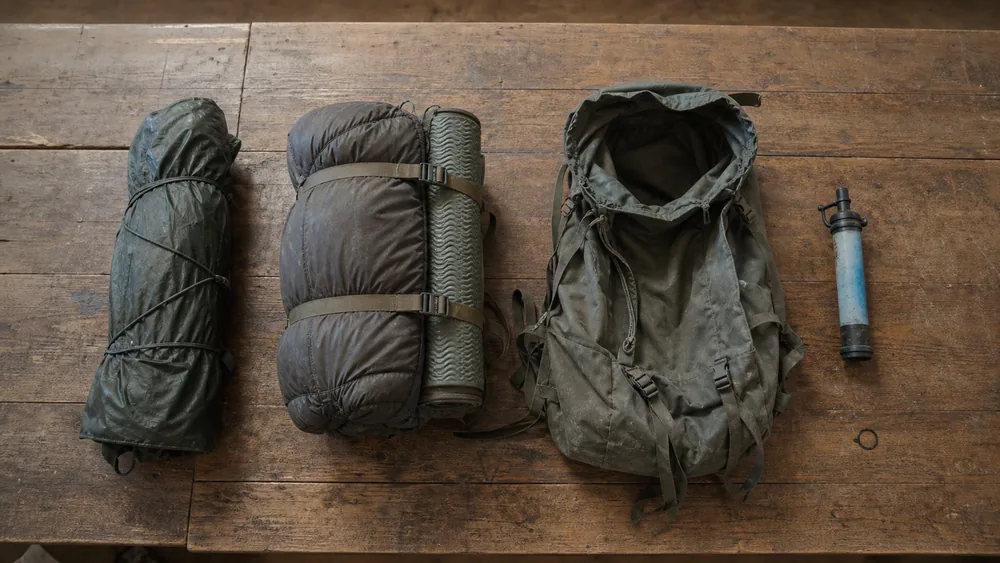
A day pack cannot be talked into holding a tent and a sleeping bag.
That is worth knowing before anybody spends money, because the usual order is backwards. People buy the tent first, discover it does not fit in the pack they own, and then buy a pack chosen around a tent they picked without knowing what they wanted.
More day hikes often beat one overnight
Neither activity is the better one, and the useful question is which fits the next few months of your life.
More day hikes win more often than enthusiasts admit.
If you have single free days rather than free weekends, if you own nothing on the list above, or if you are still building the fitness to enjoy a full day on your feet, then a season of longer day hikes gives you more time outdoors and better walking than one uncomfortable overnight will.
Pros
- Backpacking reaches ground that is simply too far from a road to see in a day
- You get the two best hours of the day, early morning and last light, from inside the landscape
- Consecutive days build a kind of fitness and calm that single days do not
Cons
- Weather and injury cost far more once the exit is hours away rather than minutes
- It needs equipment a day hiker does not own, and a pack that will not substitute
- Recovery has to survive day two, which catches out strong walkers who never trained for consecutive days
That last point deserves emphasis, because it surprises fit people. Strong day hikers are rarely undone by the first day, and they are frequently undone by the second morning, when feet are sore, sleep was short, and appetite has not caught up with what the body spent.
Equipment is the visible barrier, and skills are the one people notice second.
Day hiking asks you to read a forecast, follow a route, and judge how far you can get before dark. Backpacking keeps all of that and adds a handful of things that only exist once you stop walking.
You have to pitch a shelter in wind and failing light, pick a camp spot that stays dry and legal, treat water from a source you have not seen before, store food so animals leave it alone, and deal with waste properly.
None of those is difficult on its own.
The difficulty is that they arrive together, at the end of a long day, when you are tired and it is getting dark. That is why the first overnight is worth making deliberately easy.
For most readers this is a sequence rather than a fork. Day hiking builds the legs, the navigation, and the weather judgement that make a first overnight enjoyable instead of survivable.
Keep the car in reach on your first overnight
The design goal for a first trip is to add one variable at a time. You are adding a load and a night, so hold everything else steady.
The simplest version works well.
Pick a campsite a short walk from the trailhead, ideally somewhere you could retreat from in under an hour. That keeps the day hiker's escape route intact while you find out what carrying the load and sleeping outside actually feel like.
- Camp within an hour's walk of the car, so leaving early stays easy.
- Borrow or rent the shelter and the sleep system rather than buying them.
- Carry the full loaded pack on a familiar day hike first, before committing to a night.
- Go with somebody who has done it, which halves the systems you have to get right.
- Choose settled weather on purpose. A first night is for learning the kit, not testing it.
- Write down everything you did not touch, because that list is your lighter second trip.
The loaded day hike is the step most people skip and the one that teaches the most. You find out how the pack sits, how your pace drops, and whether the boots that were fine at fifteen pounds are still fine at thirty, all while the car stays close.
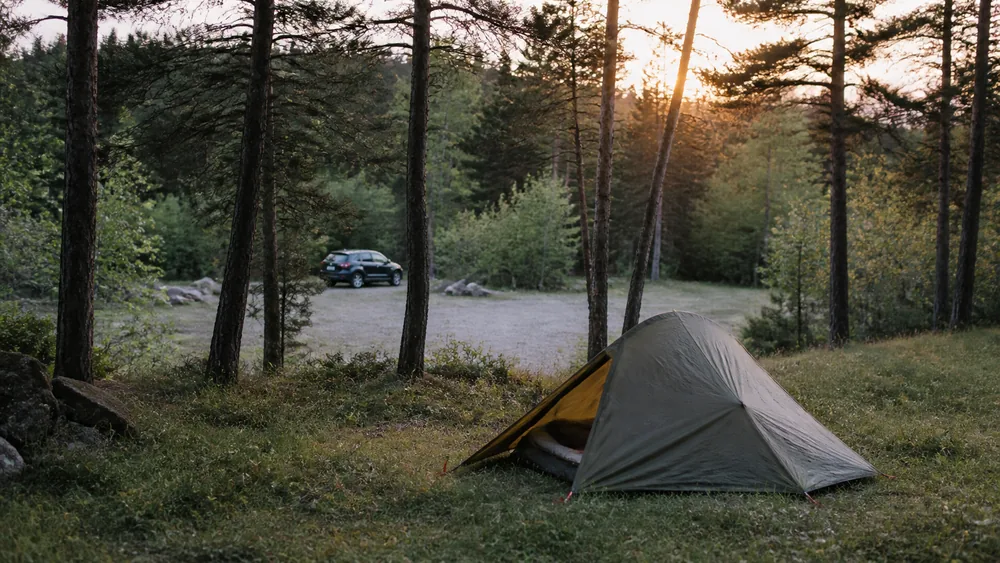
Pay attention to the second morning above everything else.
How your feet feel, how you slept, and whether you want breakfast are the three signals that tell you whether longer trips are going to suit you. Day two is the real test, and a first overnight that ends after it has told you what you needed to know.
Sources
The load guidance used throughout, including the roughly 20 percent of body weight for a loaded backpacking pack against roughly 10 percent for a day pack and the 150 pound worked example, comes from: REI Expert Advice, How Much Should Your Pack Weigh.
The finding that carrying about a quarter of body weight raised energy cost by roughly half at an unchanged pace, and that a load is paid for in either effort or speed, comes from a review of load-carriage research: What Research Says About Pack Weight, Mountain Movement Speed, and Energy Cost.
The underlying relationship between carried mass, walking speed, and metabolic rate, measured across loads up to two thirds of body mass, is set out in: Modeling the Metabolic Costs of Heavy Military Backpacking.
AnswersQuestions readers ask
Is backpacking just hiking with a bigger pack?
No. The load roughly doubles, and shelter, sleep, cooking, and water treatment become systems you carry and have to operate in the dark. The walking itself is the part that changes least.
How much heavier is a backpacking pack?
Standard guidance puts a loaded backpacking pack near or under 20 percent of body weight and a day pack near or under 10 percent. For a 150 pound walker that is roughly 30 pounds against 15.
Is backpacking harder than hiking?
On the same trail, yes, and the load explains most of it. One review of load-carriage research found that carrying around a quarter of body weight raised energy cost by roughly half at an unchanged pace.
Should I try hiking before backpacking?
For most people it is the better order. Day hiking builds the legs, the navigation, and the weather judgement that make a first overnight enjoyable rather than merely survivable.
What do I need to buy to start backpacking?
Four things a regular day hiker usually lacks: shelter, a sleep system, a pack big enough to hold them, and water treatment. Shelter and sleep are widely rentable, and the pack is the item that genuinely blocks a first trip.
How far should I walk on my first backpacking trip?
Less than your usual day-hike distance, because the load slows you down. Camping within about an hour of the car keeps an easy exit if the night goes badly.