
How to Choose a Day Hike That Matches Your Fitness
Judge a day hike by climb, terrain, and exit options rather than by distance alone, then pick the version of the route your current fitness can finish with something left over.
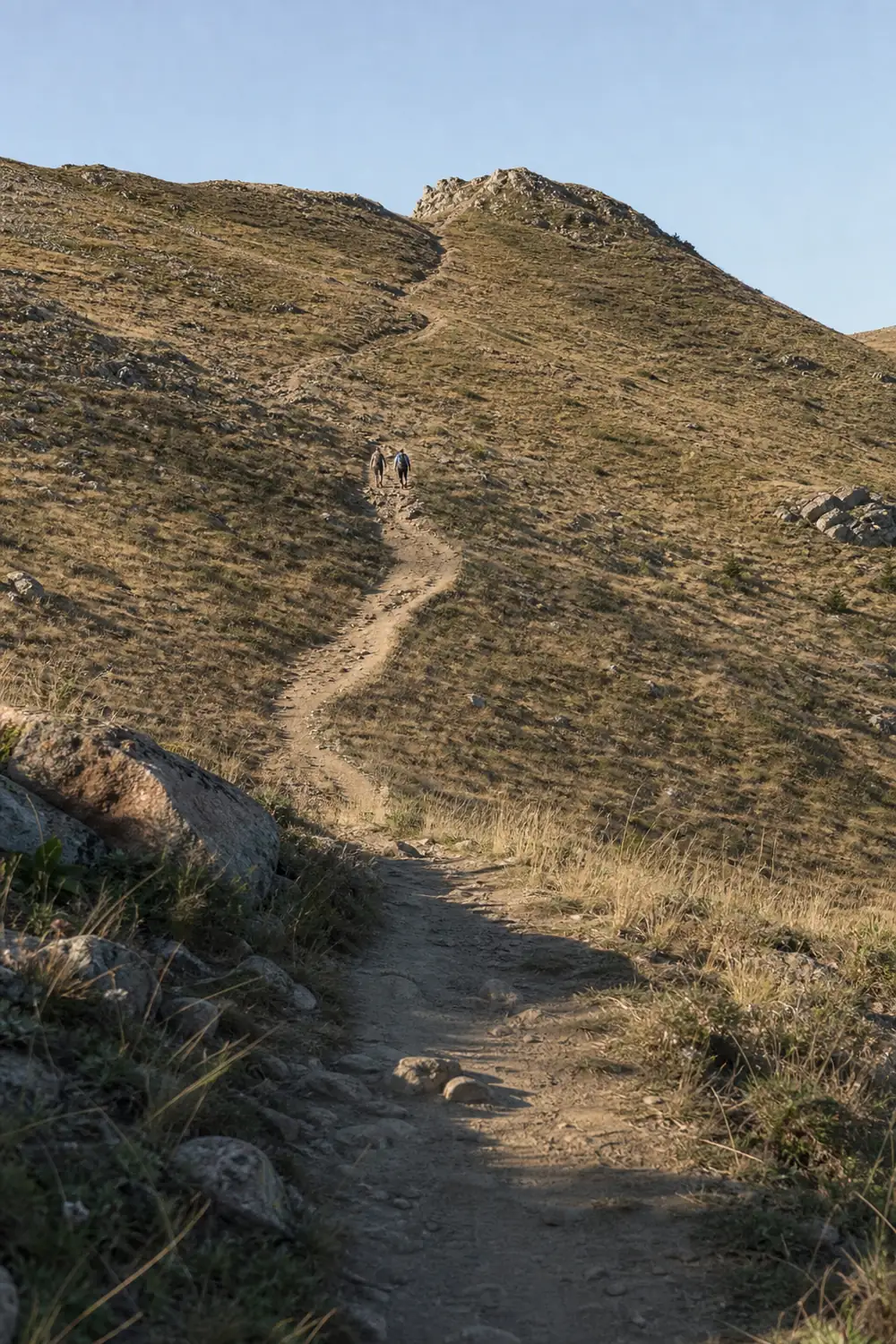
Match a route to the fitness you have today by converting its statistics into honest effort and setting a turnaround before you start.
A route that looks modest on a map can take twice as long as expected and leave you walking the last mile in the dark.
The statistics were never wrong. They just did not describe the effort.
Fitness is only half of the question anyway. The other half is what the route demands, and a hiker who reads both accurately will out-plan a stronger one who reads neither.
Matching a hike to your current fitness is arithmetic plus honesty. You convert the route into effort, compare it against what you have actually finished lately, and pick the version you can complete with something in reserve.
Those ratings show how strongly each factor drives real difficulty. Distance sits in the middle of that list, which is the opposite of how most people choose a hike.
Why does a route that looks easy on paper wear people out?
Part of the problem is that difficulty ratings are relative to their source. A route marked moderate by an alpine club and one marked moderate by a county park service can differ by several hours of hard walking.
Trail descriptions report the things that are easy to measure. Miles and elevation gain are printed everywhere, while surface, steepness distribution, exposure, and exit options usually are not.
The gap between statistics and effort widens as the terrain gets rougher. On a graded path the numbers are roughly honest, and on broken ground they understate the day badly.
What a trail description usually leaves out:
- How the climb is distributed, in one push or spread across the route - What the surface is actually like underfoot - Whether there is any shade on the exposed sections - Where you could stop early if the day goes wrong
Two routes with identical numbers can produce completely different days. Six miles spread evenly along a graded valley path and six miles climbing a rocky spur in two hard pushes ask different questions of your legs, your feet, and your patience.
Why distance alone tells you almost nothing
Elevation gain is the factor that reorders everything. Climbing is slow, and it costs energy at a rate flat walking never approaches, so a thousand feet of ascent can add as much fatigue as a couple of extra flat miles.
The rough conversion most hikers use adds one to two miles of flat-equivalent distance per thousand feet of climb. It is a rule of thumb rather than physiology, and it is far more useful than reading the mileage on its own.
Steepness matters separately from total gain. A thousand feet climbed over three miles is a pleasant ascent, and the same thousand feet in half a mile is a different activity that uses different muscles and burns through your reserves faster.
Surface does the next largest amount of damage. Loose rock, roots, mud, and boulder-hopping all slow you down and demand constant small corrections that tire you in ways smooth tread does not.
Sustained climb
A single long ascent with no flat relief gives your legs nowhere to recover, which is harder than the same gain spread across rolling ground.
Rough tread
Loose rock, roots, and mud slow pace and add constant balance work that accumulates over hours.
Altitude
Above roughly 8000 feet, thin air cuts the pace you can hold regardless of how fit you are at sea level.
Heat and exposure
Open ground with no shade raises effort, water needs, and the chance you slow down badly in the afternoon.
Pack weight
Every pound is carried on every step, and it hits hardest on the descent rather than the climb.
Cumulative effect is what catches people out. Any one of these factors is manageable on its own, and a route that combines rough ground, a sustained climb, and afternoon heat multiplies rather than adds.
Altitude deserves particular care because fitness does not protect you from it. The adjustments in a thin-air day plan apply to strong hikers and new ones alike.
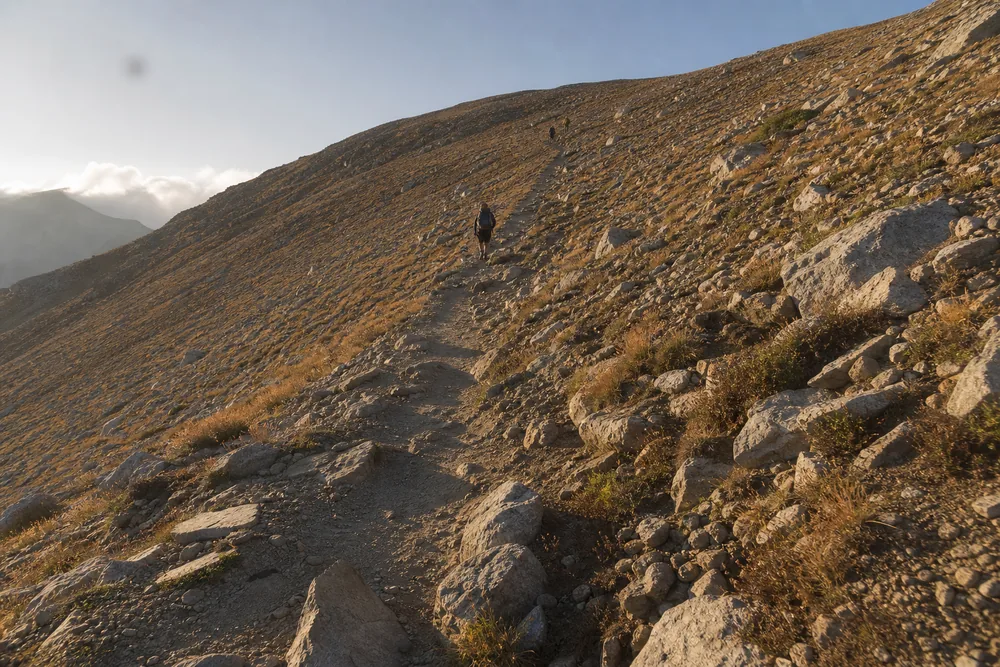
Water needs rise with all of these factors at once. A hard climb in warm weather can double what you drink, and the water carry calculation for a demanding route looks nothing like the one for a flat walk of the same length.
Heat compounds all of it. A route that suits your fitness in April can exceed it in July, which is why hot-day hiking adjustments usually mean choosing a smaller objective rather than carrying more water.
What your last few hikes actually tell you
Gym fitness transfers less than people expect. Regular cycling or running builds useful aerobic capacity, and neither prepares your feet, ankles, or descending muscles for six hours on uneven ground carrying a pack.
Your recent history is better evidence than any fitness self-assessment. What matters is the hardest hike you finished comfortably in the last month or two, and how you felt the following morning.
Be specific about the benchmark rather than approximate. Distance, elevation gain, how long it took, and what the ground was like all belong in the comparison, because a vague memory of a good day is not a measurement.
Comfortably is doing a lot of work in that sentence. Finishing exhausted, sore for three days, or only because the car was close is not the same as finishing with reserve.
Signs your last hike was at your limit rather than inside it:
- You finished significantly slower than you started - You were sore for more than two days afterwards - You skipped the last viewpoint to get back sooner - You ran out of water, food, or daylight margin
- Name your benchmarkWrite down the hardest hike you have finished comfortably in the last two months, with its distance and climb.
- Convert the new routeAdd one to two flat-equivalent miles per thousand feet of gain, then compare against the benchmark.
- Add the real overheadsInclude breaks, photos, navigation stops, and the pace of the slowest person present.
- Check against daylightSubtract an hour of margin from usable light, and see whether the number still fits.
- Choose the smaller versionIf any of those steps felt uncomfortable, take the shorter option rather than hoping.
Run that sequence honestly and it usually produces a smaller route than the one you first considered. That is the process working rather than failing.
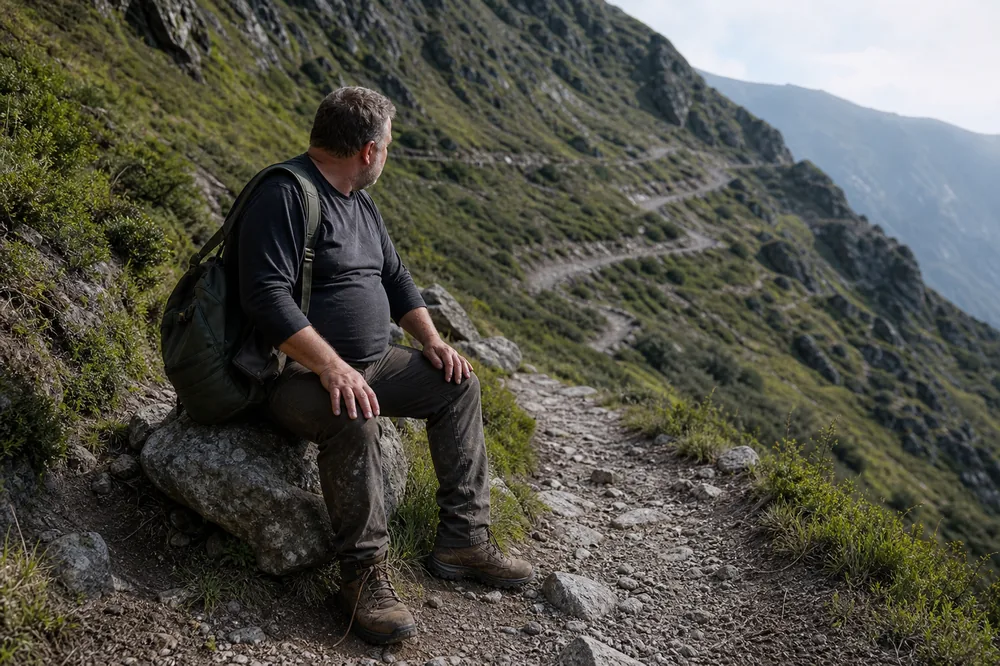
Clothing and footwear affect the same equation quietly. Boots that fit badly or layers that leave you damp cost energy over a long day, and the choices in a hiking layer system matter more as the route gets longer.
If your benchmark is thin because you have not hiked much recently, start well below what you think you can manage. A first outing that ends early and cheerfully teaches you more than one that ends in a rescue conversation, and the pacing habits in a first-hike plan are built for exactly that.
Which route features punish an unfit hiker most?
Some features cost far more than their statistics suggest, and they are the ones worth screening for before you commit to a route.
Screening takes two minutes with an elevation profile. A quick look at the shape of the climb, where the steep sections sit, and whether the route crosses any road tells you most of what the mileage hides.
A sustained climb with no flat relief is the clearest example. Rolling terrain lets your legs recover in short bursts, and a continuous ascent removes that entirely, which is why hikers who manage undulating routes comfortably can stall on a shorter but relentless one.
Steep ground concentrated at the end of a route is worse than the same ground at the start. You meet it with tired legs and less patience, and a climb that would have been routine in the first hour becomes the reason you finish in the dark.
No bail-out point is the feature that turns a hard day into a serious one. An out-and-back with a road at the midpoint lets you stop, and a committing loop with no exit means the only way home is the whole thing.
| Route feature | Why it costs more than it looks | The adjustment |
|---|---|---|
| Sustained climb, no flat | Legs never recover between efforts | Pick rolling terrain or plan a turnaround partway up |
| No bail-out or shortcut | A tired hiker must complete the full route | Prefer out-and-back routes while building fitness |
| Long steep descent | Damages legs and arrives when you are tired | Shorter descent, or accept a slow careful finish |
| Rough or loose surface | Constant balance work, slower pace | Add a third to your time estimate |
| Exposed with no shade | Heat and sun raise effort all afternoon | Start earlier or choose a shaded valley route |
| Remote with poor access | Small problems become large ones | Stay closer to trailheads until your margin is bigger |
Remoteness multiplies every other feature. A demanding route twenty minutes from a road is an inconvenience when it goes wrong, and the same route three hours from the nearest trailhead is a genuine problem.
Descent is the feature people plan for least. Going down loads your muscles while they lengthen, which produces more soreness and more loss of control than the climb did, and it arrives at the end of the day when your concentration is already worn thin.
That effect is why a route with a short steep finish can be harder than its profile suggests. Technique helps a great deal here, and the corner and stride habits in a controlled descent method reduce both the damage and the risk.
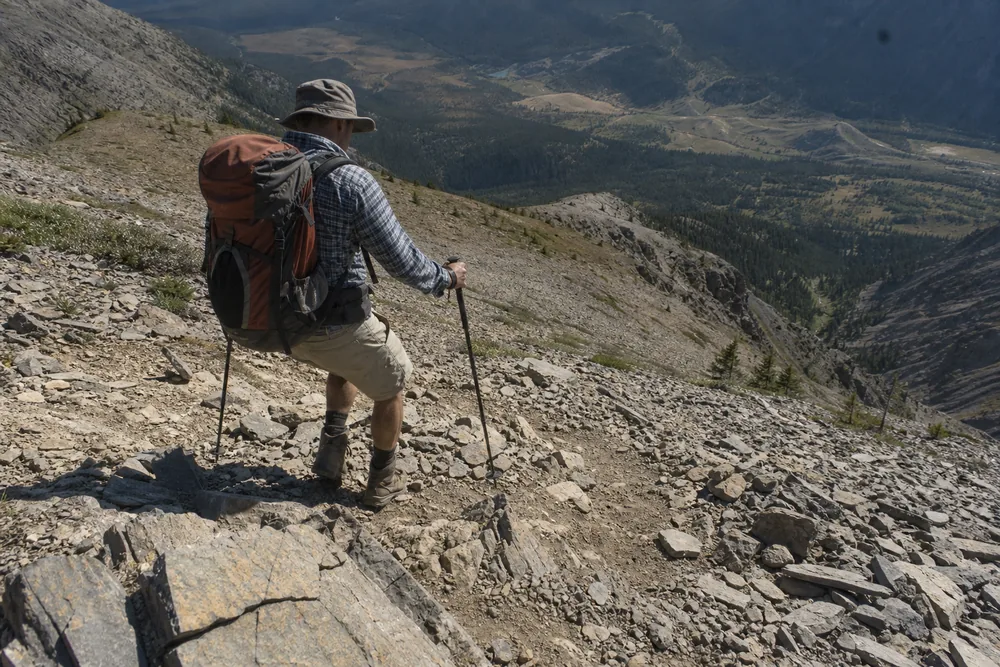
Weight on your back changes every one of these. Carrying camera gear, extra water, or a child's equipment shifts a route up a difficulty band, and the effects of a heavier daypack load show up first on exactly the descents described above.
Group composition matters as much as terrain. The slowest member sets the real pace and the real finish time, and the group pace habits should be settled before anyone chooses the route.
Do the arithmetic before you commit
People routinely underestimate by a third or more, and almost nobody overestimates. Assume you are in the first group until several finished hikes prove otherwise.
A rough time estimate beats a confident guess. One widely used rule allows about an hour for every three miles of flat walking, plus an extra hour for every two thousand feet of ascent.
Descent needs its own allowance rather than being treated as free. Coming down is faster than going up on gentle ground and often slower on steep or loose ground, where careful footing costs more time than the climb did.
That figure describes moving time only. Real days include breaks, photographs, navigation, food, and the fifteen minutes that disappear at every viewpoint, so adding a third to the total is closer to what actually happens.
Scaling the day down beats abandoning it
Treating the day as all or nothing is what pushes people past their limit. The choice is rarely between the full route and staying home, and framing it that way removes the option most likely to give you a good day.
Most ambitious routes contain a smaller good hike inside them. A summit push often has a fine viewpoint two thirds of the way up, and a long loop usually has an out-and-back that captures the best section.
Out-and-back routes make this easiest. Every step outward is a step you have already proven you can reverse, so the decision to stop can be made at any point rather than only at fixed junctions.
Loops remove that flexibility. Once you pass the halfway point of a loop, continuing is usually shorter than returning, which means the decision was really made much earlier than it felt.
Planning that smaller version in advance changes how the decision feels. Turning around at a point you already chose is following the plan, and turning around at a random moment feels like failure, even though the outcome is identical.
A scaled-down day also gives you better information. Finishing a shorter route strongly tells you what to attempt next, and failing on a longer one mostly tells you that it was too long.
Pick your alternative before you leave the car. Name the junction, the lake, or the col where the shorter option branches off, and agree it with anyone hiking with you.
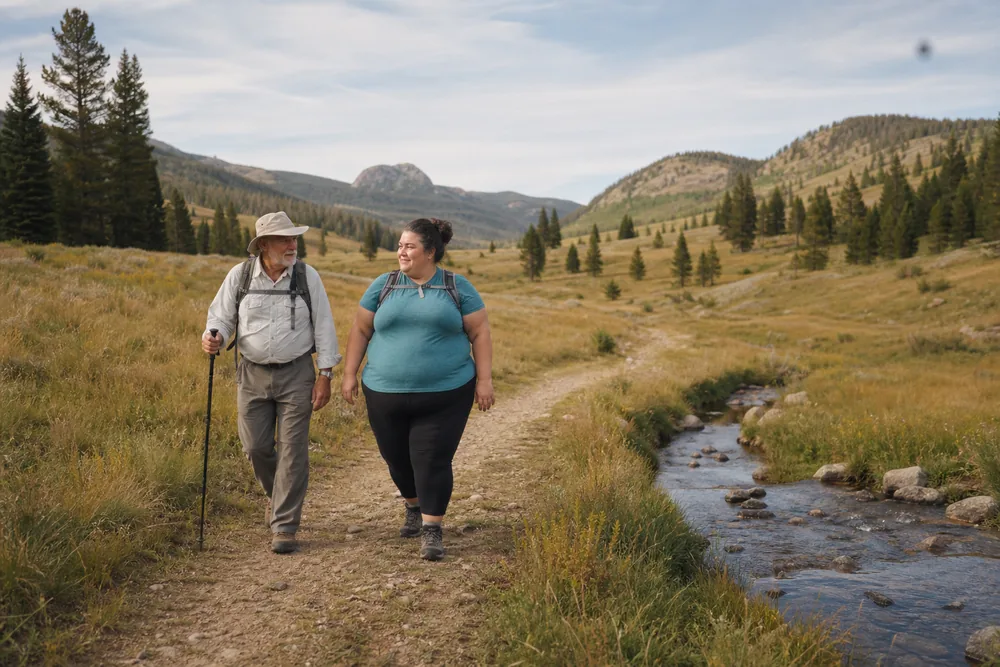
Building fitness is a separate project from choosing today's hike. When conditioning is genuinely the limit rather than route choice, the progression in a hiking-specific training plan is the thing that moves the ceiling.
Route selection has its own broader craft. Access, permits, seasons, and finding candidate trails in the first place belong to choosing a hiking trail, and this article only covers the matching step that follows.
Setting a turnaround you will actually honour
A turnaround time is worthless if you negotiate with it. Every hiker who has been benighted had a moment where the plan said stop and the summit said continue.
The point of fixing it early is that the decision gets made by a rested version of you rather than a tired one standing below a summit.
Fatigue reliably makes summits look closer than they are. The last section of a climb is the one people consistently misjudge, which is precisely when a fixed time protects you from your own optimism.
Use a clock time rather than a landmark where you can. Landmarks move as fatigue distorts judgement, and a time written down before the walk does not.
- A clock time for turning around, agreed before leaving the trailhead
- A named point where the shorter version of the route branches off
- The latest time you can start the descent and still finish in daylight
- An honest read of whether your legs could repeat the last hour
- Agreement from everyone in the group about who makes the call
- Enough water and food for the full route rather than the planned one
Write the time somewhere you will actually see it. A note on your phone case or the back of your hand outperforms a number you agreed to verbally three hours earlier.
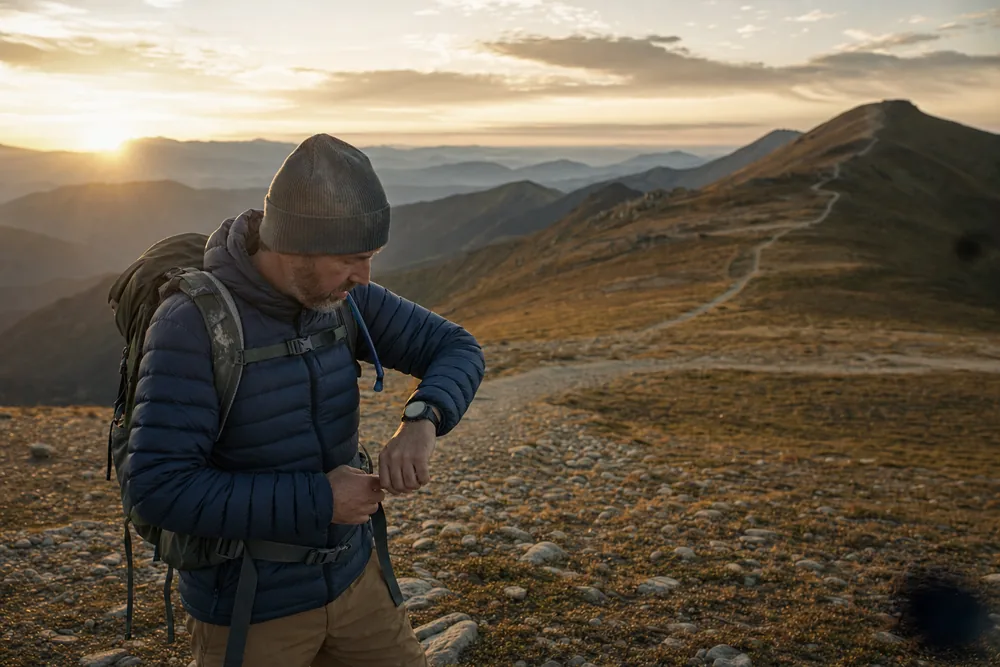
Groups need the turnaround settled out loud. An unspoken assumption that someone will call it usually means nobody does, and the least confident person in the party is the one who suffers for that.
The signals that you have overreached are physical and specific. Legs shaking on flat ground, an appetite that has disappeared, and stumbling on ground you would normally walk cleanly all mean the margin is gone.
Eating and drinking properly changes how much of this you feel. A hiker who has skipped food for four hours reads like an unfit one, and steady trail fuelling habits remove that confusion before you judge your own limits.
Those signs are worth taking seriously rather than pushing through. The broader judgement calls in a hiking safety plan apply the same way to fitness limits as they do to weather, and the errors gathered in frequent hiking mistakes cluster heavily around people who chose a route that never fitted the day.
Sources
- National Park Service, hiking safety guidance on trip planning, pacing, and turnaround decisions - Naismith's rule and its common modern corrections for ascent, descent, terrain, and group pace
Step by stepPractical steps
- Write down the hardest hike you have finished comfortably in the last two months.
- Convert the new route into flat-equivalent distance by adding roughly one to two miles for every thousand feet of climb.
- Estimate moving time, then add breaks, photos, navigation, and the slowest person in the group.
- Compare that finish time against usable daylight and subtract an hour of margin.
- Pick the shorter version of the route if any of those numbers are uncomfortable.
AnswersQuestions readers ask
How many miles is a reasonable first day hike?
There is no universal number because terrain and climb change the answer completely.
A useful starting point is the longest walk you already do comfortably on flat ground, then subtract for elevation gain and rough surface. Three flat miles and three steep miles are different outings.
How do I convert elevation gain into effort?
A common rule of thumb adds one to two miles of flat-equivalent distance for every thousand feet of climb. It is rough rather than precise, but it stops people reading a six-mile route with three thousand feet of gain as a short day.
Why do I run out of energy on the descent rather than the climb?
Descending loads your leg muscles while they lengthen under tension, which causes more muscle damage than climbing does. It also arrives when you are already tired, so technique and concentration slip at the point where footing matters most.
Should I train first or just pick an easier hike?
Pick the hike you can finish today, then build from there. Choosing an honest route gives you a good day and useful information about your current limits, and conditioning improves faster from regular finished hikes than from one demoralising failure.
How do I judge a route for a mixed-ability group?
Plan the whole day around the least experienced person, not the average. The slowest member sets the real pace, the real finish time, and the real turnaround, and a route chosen for the fittest hiker turns everyone else into a problem to manage.