
How to Hike with a Heavy Daypack
Carry a heavier than usual day load without wrecking your shoulders or your knees, using load placement, a hipbelt you actually tighten, and a shorter step on the way down.

Handle a heavy day load through what makes it heavy, where the weight sits, how the hipbelt works on a small pack, and what stays in the car.
Most day hikes leave the trailhead with a pack under five kilos. Then a trip comes along where that number doubles, and ground you thought you knew starts behaving like harder ground.
Weight arrives for ordinary reasons. Four litres of water instead of one, a camera body and a second lens, two spare fleeces because a seven year old stops moving and gets cold, the group stove, the shell you will probably never take out.
The load by itself is rarely the real trouble. A small pack carries weight differently than a large one, and what changes shows up in your balance, your stride, and the descent rather than in the first ten minutes of climbing.
Plan ahead and prepare.
Leave No Trace, Principle 1
Nearly every kilogram on your back during a day hike traces back to a decision made in a kitchen or a car park. That makes pack weight one of the few trail variables you fully control before you start walking.
Which items actually push a daypack over the line?
Water is almost always the largest single addition. One litre weighs a kilogram, so a dry ridge that forces a four litre carry has added more than most hikers' entire base kit, which is why a water carry plan sets the weight of the day before anything else goes in.
Camera gear comes second and gets underestimated most. A mirrorless body with a mid-range zoom sits near 1.2 kg, and one telephoto lens pushes the same bag past two.
Family days weigh more than solo days over identical ground. Small hikers cool down within minutes of stopping, so the adult pack ends up holding the spare insulation, the extra food, and eventually the child's own bottle, which is the quiet arithmetic behind most hiking with children outings.
Group gear concentrates instead of spreading. A shared stove, a fuel canister, and a pot all land in one pack, and that same person is usually carrying the first aid kit and the paper map.
Shoulder season adds hardware you may never use. Microspikes, a light axe, and a genuine insulated jacket can appear on the same May list, and the same stacking happens again with winter hiking layers once the snowline drops.
| Common addition | Rough weight | When it shows up | ||
|---|---|---|---|---|
| Three litre water carry | 3.0 kg | Dry ridges, hot days, no reliable source | ||
| Camera body plus one zoom | 1.6 kg | Photography-led outings | ||
| Insulated jacket and hard shell | 0.9 kg | Exposed summits, shoulder season | ||
| Spare layers and food for one child | 1.2 kg | Family walks | ||
| Shared stove, fuel, and pot | 1.1 kg | Group lunch stops | ||
| Microspikes and a light axe | 1.4 kg | Late spring snow |
The pattern across those rows matters more than any single line. Two of the categories are elastic and the rest are not, so the honest place to cut is usually the part of the day you were looking forward to.
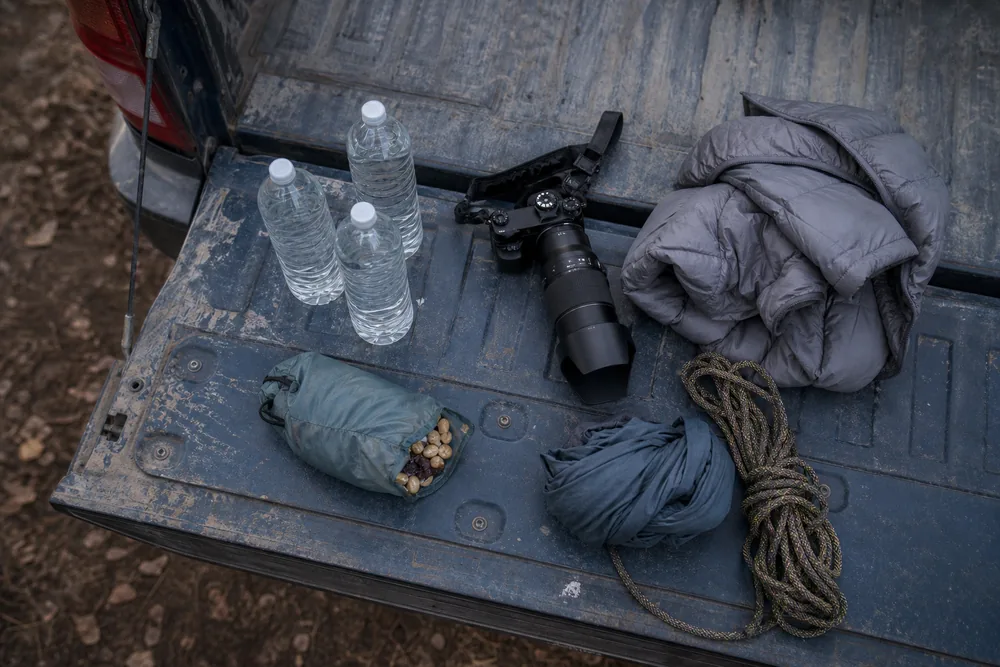
There is no universal threshold, though there is a useful band. Most hikers notice a real change in how they move somewhere around ten to fifteen percent of body weight, which lands between 7 and 10 kg for a 70 kg adult.
Below that band a daypack still behaves like a daypack. Above it the pack starts making decisions for you about stride length, foot placement, and how often you stop.
- Water for more than four hours with no refill on route - Any optical or electronic item over one kilogram - Insulation or traction carried for conditions you may not meet - Shared items nobody else volunteered to take - Spares that quietly doubled, such as a second headlamp and a second first aid kit
Weigh the pack once at home before a deliberately heavy day. A bathroom scale under a loaded day hike kit converts a vague sense of heaviness into a number you can argue with.
How does the extra weight change your balance and pace?
Your center of mass moves back and slightly up. To stay over your feet you lean forward from the ankles, which loads the front of the shins and the arches far more than an unloaded walk does.
That forward lean shortens your stride whether you choose it or not. On a moderate climb a hiker carrying 12 kg typically takes noticeably shorter steps than the same hiker carrying 4 kg, and the cadence rises to compensate.
The pace cost is real and worth planning around. Adding roughly a tenth of your body weight tends to slow a steady climbing pace by something in the range of ten to twenty percent, so the ambitions that suit a hiking pace on climbs plan need trimming before the trailhead, not at the summit.
Balance suffers most where the ground stops being flat. A pack that swings half a second behind your torso turns easy scrambling on rock into something that needs both hands and full attention, because the load keeps arriving after you have already committed to a move.
Fatigue also arrives earlier in the day than you expect. The extra work is not concentrated in the hardest hour, and it accumulates from the first step, so the tiredness you would normally meet at hour six shows up around hour four instead.
What goes where inside a small pack?
Put the dense items against the back panel, centred between your shoulder blades and your waist. That single placement does more for how a loaded daypack feels than any strap adjustment you can make afterwards.
The reason is leverage. A kilogram sitting five centimetres from your spine pulls on you far less than the same kilogram riding in an outer stretch pocket, because the further the weight sits from your back the harder your shoulders and lower back work to hold it upright.
Water is the easiest weight to place well. A reservoir in the sleeve against the back panel is already in the right position, and bottles split evenly between two side pockets stay balanced left to right as they drain at similar rates.
- Empty the pack firstLoading on top of yesterday's contents guarantees dense items end up wherever there was room.
- Set water against the back panelA reservoir or the heaviest bottle goes closest to your spine, not in an outer pocket.
- Stack dense gear at mid-backCamera body, stove, fuel, and traction sit between shoulder blade height and the top of your hips.
- Pack soft gear outward and lowFleece, shell, and spare socks fill the space in front of the dense core and under it.
- Keep the lid and outer pockets lightWeight in the top pocket tips the load backwards every time you look up.
- Cinch the compression strapsPull the load tight against your back so nothing shifts on a step down.
Height matters as much as depth on a day hike. A pack under 30 litres is short, so the dense core naturally sits high, and the fix is to build the soft layer underneath rather than dropping heavy items to the bottom where they will drag the pack off your shoulders.
That is the opposite of the multi-day packing order most hikers learn first, where a sleeping bag fills the base and the heavy food bag sits above it. A daypack has no base layer of bulk to build on.
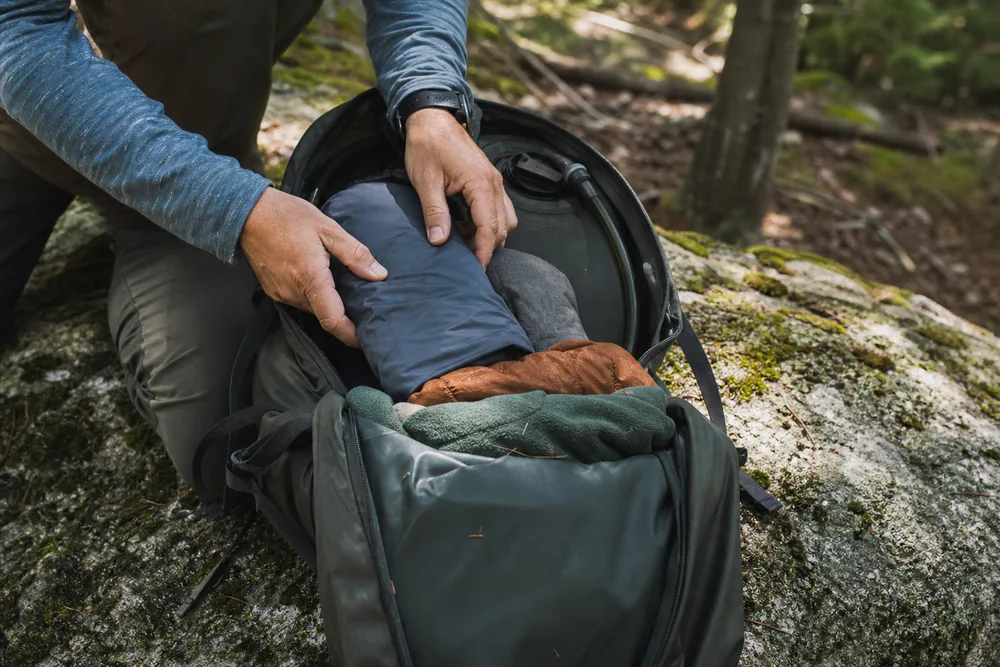
Keep the load column narrow. A pack that bulges sideways behaves badly on side-hilling and catches on branches at exactly the moment your balance is already working hard.
Reachability is the other half of the job. Anything you need without stopping belongs in the hipbelt pockets or the side pockets, because a heavy pack is genuinely unpleasant to take on and off repeatedly.
Two things always earn a reachable slot. Navigation is one, since checking compass bearings against a map should never require unpacking, and food is the other, because trail snack timing collapses when eating means a full stop.
- Reservoir or heaviest bottle against the back panel - Camera, stove, and traction stacked at mid-back - Soft layers filling the outer and lower space - Map, snacks, and a headlamp within arm's reach - Nothing dense in the lid or the outer stretch pocket
Repack once, ten minutes into the walk. The first climb tells you what settled badly, and fixing it early costs two minutes instead of six hours of a sore shoulder.
A daypack hipbelt earns its keep only when you load it
Most packs under 30 litres come with a thin webbing hipbelt, and most hikers leave it dangling.
On a light day that is fine. Once the pack passes about 7 kg, that unused strap is the difference between shoulders that ache at the car and shoulders that ache at lunch.
A webbing belt is a stabiliser rather than a load transfer system. It stops the pack swinging away from your back on steep steps, and it can take perhaps a fifth of the weight off your shoulders, which is far less than the padded belt on a backpacking pack but not nothing.
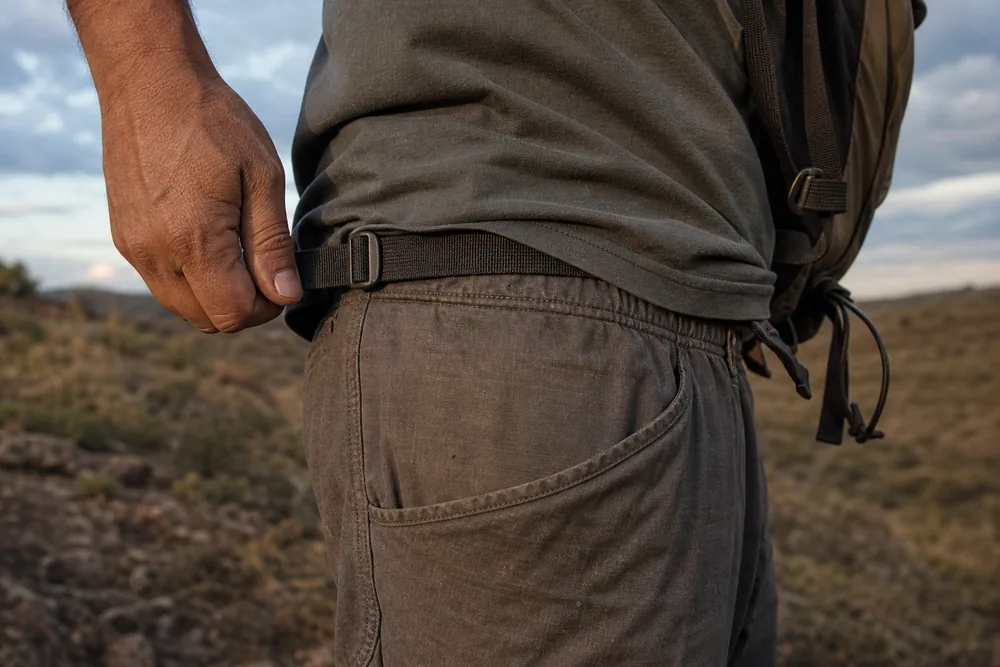
Position decides whether it works at all. The belt must sit on the iliac crest, the bony ridge at the top of your hips, so there is a shelf for it to rest on.
Then loosen the shoulder straps slightly before you tighten the belt. Cinching the belt while the shoulder straps are already snug just adds pressure without moving any weight off the top.
If the belt still will not hold, the problem is usually upstream. A pack sized to the wrong torso puts the belt above or below the crest no matter how you adjust it, and the torso length fit check answers that question in about a minute.
Watch the skin under a newly used belt. A strap you have never worn loaded before is a fresh friction surface, and belt line rubbing tends to announce itself somewhere around the third hour of a warm day.
Why does the descent hurt more than the climb with a loaded pack?
Going down, your quadriceps work while lengthening. That contraction produces more muscle damage than the shortening work of the climb, and the pack adds its weight to every single landing.
The arithmetic is unkind. A 12 kg pack on a 70 kg hiker means each step down absorbs the impact of an 82 kg body, and a long descent contains several thousand of those steps.
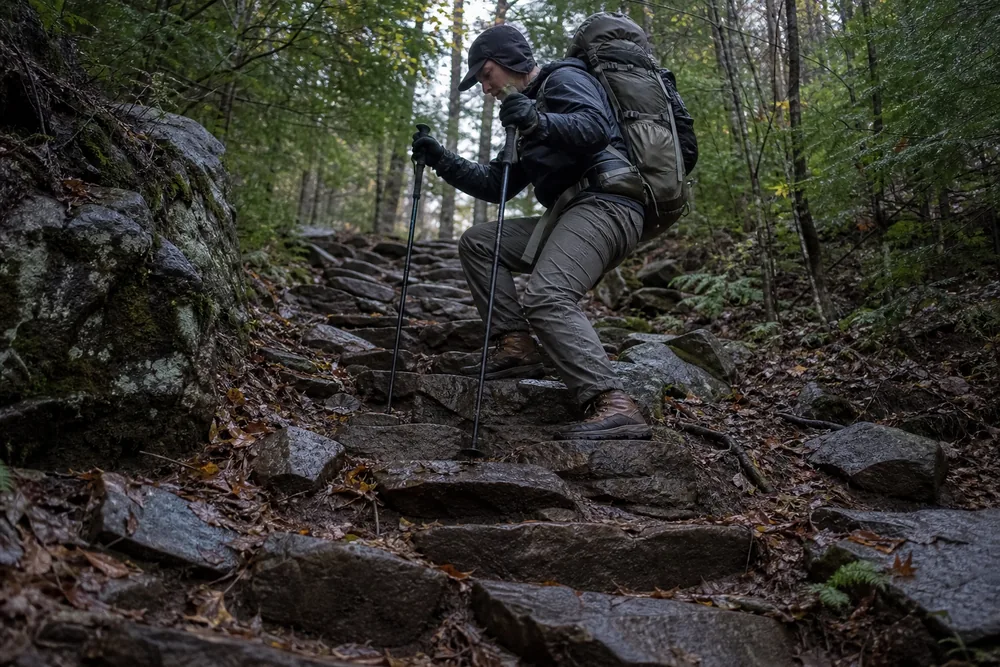
Shorter steps are the whole answer. Halving your step height doubles the number of landings but cuts what each one costs, and your knees care far more about peak force than about repetition count.
Trekking poles matter more with weight than without. Planting both poles ahead and below on steep ground moves a meaningful share of the load into your arms, and the same low, early plant that makes switchback corner control work is what keeps a heavy pack from pulling you past your feet.
The soreness two days later is a training signal rather than a mystery. Loaded downhill walking is the specific stress that downhill leg conditioning prepares you for, and doing it cold once a season is why one heavy hike can ruin the following week.
Should it come with you or stay in the car?
Sort the pack at the car, not at home. The trailhead is where you finally know the temperature, the cloud, the parking, and how much daylight you actually have.
Three questions settle almost every item. Will I use this today, will I regret not having it if the weather turns, and does anything else in the pack already do this job.
Water is the item most worth recalculating at the last minute. A cooler morning than forecast can cut a four litre carry to three, which is a kilogram gone for free, and a water requirement by temperature estimate makes that call in seconds.
- Check the forecast again at the trailhead before sealing the pack
- Pull one full litre if the day came in cooler than planned
- Move shared group gear onto whoever is carrying least
- Leave the second lens if the light is flat and grey
- Confirm someone has the first aid kit rather than assuming
- Take the insulated jacket even when it feels unnecessary
- Leave spare food beyond one extra meal in the car
Some things never come out no matter how heavy the pack gets. Insulation, light, and the means to navigate stay in, because the trail safety margins that matter are exactly the ones that feel wasteful on a bright morning.
Comfort items are where the real savings live. A second lens, a folding stool, a full flask of coffee, and a paperback add up faster than any single piece of safety kit you might be tempted to drop instead.
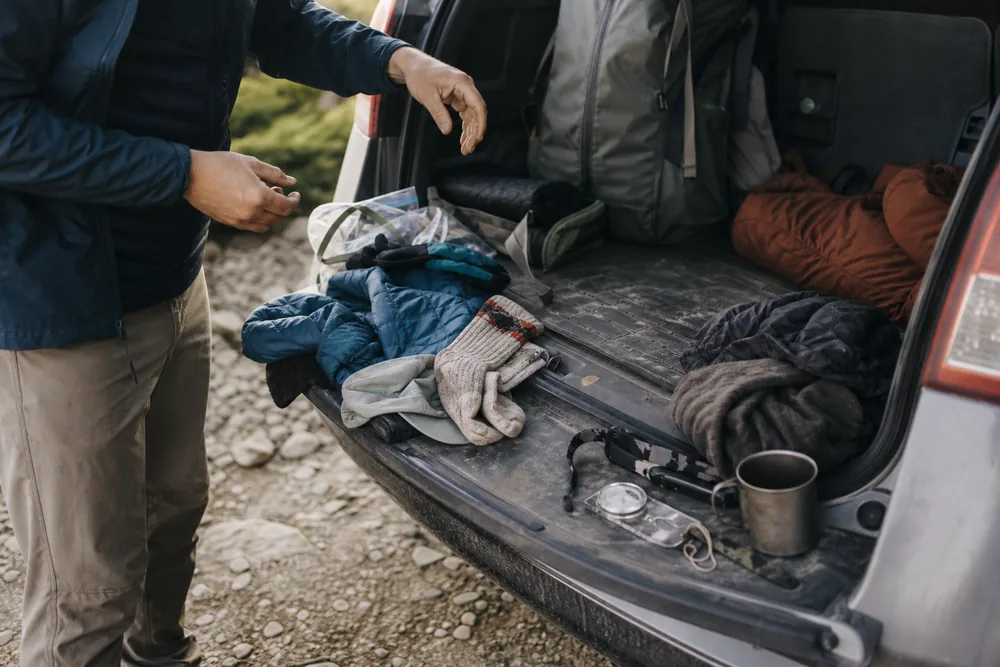
Route choice can cut weight better than any packing decision. Picking a loop that passes a reliable stream at the halfway point removes two litres from the first climb, so choosing a trail with refill points in mind is worth more than shaving grams off a stove.
Heat changes the calculation in one direction only. When the forecast is high the water goes up and everything else has to come down, and the tradeoffs behind hot weather hiking are the reason a summer pack can be heavy and minimal at the same time.
Leave a note on the dashboard if you shed something significant. Knowing the spare layer is in the boot, not on your back, matters if the weather turns and you are deciding whether to push on or come back down.
Small habits that make a loaded day repeatable
Pack the night before, then carry it up and down your stairs twice. Two minutes of that finds a badly placed camera body and a belt sitting too low, which is two minutes well spent against six hours of correction.
Start slower than feels right. A heavy pack punishes an enthusiastic first climb harder than a light one, and the twenty minutes you lose walking gently at the start come back with interest by the second hour.
Test walk at home
Load the pack fully and walk stairs for two minutes to find shifting gear and a badly positioned belt.
Front-load the hard climbing
Do the steepest section while your legs are fresh and before the day heats up.
Shed water deliberately
Drink the heaviest bottle first so the weight comes off early rather than sitting unused.
Reset at every real stop
Reseat the belt, re-cinch compression straps, and move anything that has migrated outward.
Split shared gear honestly
Rotate the stove, the pot, and the first aid kit through the group instead of defaulting to one person.
Break differently than you would on a light day. Sitting down and getting the pack off completely for five minutes does more than three quick standing pauses, because the load never really comes off during a standing rest.
Groups need a different pace agreement when packs are uneven. The person carrying the stove and the water for two is doing measurably more work, so group pace setting should follow that hiker rather than the fastest one.
- Practise the load before the trip rather than on it - Drink from the heaviest container first - Take the pack fully off at real stops - Rotate shared gear between hikers during the day - Reseat the hipbelt every time you stop
Thin air compounds everything a heavy pack already does. Above roughly 2500 metres the same load costs more oxygen and more recovery time, so the pacing rules for altitude day hikes should be applied more strictly, not less, once the pack is full.
The skill improves faster than the fitness does. Most hikers find that their second or third deliberately heavy day feels far better than the first, mainly because the packing, the belt, and the pace got sorted rather than because the legs got stronger.
Sources
- Leave No Trace Center for Outdoor Ethics, Principle 1: Plan Ahead and Prepare - U.S. National Park Service hiking safety guidance on water carry, layering, and turnaround planning
Step by stepPractical steps
- Empty the pack before loading so dense items are not placed around yesterday's contents.
- Set the water reservoir or heaviest bottle against the back panel, closest to your spine.
- Stack dense gear such as camera body, stove, and traction at mid-back height.
- Pack soft layers outward and underneath the dense core rather than at the very bottom.
- Keep the lid and outer stretch pockets light so the load does not tip backwards.
- Cinch the compression straps so nothing shifts on a step down.
AnswersQuestions readers ask
How heavy is too heavy for a daypack?
As a working band, most hikers start to move differently somewhere between ten and fifteen percent of body weight, which is roughly 7 to 10 kg for a 70 kg adult. Above that a pack under 30 litres usually lacks the suspension to carry the load comfortably, so the answer is less about a number and more about whether the hipbelt can hold position for a full descent.
Should I use the hipbelt on a small daypack?
Yes, once the pack passes about 7 kg. A thin webbing belt will not transfer weight the way a padded backpacking belt does, but it stops the pack swinging on steep steps and can take roughly a fifth of the load off your shoulders.
Set it on the top of your hip bones and loosen the shoulder straps slightly before you tighten it.
Where should the heaviest item sit inside a daypack?
Against the back panel, centred between your shoulder blades and the top of your hips.
Weight held close to the spine pulls on you far less than the same weight in an outer stretch pocket. Soft gear then fills the space in front of and underneath that dense core.
Does a heavy daypack slow you down much?
Adding around a tenth of your body weight typically costs ten to twenty percent of a steady climbing pace, and it also shortens your stride whether you intend it or not. Plan a shorter route or a later turnaround rather than expecting to hold your usual timings.
Why do my knees hurt after a heavy day hike but not a light one?
Descending loads your quadriceps while they lengthen, and the pack adds its full weight to every landing.
A 12 kg pack on a 70 kg hiker means each downward step absorbs the impact of an 82 kg body across several thousand steps. Shorter steps and early pole plants cut the peak force on each one.