
How to Hike in a Group and Set the Pace
Put the slowest hiker at the front, judge effort by whether they can still speak in full sentences, and regroup at places rather than at intervals.
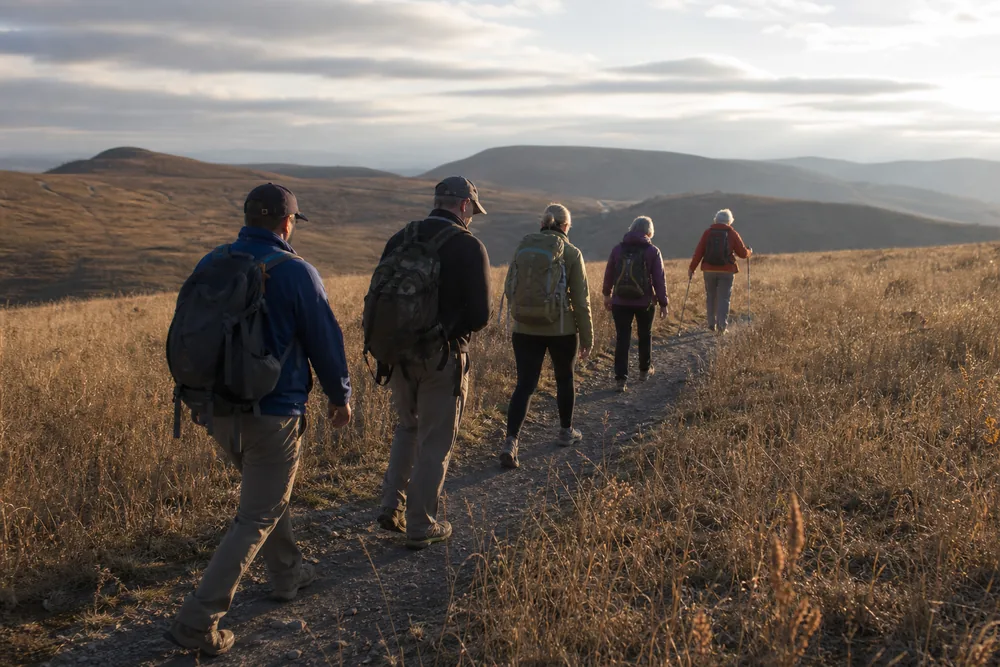
Set a pace a mixed-ability group can hold, space and regroup without stalling, and decide when the group should turn back together.
A group hike runs at one speed, and that speed belongs to whoever is having the hardest day. Most groups find this out about an hour in, when the front pair is out of sight and nobody can say for certain where the last person is.
Pacing is the first thing a group gets wrong and the last thing anyone thinks to fix. The missed junction, the cold wait on a windy summit, the argument about turning back, most of it starts as a pace problem that ran unmanaged for two hours.
What follows is how to pick a speed a mixed party can hold all day, how to spread out and come back together without constant stopping, and how to decide when staying together has stopped being the right call.
Visit in small groups when possible. Consider splitting larger parties into smaller groups.
Leave No Trace, Principle 1: Plan Ahead and Prepare
That line is usually read as an impact rule. It works as a pace rule too, because the spread in ability inside a party grows faster than the party does, and eight people almost never share one comfortable walking speed.
How to choose who sets the pace
Put the slowest hiker at the front. This feels backwards to nearly everyone, and it is the single change that repairs the most group days.
A slow hiker at the back is being chased. They watch the gap open, push above the effort they can sustain, and reach every stop with no recovery left because the people ahead are already rested and ready to move.
The fittest person belongs at the back or second in line, not out front. Their natural speed is the one nobody else can match, and a leader who keeps glancing over their shoulder is a leader who accelerates every time they stop glancing.
Ability and fitness are different things.
Someone with strong lungs and worn knees climbs well and descends badly, so the right pace setter on the way up may be the wrong one on the way down. Change the order at the high point instead of assuming it holds all day.
Illness, heat, altitude, poor sleep, and the last meal move a hiker's ceiling by a wide margin. Whoever led comfortably last month can be the one struggling today, and the group wants to notice in the first mile rather than the fifth.
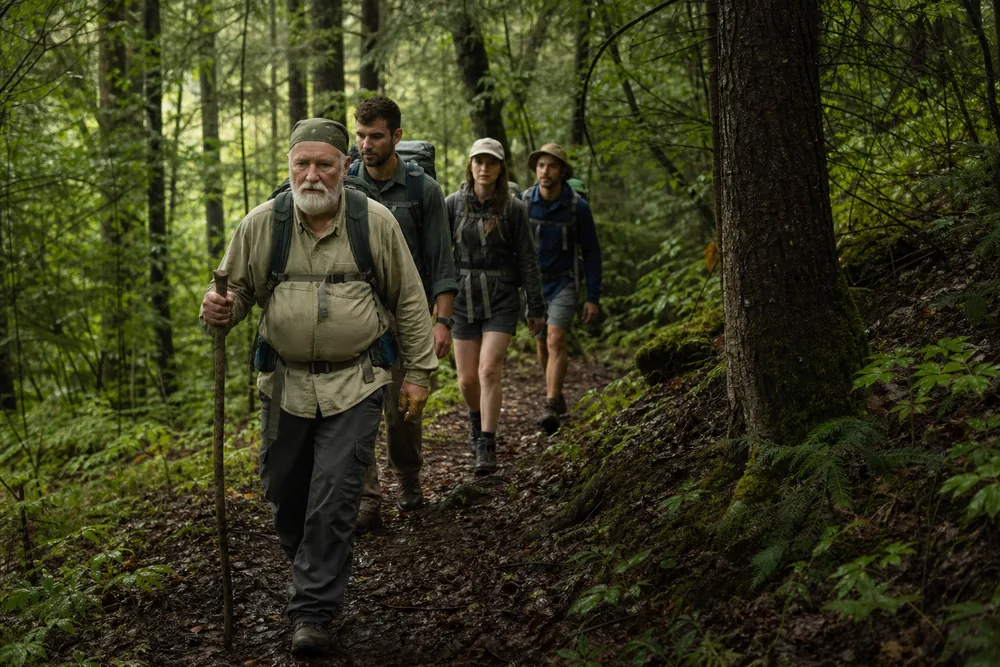
Announce the arrangement at the trailhead. A party that has not talked about pace drifts to the fastest person's rhythm inside ten minutes, because that person naturally ends up in front on the first climb.
- Name a pace setterPut the hiker with the least reserve today at the front of the line.
- Name a sweepAsk a confident hiker to walk last and never pass the person ahead.
- Agree the stopping ruleThe party stops where the trail splits, not where the front pair feels like it.
- Set the first checkRegroup fifteen minutes in, before anyone locks into a speed.
- Adjust once, out loudChange the order after the first climb if the front is wrong.
The sweep matters as much as the pace setter does. Their only job is to be behind everyone, so if the sweep walks alone, somebody is missing and the party learns it now rather than at the next junction.
Terrain does half this work before anyone leaves home. A party with a wide ability spread fares better on rolling ground with obvious regroup spots than on a relentless climb, so trail choice belongs to the least experienced person rather than the keenest.
Mixed parties usually include somebody on their second or third real hike. Those newer hikers walk fine for an hour and then fade fast, which the pace setter arrangement absorbs and a race up the first hill does not.
Children change the rules again, since they set an erratic rhythm of their own, and hiking with children is closer to managing bursts of energy than holding a steady pace.
When the talk test beats a target speed
Speed targets fail because one number means different efforts to different people. Two and a half miles an hour is a stroll for one hiker and near threshold for another.
Effort is the shared unit. The talk test measures it directly and needs no watch and no argument.
Full sentences, not gasped words is the standard to hold. If the pace setter speaks a complete sentence without breaking mid-phrase to breathe, the party is moving at a speed it can keep for hours.
If they can sing, the party is too slow to finish in daylight. If they answer in three or four words, everyone behind them is spending reserves they will want later.
- Sustainable pace
- Full sentence, no break to breathe
- Too easy
- Can sing or talk continuously on a climb
- Too hard
- Answers three or four words at a time
- Check frequency
- A real question every twenty minutes uphill
- Where it fails
- Loud wind, noisy scree, a buff over the mouth
The check has to be a real question. "You okay?" earns a yes from almost everybody, because people under strain will not volunteer bad news to a closed question asked over a shoulder.
Ask what they ate this morning, how the new boots feel, or whether that cloud is building. Anything that forces a full clause out of them.
Uphill is where the test earns its keep. Flat ground hides effort differences because nearly everyone can walk flat at nearly any speed, and a party only fragments once the trail tilts.
Conditioning shows up honestly here. A hiker building an aerobic base across a season passes the talk test at speeds that used to break them, and the change arrives slowly enough that friends rarely update their assumptions.
Personal speed is a separate project. Cadence, stride, and rest discipline belong to individual walking speed, and none of it helps a party whose slowest member is already at their limit.
Heat drags the whole scale down. On a hot day the sustainable effort sits well below what the same party held in spring, and heat strain shows in the pace setter's sentences before it shows anywhere else.
Thin air does the same thing faster. Above roughly 8,000 feet the talk test tightens for everybody, which is why pacing at altitude gets treated as its own problem.
How much space should the group leave between hikers?
Bunching is the default and it is wrong nearly everywhere. Hikers close up because talking is easier at two feet than at twenty, and the cost only appears when something goes wrong.
Leave real room on anything steep, loose, or wet. A hiker who slips lands on the tread below, which is exactly where the next person is standing if the line has closed up, and one slip becomes two.
- Three to five paces on flat, dry, wide trail where talking is the point - Ten paces or more on a climb where a kicked rock can travel - Enough gap on a descent that a slide stops before it reaches anyone - Single file with visual contact wherever the trail edge drops away - Close enough to hear a normal voice in wind, fog, or fading light
Distance is not the measure that matters. Visibility is.
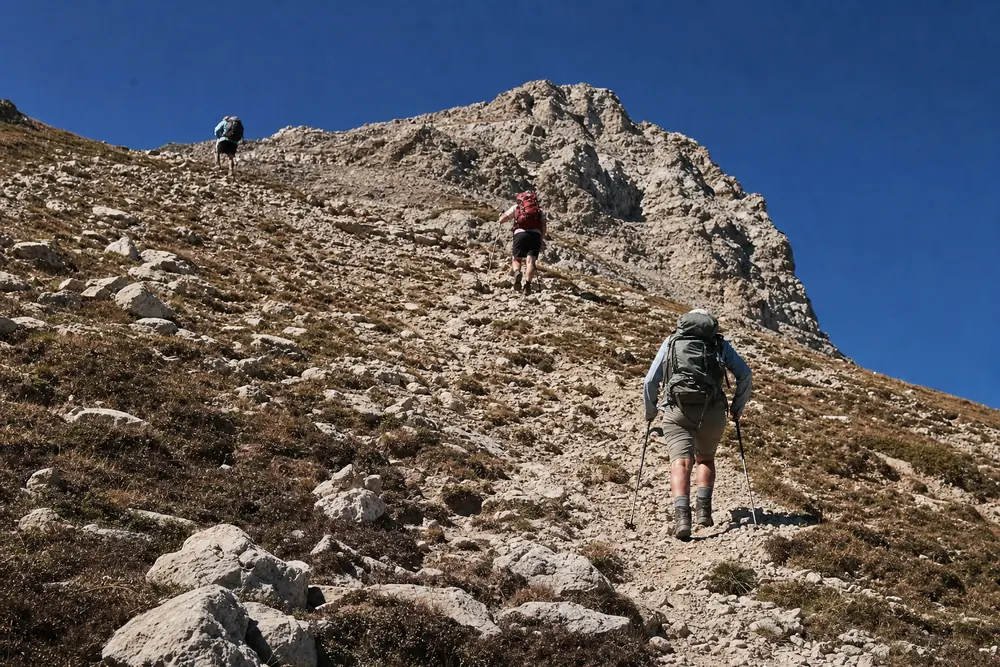
A party strung over a hundred yards is still whole if every hiker can see the person ahead and behind. A party twenty feet apart is broken if the front three are around a bend nobody else has reached.
One rule holds the whole thing together. Nobody passes the pace setter and nobody drops behind the sweep.
Everything between those two people is allowed to float.
Loose ground deserves stricter spacing than most parties use. On scree and loose stone a dislodged rock gathers speed across the whole gap, so ten paces is a minimum rather than a politeness.
Descents stretch a party without anyone deciding to. Gravity makes quick hikers quicker and cautious ones slower, and switchback descent control gets worse when people feel rushed from behind.
Load changes spacing as well. Anyone carrying a heavy daypack needs more room to recover balance on awkward ground and loses more time per bad step than the rest of the party expects.
Other parties compress yours as well. A long line takes time to funnel past an oncoming group, and the yielding conventions that decide who steps aside also decide how much spacing survives a busy weekend.
What a regroup point does that a rest stop does not
A regroup point is a place, chosen before you start walking, where everyone stops and waits until the whole party arrives. A rest stop is a pause for breath.
Parties confuse the two and lose people because of it.
A regroup exists for information. With everyone in one spot you can count heads, look at faces, check water, ask about feet, and read the sky with everybody hearing the same answer.
Places beat intervals. A timed regroup punishes the slow hiker twice, since they arrive last and leave with the least recovery, while a landmark gives everyone the same target.
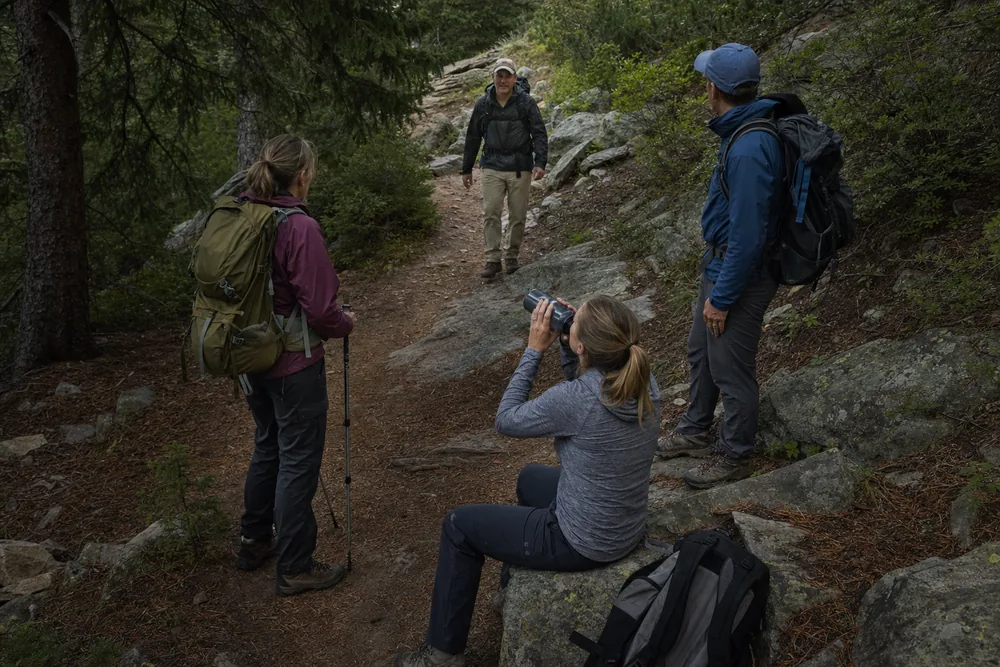
Choose the places before boots hit the dirt.
| Regroup point | Why it works | What to check there |
|---|---|---|
| Every trail junction | No wrong turn while standing still | Headcount, map, next leg |
| Base of a climb | Last flat ground before effort rises | Water, layers off, food |
| Top of a climb | A pause everyone has earned | Breathing, order for the descent |
| Last reliable water | Refill binds the whole party at once | Bottle volume, filter, next source |
| The high point | Where the day gets decided | Time, weather, energy, light |
Wait properly once you get there. Whoever arrived first has rested ten minutes by the time the last person walks up, so a party that leaves the moment the slowest hiker appears has marched that person all day without a break.
Start the clock when everybody is together, not when the front pair sat down.
Water is the resource parties misjudge most as a unit. Individual bottles hide a shortage at party level, and a water carry plan is easier to audit at a regroup than in a car park.
Fuel behaves the same way. The person fading at the back is often just low on calories, and deliberate snack timing at each stop catches that before it looks like a pace problem.
Feet are worth a question at every stop. Hot spots are cheap to fix in the first mile, and chafing on long days slows a hiker in a way that looks like poor fitness from behind.
Gear gaps surface at regroups too. Someone who left a shell in the car changes what the party can commit to, so a look at each day hike kit belongs in the first stop rather than the last.
Should you ever split the group?
Yes, but only in one shape. A party may split into two self-sufficient parties, and it must never split into a party and a lone hiker.
Self-sufficient means each half can navigate, treat an injury, stay warm, and walk out alone. Two hikers holding the map and the only first aid kit while three others wait behind is one party pretending to be two.
The one-person split is the version to refuse outright. Sending a lone hiker back to the car, ahead to the summit, or off to find a missing member turns one problem into two, in two places.
Splitting on purpose at the start is a different thing and often the better plan. When four people want a long loop and three want a short out-and-back, two trips with two plans beat pretending one speed suits everyone.
Each half needs navigation, first aid, a wind layer, a headlamp each, and a stated place and time to meet again.
Whoever ends up walking alone is now on a solo hiking plan rather than a group one, with the wider margins and the check-in that implies.
Duplicated kit is what makes a split workable. Settling what each person carries before the trailhead means either half can function without raiding the other.
Acceptable
Two halves, each with navigation, first aid, warmth, light, and a named meeting place and time.
Acceptable
A two-objective day agreed at the trailhead, with both plans left at home.
Refuse
One hiker sent ahead or back alone, short of a real emergency with no alternative.
Refuse
A split where one half holds the map, the shared kit, or the only charged phone.
Refuse
An improvised split made once people are cold, tired, and arguing.
Headcounts, junctions, and knowing where everyone is
Count people out loud at every junction, every time. Four seconds is the only dependable way to know a party is still whole.
Counting silently fails because you count the people you expect to see. Saying the number aloud makes somebody else check it, and that is where the mistake gets caught.
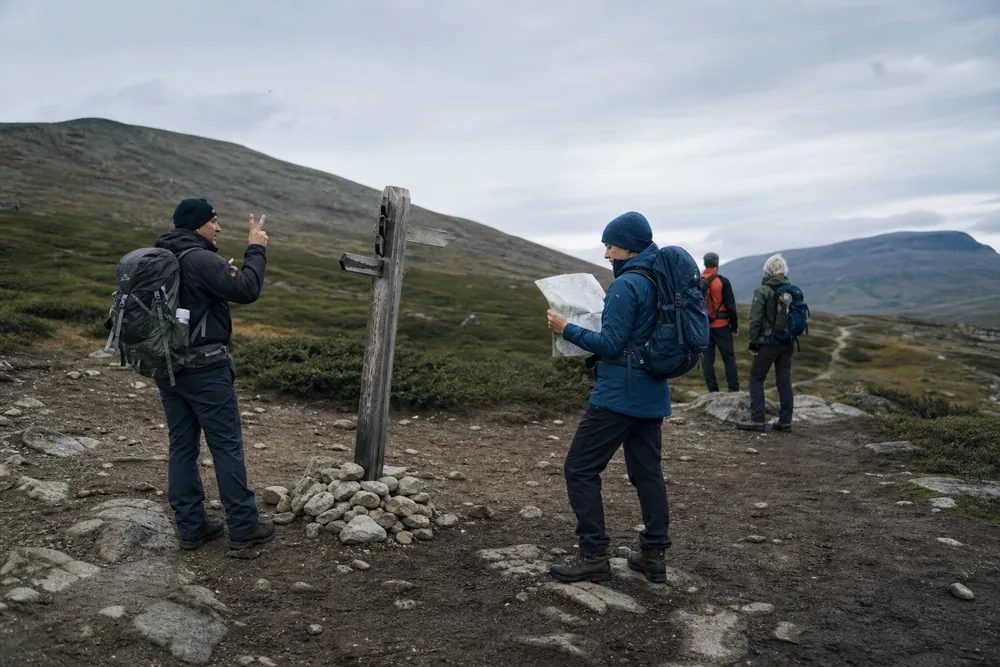
Parties lose people at junctions, not on open trail. A hiker alone on a single path catches up eventually, while one who takes the wrong branch walks confidently away from everybody.
The waiting rule handles most of it. Whoever reaches a junction first stops and stays until the sweep arrives, which means no fork gets passed by part of a party.
Agree beforehand what a separated hiker should do.
- The separated hiker stops walking and stays put - The party retraces to the last confirmed sighting - Three whistle blasts mean stop moving and answer - One person watches the clock so searching does not eat the daylight - Nobody leaves the party alone to go looking
Two moving parties can miss each other repeatedly on the same trail, which is why the stationary rule exists. Voice carries badly in wind, so a whistle in every pocket works where shouting fails.
Phones are useful and are not a plan. Coverage vanishes in valleys and batteries drop fast in cold.
Navigation should never sit with one person. If only the leader can find the way, a fragmented party has one half that knows where it is and one half that does not, so spread compass work across two or three people.
Say the plan aloud before leaving the trailhead. When everyone can name the destination, the turnaround time, and the way back, either half of a party can act sensibly out of sight of the other.
Calling the turnaround before the group falls apart
Set a time, not a landmark, and set it in the car park. A party that agrees to turn at two o'clock wherever it has reached will do it, while a party that agrees to turn at the summit keeps walking until dark.
The slowest hiker sets the return estimate. Downhill runs faster than uphill for most people but not all, and a party assuming the descent takes half the ascent walks out in the dark more often than it expects.
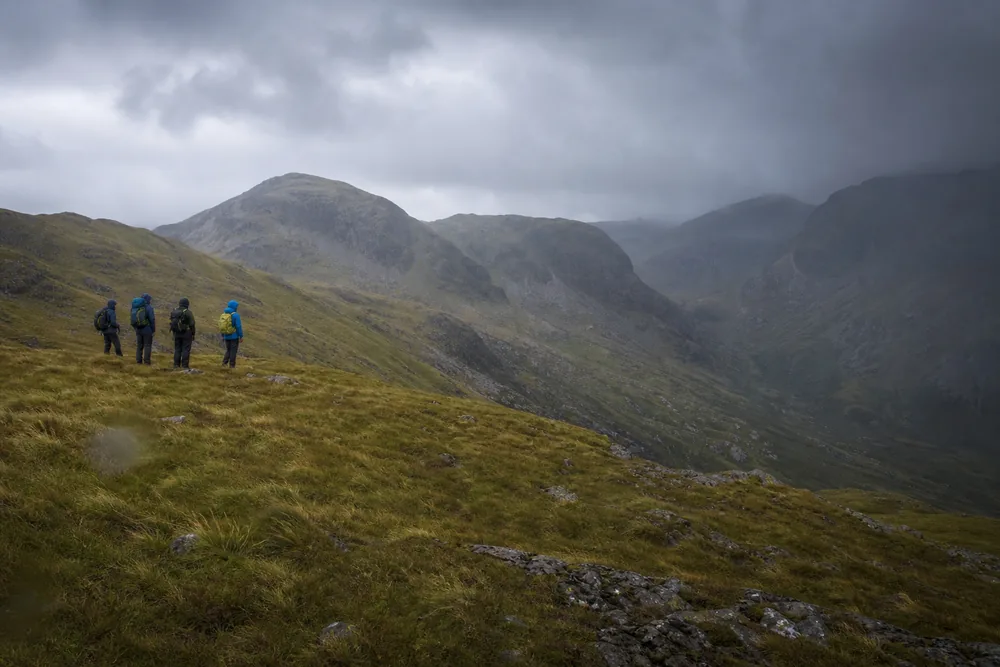
Watch for the signals that arrive before the deadline does.
- The gap between front and back grows at every regroup
- Your pace setter has stopped answering in full sentences
- Somebody who was talking an hour ago has gone quiet
- Each regroup needs a longer rest than the one before
- Weather is building faster than the party is climbing
- Nobody has eaten in two hours and several people are slowing
- You are behind time at the second checkpoint and the ground gets harder
Quiet is the signal parties miss most often. A hiker who has stopped talking is either working too hard to speak or getting cold, and both are early hypothermia signs in wet wind, well before shivering starts.
Make the call as a decision rather than a vote. Parties talk their way past sensible turnaround times because nobody wants to end the day, so name the hiker who decides before you start walking.
Turning back early is an ordinary outcome, not a failure. The same hiking safety margins that govern weather and daylight apply to a party that has run out of the ability to stay together.
A party that cannot hold one pace has already answered the question. Splitting is unsafe, waiting is making people cold, and pushing on widens the gap, which leaves walking down together as the only option that keeps everybody in sight.
Sources
- Leave No Trace Center for Outdoor Ethics, Principle 1: Plan Ahead and Prepare, guidance on small group sizes and splitting larger parties - U.S. National Park Service hiking safety guidance on group planning, turnaround times, and staying together on trail
Step by stepPractical steps
- Name a pace setter at the trailhead and put them at the front of the line.
- Name a sweep who walks last and never passes the person ahead of them.
- Agree that the group stops and waits at every trail junction.
- Run a short regroup fifteen to twenty minutes in, before anyone locks into a speed.
- Check the pace with an open question that needs a full sentence to answer.
- Set a clock turnaround time before you start walking and hold it.
AnswersQuestions readers ask
Who should set the pace in a hiking group?
The hiker with the least reserve on that particular day, walking at the front.
Putting them first turns their sustainable speed into the group's speed. Leaving them at the back turns them into someone being chased, which burns their reserves faster and creates the gap everyone is trying to avoid.
How do you know if the pace is too fast?
Ask the person at the front an open question and listen to the answer. If they reply in a full sentence without breaking to breathe, the pace is sustainable.
If they can only manage three or four words at a time, the group is above the effort it can hold and needs to ease off before the next climb.
How far apart should hikers in a group walk?
Three to five paces on flat, dry trail where talking matters, and ten paces or more anywhere loose rock can be kicked free or a slip could carry someone into the person below.
The real test is visual rather than metric. Everyone should be able to see the hiker ahead and the hiker behind.
Is it okay for a faster pair to go ahead to the summit?
Only if the group divides into two halves that can each navigate, treat an injury, stay warm, and walk out alone, with an agreed meeting place and time. A split that leaves one person waiting by themselves at a junction, or walking out on their own, is the arrangement behind a large share of avoidable callouts.
How often should a group regroup?
At places rather than intervals.
Every junction, the bottom and top of any sustained climb, the last reliable water, and the high point. Landmark stops give everyone the same target, while timed stops give the slowest hiker the shortest rest and the least recovery.
What should someone do if they get separated from the group?
Stop walking and stay put. Two parties moving in search of each other can miss on the same trail more than once.
Three whistle blasts is the standard signal to stop and answer, and the group should backtrack to the last point where everyone was confirmed present.